The Empresses of the Qing
清朝皇后
“The Last Dynasty”
It begins with two Mongol women whose marriages bought the cavalry that took China, and ends with a signature on an abdication and a woman dying of opium withdrawal in a prison cell in 1946. Two thousand one hundred and thirty-two years of empire close on this page.
Their Story
Empress Xiaoduanwen 孝端文皇后 · Jerjer
1599 – 1649 · consort of Hong Taiji
A Khorchin Mongol noblewoman, married to Hong Taiji at fifteen in an alliance that was the foundation of the whole Qing enterprise — the Manchus could not have taken China without Mongol cavalry, and the marriages were the treaty.
She was empress of a state that did not yet rule China. Her niece Bumbutai came into the same household, and it was Bumbutai’s son who went through the Wall.
Grand Empress Dowager Xiaozhuang — Bumbutai 孝庄文皇后 · Erdeni Bumba
1613 – 1688 · the most important woman of the early Qing
She made two emperors and effectively founded the dynasty’s civil order.
A Khorchin Mongol, married to Hong Taiji at twelve. When he died suddenly in 1643 without naming an heir, the succession came down to an armed standoff between his eldest son and his brother Dorgon; the compromise was her five-year-old son. The Manchus entered Beijing the following year.
She raised him, and when he died of smallpox at twenty-two she chose his third son as successor — reportedly because the boy had already survived smallpox and would not die of it. That child became the Kangxi Emperor, who reigned sixty-one years, the longest in Chinese history.
She raised him too, and taught him to govern. He said openly that everything he was, he owed to his grandmother. She refused a formal regency and refused honours for her family, and when she died in 1688 he broke precedent and kept her coffin above ground for thirty-five years rather than bury her away from him.
Everything I am, I owe to the teaching of my grandmother.
The Kangxi Emperor, on Grand Empress Dowager Xiaozhuang
Empress Xiaohuizhang 孝惠章皇后
1641 – 1718 · consort of the Shunzhi Emperor
Another Khorchin Mongol, married to Shunzhi at thirteen and nearly deposed within two years because he was entirely absorbed by Consort Donggo. Bumbutai protected her.
She outlived him by fifty-seven years and was treated by the Kangxi Emperor as a mother throughout — he was famously attentive to her, and she died in 1718 aged seventy-seven.
Consort Donggo 董鄂妃 · Empress Xiaoxian
1639 – 1660 · consort of the Shunzhi Emperor
The great love story of the Qing, and a disaster for the state. Shunzhi was obsessed with her, promoted her to Imperial Noble Consort within weeks, and attempted to depose his empress to make room.
Their son died at three months. She died in 1660 at twenty-one. Shunzhi ordered thirty of the palace staff to follow her in death, gave her a posthumous empress’s title, and had a funerary text of four thousand characters written for her.
He died himself five months later, officially of smallpox, aged twenty-two. A persistent tradition holds that he abdicated and became a monk at Mount Wutai instead.
The empresses of the Kangxi Emperor 孝诚仁 · 孝昭仁 · 孝懿仁皇后
Empresses Xiaochengren, Xiaozhaoren and Xiaoyiren
He had three empresses and outlived all of them. The first died in childbirth at twenty-one; the second lived six months in the position; the third was made empress on her deathbed so that she would die holding the title.
After 1689 he never appointed another, and reigned for a further thirty-three years with the position empty. He had fifty-six children and the succession struggle among his sons was the most vicious in Qing history.
Empress Xiaojingxian 孝敬宪皇后
d. 1731 · consort of the Yongzheng Emperor
Married to Yinzhen before he won the succession, and empress for nine years of the most administratively ferocious reign the dynasty had. Yongzheng worked eighteen-hour days, wrote tens of thousands of vermilion-ink comments on memorials in his own hand, and left the treasury full.
Empress Xiaoxianchun 孝贤纯皇后 · Fuca
1712 – 1748 · consort of the Qianlong Emperor
The Qianlong Emperor was the longest-reigning and probably the most powerful monarch in the world in his lifetime, and the death of his first wife broke something in him permanently.
She wore ornaments of grass and flowers rather than pearls, to remind the court of Manchu frugality. Two of her sons died small. She died in 1748 on the imperial barge returning from the eastern tour, aged thirty-six.
He wrote poems about her for the remaining fifty-one years of his life — well over a hundred of them, the last when he was eighty-eight. He also, in the months after her death, had officials demoted, exiled and in some cases executed for insufficient mourning, and disinherited two of his own sons for not looking grief-stricken enough at the funeral.
The later empresses 孝淑睿 · 孝慎成 · 孝全成 · 孝德显 · 孝哲毅
Jiaqing through Tongzhi, 1796 – 1875
The nineteenth-century empresses preside over the long contraction: the White Lotus rebellion, the Opium Wars, the burning of the Summer Palace in 1860, the Taiping rebellion that killed perhaps twenty million people.
Empress Xiaozheyi, married to the Tongzhi Emperor, is the sharpest case. He died of smallpox in 1875 at eighteen. She was pregnant. Cixi installed a different child as emperor — a choice that only worked if there was no heir — and Empress Xiaozheyi died seventy-four days later, aged twenty-one. The official cause was grief. Almost nobody at the time believed it.
Empress Dowager Longyu 隆裕太后
1868 – 1913 · consort of the Guangxu Emperor
Cixi’s niece, married to the Guangxu Emperor to keep the family’s hold on the throne, and disliked by him for exactly that reason. She spent twenty years in a marriage that was a political instrument and was never anything else.
On 12 February 1912, as regent for the six-year-old Puyi, she signed the abdication. Two thousand one hundred and thirty-two years of imperial government in China ended with her seal on a document she had been negotiated into.
She died fourteen months later at forty-four. The Republic gave her a state funeral, and its president called her the equal of any statesman — which was, in the circumstances, the kindest thing anyone had said to her in her life.
Empress Wanrong 婉容 · Gobulo Wanrong
1906 – 1946 · consort of the Xuantong Emperor (Puyi)
The last empress of China. She was sixteen, educated at an American missionary school in Tianjin, spoke English, played piano, and married a deposed emperor who was still living in the Forbidden City as a private guest of the Republic.
They were expelled in 1924. She followed Puyi to the Japanese concession and then to Manchukuo, where he was installed as a puppet and she was effectively imprisoned. She became addicted to opium. She had a daughter by another man; the child was taken away at birth and is generally believed to have been killed.
When the Soviets invaded in 1945 she was abandoned in the retreat and taken by Chinese Communist forces. She died in a prison cell in Yanji in June 1946, aged forty, in withdrawal and unable to eat. Her body was never recovered and she has no grave.
A note on the sources
The Qing is the best-documented dynasty in Chinese history and much of it survives in Manchu as well as Chinese — the Grand Council archives, the vermilion rescripts, the palace memorials. For the last decades there are also photographs, foreign diplomatic reports, and the memoirs of people who were in the room.
Wanrong’s final years are documented largely through Puyi’s own later account, written under conditions that make it unreliable in places, and through the recollections of household staff. The outline — Manchukuo, the addiction, the taken child, the prison at Yanji — is not disputed.
- Zhao Erxun et al., Qing Shi Gao (Draft History of Qing) — 1928
- Evelyn S. Rawski, The Last Emperors: A Social History of Qing Imperial Institutions — California, 1998
- Jonathan D. Spence, The Search for Modern China — Norton, 1990
- Aisin-Gioro Puyi, From Emperor to Citizen — 1964
Connections
- Her own painting Empress Dowager Cixi — who ruled China for forty-seven years and chose the last two emperors.
- And Primary Consort Minhui.
- The dynasty before The late Ming empresses — the Manchus entered Beijing six weeks after the Chongzhen Emperor died on Coal Hill.
- Where it started Empress Lü Zhi — the first woman to hold this title, two thousand one hundred years before Longyu signed it away.
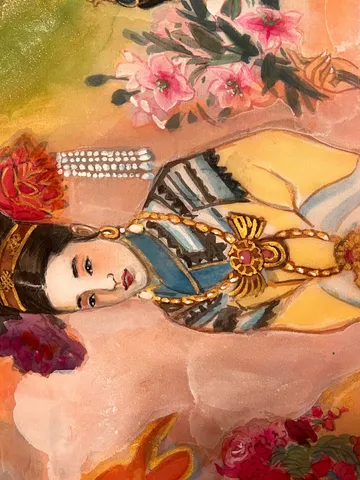
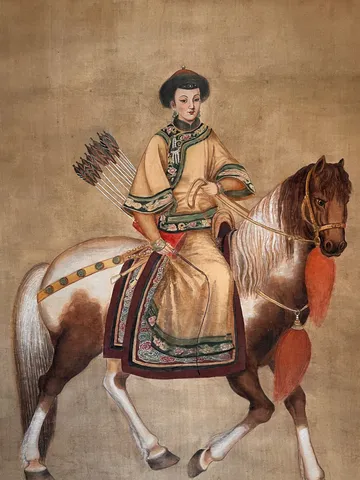
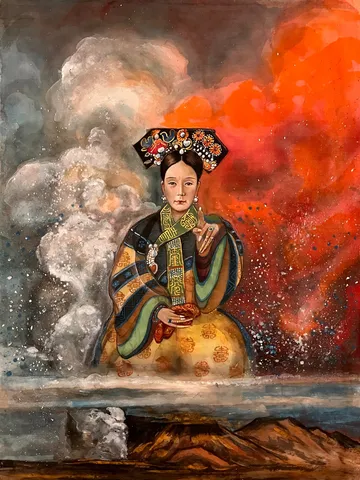
About this Painting
| Artist | Xiang Li 李湘 |
| Medium | Chinese watercolor on silk |
| Subjects | The empresses of the Qing dynasty |
| Painted | 2024 |
| Collection | The Chinese Empresses Collection |
| Availability | Original held by the artist · Prints available |