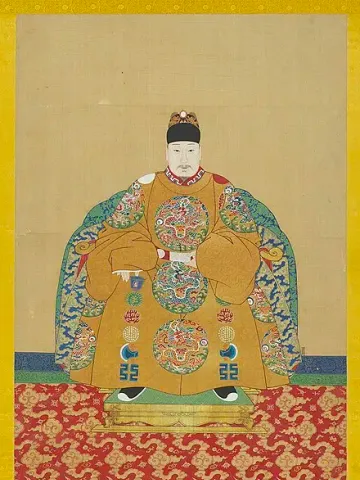
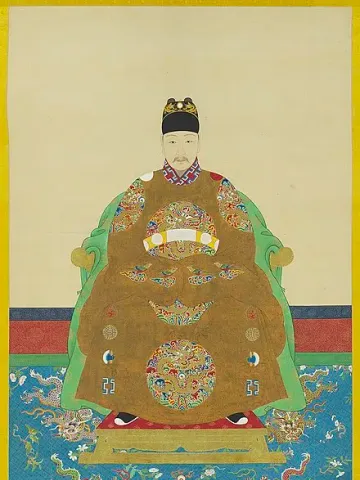
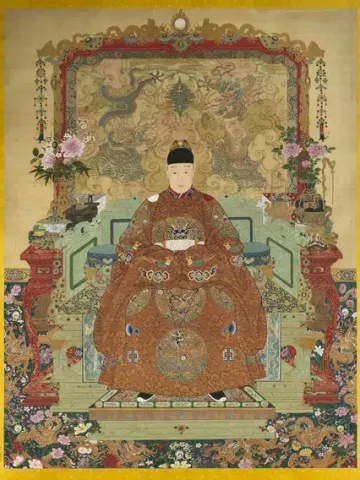
The Empresses of the Late Ming
明朝后期皇后
“Eighteen Years, and You Never Listened”
The last of the three. It opens with the longest-serving empress in Chinese history and closes on Coal Hill in April 1644 — two women hanging themselves within an hour of each other as the rebels came through the gates.
Their Story
Empress Xiaoduanxian — Wang Xijie 王喜姐 · 孝端显皇后
1564 – 1620 · consort of the Wanli Emperor · empress 1578 – 1620
Forty-two years an empress — the longest anyone has held the position in Chinese history.
She was chosen at thirteen by Empress Dowager Li and married to the fourteen-year-old Wanli Emperor. She bore one daughter and no sons, which mattered enormously, because the succession crisis that consumed the next three decades was entirely about whose son would inherit.
Wanli wanted the son of his favourite, Consort Zheng. The bureaucracy insisted on the eldest son, born to a palace maid he had slept with once and then ignored. The deadlock lasted fifteen years, hundreds of officials were dismissed, beaten or exiled over it — and Wanli responded by simply refusing to govern. He stopped attending court, stopped making appointments, and for roughly twenty-five years the Ming state ran itself with an emperor who would not come out of the palace.
Empress Wang stayed out of it, protected the heir quietly, and outlived almost everyone. She died in April 1620. Wanli died three months later, and the dynasty had twenty-four years left.
Empress Guo and Empress Wang 孝元贞皇后 · 孝和皇后
consorts of the Taichang Emperor
Their husband was the eldest son whose existence caused the crisis. He waited thirty-eight years to inherit, took the throne in August 1620, and was dead in twenty-nine days.
He was given a purgative by a court official, then a red pill by a minor bureau clerk, then a second red pill. The Red Pills Case became one of the three great scandals of the late Ming and was still being argued about when the dynasty fell.
Both women had died before he inherited and were honoured posthumously. Empress Guo (1580–1613) was his principal wife while he was crown prince, and was posthumously titled Empress Xiaoyuanzhen — one woman under two names, not two women. Empress Wang (d. 1619), posthumously Xiaohe, was the mother of the Tianqi Emperor; she was mistreated in Wanli’s household in her last years and her son had her honoured within days of taking the throne.
Empress Zhang 张皇后 · Empress Xiaoai 懿安皇后
1606 – 1644 · consort of the Tianqi Emperor
She was fifteen and picked from five thousand candidates, and she walked into a palace run by the eunuch Wei Zhongxian and the emperor’s former wet nurse, Madam Ke — the pair who between them killed or ruined most of the reformist officials in the empire while the emperor did carpentry.
She opposed them openly. Asked once what she was reading, she said the Zhao Gao chapter — the history of a eunuch who destroyed a dynasty — and said it to Wei Zhongxian’s face.
They arranged for her to be attended in pregnancy by their own people, and she lost the child. She had no others.
When Tianqi died in 1627 she made sure the throne went to his brother, and told him to bring his own food into the palace and eat nothing prepared there. He purged Wei Zhongxian within months.
In April 1644, when the rebel armies entered Beijing, she hanged herself.
Empress Zhou 周皇后 · Empress Xiaojielie 孝节烈皇后
1611 – 1644 · consort of the Chongzhen Emperor
The last empress of the Ming. She married Chongzhen before he inherited, and by every account they were a genuinely close and rather ordinary couple in an impossible position — a treasury that was empty, a peasant rebellion in the north-west, the Manchus beyond the Wall, and an emperor who executed his own generals out of panic.
On the night of the twenty-fifth day of the third month of 1644, Li Zicheng’s army was inside Beijing. Chongzhen went to her rooms and told her it was over.
I have served you eighteen years, and you never once listened to a word I said. Now it has come to this.
Empress Zhou to the Chongzhen Emperor, the night Beijing fell — 1644
He killed his daughters himself, ordered the other consorts to die, and went up Coal Hill behind the palace with one eunuch and hanged himself from a tree. He was thirty-three.
They were buried together, hurriedly, in the tomb of a concubine — the only Ming emperor without a tomb of his own.
A note on the sources — and a correction
Correction: the book’s entry for Wang Xijie contained errors of detail that have been fixed in both the book and here. She is Empress Xiaoduanxian, Wanli’s empress for forty-two years, and the record is unusually good because her funeral and the succession crisis generated enormous quantities of paperwork.
The fall of Beijing is documented by people who were in the city. Empress Zhou’s last words are reported in several accounts with slight variations; the sense is consistent across all of them.
- Zhang Tingyu et al., Ming Shi (History of Ming), ch. 114 — 1739
- Ray Huang, 1587, A Year of No Significance — Yale, 1981
- Frederic Wakeman, The Great Enterprise: The Manchu Reconstruction of Imperial Order — California, 1985
- Ellen Soulliere, “Palace Women in the Ming Dynasty” — 1987
Connections
- Before Early Ming and Middle Ming.
- What came next The Qing empresses — the Manchus entered Beijing six weeks after Chongzhen died.
- The comparison Empress Xianmu (Cao Jie) — the other empress who watched a dynasty end from inside the palace and refused to make it easy.
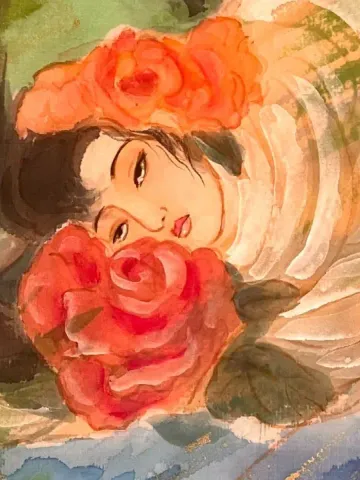
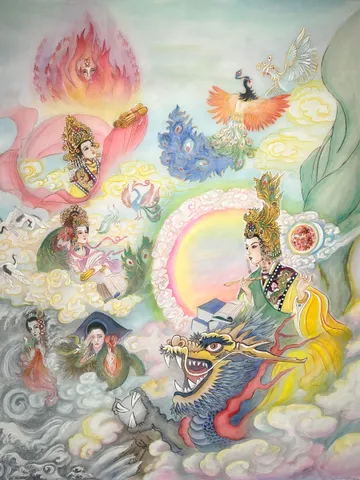
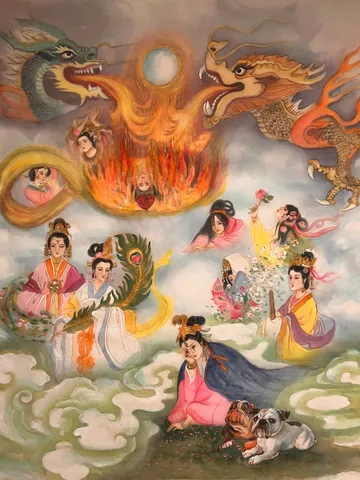
About this Painting
| Artist | Xiang Li 李湘 |
| Medium | Chinese watercolor on silk |
| Subjects | The empresses of the late Ming |
| Painted | 2023 |
| Collection | The Chinese Empresses Collection |
| Availability | Original held by the artist · Prints available |