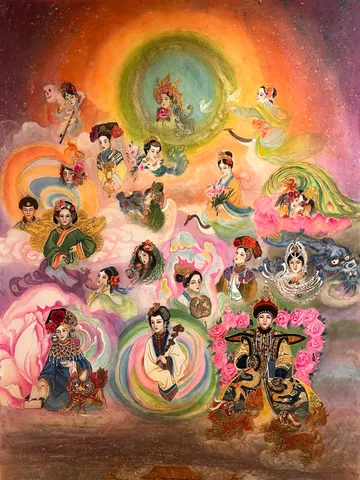
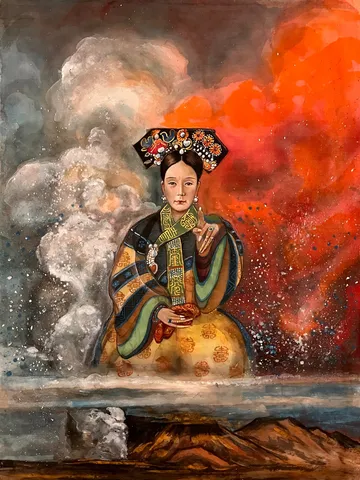
Primary Consort Minhui
敏惠恭和元妃 · 海兰珠
“1609 – 1641 · the great love of Hong Taiji, founder of the Qing”
She was never empress. She held the throne of no one and issued no edict. She is on this wall because the man who founded the Qing dynasty loved her so completely that when she died he stopped functioning, and was dead himself within two years — and the succession crisis that followed put her sister’s son on the throne of China.
Her Story
Three women, one household
The Qing was built on a marriage alliance. The Manchus of the northeast could not have conquered China without the cavalry of the Khorchin Mongols, and the price of that cavalry was daughters. Between 1614 and 1634 the ruling house of Aisin Gioro took three women from the same Khorchin Borjigit family into one household: Jerjer, who became empress; her niece Bumbutai, who would found the dynasty’s civil order and raise two emperors; and Bumbutai’s elder sister Harjol.
Harjol came last, in 1634, and she was twenty-six — extraordinarily old for a first entry into an imperial household, where girls were normally taken at thirteen or fourteen. The record does not say why. The most economical explanation, and the one most historians accept, is that she had been married before.
The Guanju Palace
Hong Taiji had at that point been ruler of the Later Jin for eight years. He was forty-two, a formidable administrator and a better strategist than his father, and he was building the institutions — the Eight Banners, the Six Ministries, a written Manchu script — that would let a small northeastern confederation govern the largest empire on earth.
In 1636 he declared the dynasty Qing, took the imperial title, and ranked his five principal consorts. Jerjer became empress. Bumbutai was placed fifth. Harjol was placed second — above her younger sister, and above every other woman in the palace but the empress.
He gave her the Guanju Palace. The name is not decorative. Guanju 关雎 is the opening poem of the Book of Songs, the oldest anthology in Chinese literature, and it is a poem about a man who cannot sleep for longing:
关关雎鸠,在河之洲。窈窕淑女,君子好逑。
— the ospreys calling on the river island, and the gentleman who wants the graceful lady. Every literate person in East Asia knew that poem by heart. Naming her palace after it was a public declaration, in the most formal register available to him, of what she was to him.
The son
In July 1637 she bore him a son — his eighth. Hong Taiji declared a general amnesty across the empire, something done for the birth of an heir and for nothing less. He had seven older sons already. Nobody misread the signal.
The child died in early 1638, before his first birthday. He was never given a name.
Harjol did not recover. The records describe a long decline over three years, without naming an illness.
Songshan
In September 1641 Hong Taiji was at the front. The siege of Songshan and Jinzhou was the decisive campaign of his life — the destruction of the Ming field army in Liaodong, the operation that made the conquest of China possible. He was personally commanding.
Word came that she was dying. He left the army in the middle of the campaign and rode for Shenyang. The distance is roughly four hundred kilometres. He covered it in about six days, riding through the nights.
She died before he arrived. He is recorded as having collapsed on reaching the palace and lost consciousness — the Qing Shi Gao uses the phrase for a fainting fit, unusual language for an emperor in an official history, and it was not edited out.
He gave her the posthumous title Minhui Gonghe Yuanfei 敏惠恭和元妃. The final two characters, yuanfei, mean primary consort — the highest rank the Qing ever conferred on a woman who had not been empress, and one it never conferred again. He wrote her funerary text himself. He suspended court entertainments. He is recorded weeping at her tomb repeatedly over the following year, and at one point had to be admonished by his own ministers, who told him plainly that an emperor could not grieve like this in public.
He answered that he knew, and that he could not stop.
What her death set in motion
Hong Taiji died suddenly on 21 September 1643, seated at his desk, aged fifty-one — twenty-three months after Harjol. He had named no heir. The Manchu nobility split between his eldest son Hooge and his brother Dorgon, and the two factions came close to fighting it out with their banners drawn up in the city.
The compromise that avoided a civil war was a child neither faction feared: Fulin, the five-year-old son of Bumbutai — Harjol’s younger sister. Seven months later the Manchus came through the Shanhai Pass and took Beijing.
Had Harjol’s own son lived, he would have been the obvious heir and none of that would have happened as it did. It is one of the sharper hinges in Chinese history, and it turns on an infant who died in 1638 without a name.
Why she is in this collection
Every other subject in these paintings held a title that gave her a place in the state. Harjol held none. She governed nothing and decided nothing.
She is here because the Qing archives — which are famously dry, bureaucratic, and written in two languages by men whose job was to record grain prices and troop movements — could not keep her out. The amnesty, the poem on the palace gate, the abandoned siege, the emperor fainting, the ministers telling him to compose himself. None of that is the kind of thing an official history invents. It is what gets in anyway, when something happened that was too large for the form.
A note on the sources
Harjol appears in the Qing Shi Gao and in the Manchu-language Veritable Records of Hong Taiji’s reign, which are contemporaneous and unusually detailed for the pre-conquest period. Her age at entry, her ranking above her sister, the amnesty for her son, the ride from Songshan and the posthumous title are all in the primary record.
What is not in the record is her voice. Nothing she said survives. The television dramas that give her a personality — she is a fixture of Chinese period drama — are inventions, as is the popular claim that the sources name a previous husband. They do not; the inference from her age is reasonable, the name is not.
- Zhao Erxun et al., Qing Shi Gao, juan 214 — 1928
- Manwen Laodang (Old Manchu Archives), Hong Taiji reign
- Evelyn S. Rawski, The Last Emperors — California, 1998
- Pamela Kyle Crossley, A Translucent Mirror — California, 1999
Connections
- Her sister Grand Empress Dowager Xiaozhuang — who made two emperors, including the one this death made possible.
- Her aunt Empress Xiaoduanwen — the empress of the same household.
- The dynasty she never saw The empresses of the Qing.
- The comparison Consort Donggo — one generation later, another emperor who could not survive losing the woman he loved. He died five months after she did.
About this Painting
| Artist | Xiang Li 李湘 |
| Medium | Chinese watercolor on silk |
| Subject | Primary Consort Minhui (Harjol) |
| Painted | 2024 |
| Collection | The Chinese Empresses Collection |
| Availability | Original held by the artist · Prints available |