Emperatriz viuda Guo
Conoce a Emperatriz viuda Guo en la colección Emperatrices chinas de Xiang Li y explora su contexto histórico y sus vínculos con las mujeres de la China imperial.
郭氏 · 懿安皇后
“Seven Reigns”
Granddaughter of the general who saved the dynasty, and the most eligible woman in China. Her husband refused to make her empress for fifteen years because it would have cramped him. She then outlived him, her son, and four grandsons — and was the senior woman of the Tang for twenty-eight years.
Her Story
Her grandfather was Guo Ziyi, the general who put down the An Lushan rebellion and refused, repeatedly and publicly, to take the throne he could easily have taken. Her grandmother was a Tang princess. There was no better blood in the empire that was not already imperial.
She married Li Chun in 784 while he was Prince of Guangling, and bore his eldest son in 795. When he became Emperor Xianzong in 805, everyone assumed she would be empress.
He never did it.
His officials raised it more than once and he deflected every time. The Old Book of Tang gives the reason without embarrassment: with a wife of that standing formally installed, he would have had less freedom with the rest of his household. He preferred the freedom.
The Emperor did not create her empress. Her family was too noble, and he did not wish to be constrained.
On Xianzong’s refusal to appoint Consort Guo — Jiu Tang Shu, ch. 52
So she was Noble Consort, and the mother of the heir, and functionally the empress in everything but the document — for fifteen years.
Xianzong is the emperor who very nearly fixed the Tang. He spent his reign forcing the breakaway military provinces back under central control, one campaign at a time, and by 819 he had done it — for the first time since An Lushan, the empire was actually governed from Chang’an again.
Then in 820 he started taking immortality elixirs, became violent and erratic, and died suddenly in the night. The official cause was the elixirs. It was widely believed at the time that the eunuchs killed him, and a persistent later rumour attached her name to it too, on no evidence anyone has ever produced.
Her son took the throne as Muzong and she became empress dowager at last.
And then she simply kept going.
Muzong died in 824. Her grandson Jingzong was murdered by his own servants in 827. Her second grandson Wenzong tried to destroy the eunuchs in 835, failed catastrophically, and spent the rest of his life saying he was more constrained than the last emperor of the Han. Her third grandson Wuzong launched the great persecution of Buddhism and then died of elixir poisoning too, in 846.
Through all of it she was the senior member of the imperial family, and she was treated as such: Muzong, Jingzong, Wenzong and Wuzong all paid her formal court, and she was Grand Empress Dowager for a quarter of a century.
The one who broke it was the fifth. Emperor Xuanzong, who came to the throne in 846, was the son of a woman who had once been her maidservant, and he did not forget it. He withheld the courtesies. He let it be known that he held her responsible for his half-brother’s death.
On a summer day in 848 she climbed the Qinzheng Tower and stood at the parapet, and her attendants pulled her back.
She died that night. The court did not investigate.
When Xuanzong proposed not burying her with Xianzong, an official named Wang Hao objected on the record, and was demoted for it — but the objection worked. She was interred at the Jingling beside the husband who had never made her empress, and given the title he had withheld for fifteen years.
A note on the sources
The suggestion that she had a hand in Xianzong’s death appears late and thinly, and it is worth being explicit that no source contemporary with the event makes the charge. It surfaces after 846, at exactly the point when the reigning emperor had a motive to circulate it. The eunuch Chen Hongzhi is named by the histories as the actual killer.
Her death is recorded plainly — the tower, the attendants, the same night — and the absence of any inquiry is itself part of the record.
- Liu Xu et al., Jiu Tang Shu (Old Book of Tang), ch. 52 — 945 CE
- Ouyang Xiu et al., Xin Tang Shu (New Book of Tang), ch. 77 — 1060
- Sima Guang, Zizhi Tongjian, ch. 236–248 — 1084
- Michael Dalby, “Court Politics in Late T’ang Times”, in The Cambridge History of China, Vol. 3 — 1979
The Emperor
Emperor Xianzong of Tang 唐宪宗
Li Chun 李纯 · 778 – 820 · reigned 805 – 820
The most effective Tang emperor after the An Lushan rebellion, and the last one who mattered. He inherited an empire where a third of the provinces were hereditary military fiefs that paid no tax and took no orders, and he spent fifteen years breaking them — Sichuan, then Zhenhai, then the long grinding campaign against Huaixi that ended in 817 with a night march through a blizzard and the capture of the rebel commander in his own bed.
By 819 every province in China acknowledged Chang’an again. It is called the Yuanhe Restoration, and it did not outlive him by two years.
He then began taking mercury-based immortality drugs, grew violent toward the people around him, and died in the night in 820 at forty-two. The histories name a eunuch of his own household as the killer.
He was also the emperor who received the Buddha’s finger bone at the palace, prompting Han Yu’s famous memorial against it — for which Han Yu was very nearly executed and instead exiled to the far south.
Connections
- Her mother-in-law Empress Dowager Wang — Shunzong’s consort, who nursed a husband who could not speak.
- The women who came after The Last Seven Empresses — the consorts of the grandsons she outlived.
- The end of the line Empress He — Zhaozong’s empress, and the last of the Tang.
- The comparison Deng Sui of the Han — the other great long-serving dowager, who held actual power. Empress Guo held only precedence, for twenty-eight years.
About this Portrait
| Artist | Xiang Li 李湘 |
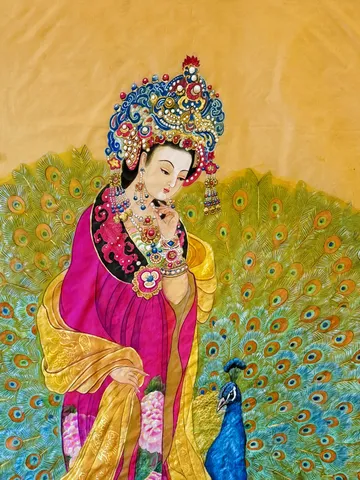
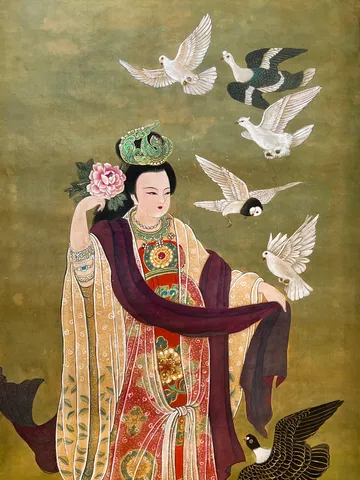
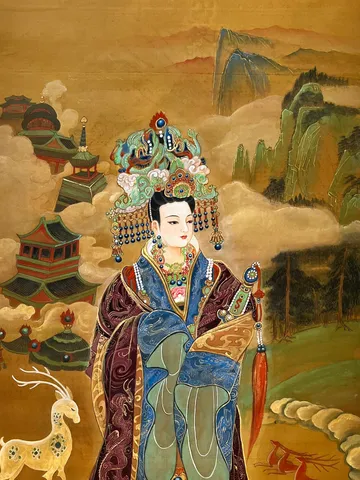
| Medium | Chinese watercolor on silk, hand-painted on hand-cut silk |
| Dimensions | approx. 36 × 72 inches (91 × 183 cm) |
| Painted | 2017 |
| Subject | Empress Dowager Guo (Yi’an), consort of Emperor Xianzong |
| Collection | The Chinese Empresses Collection |
| Availability | Original held by the artist · Prints available |