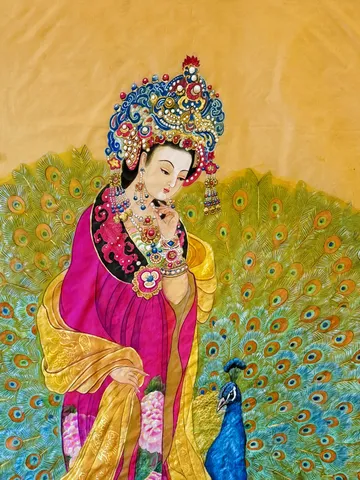
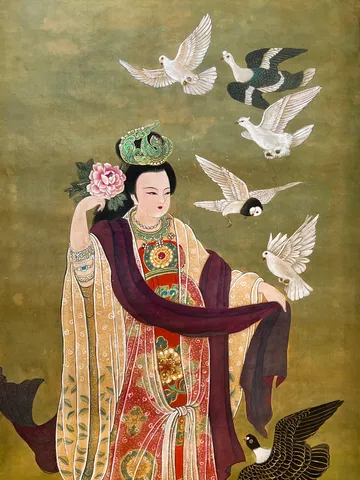
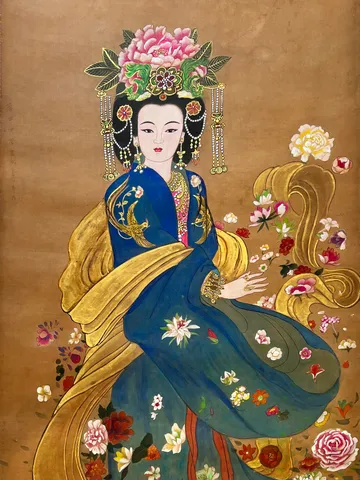
Emperatriz reinante Wu Zetian
Emperatriz reinante Wu Zetian: consulta esta página de Emperatrices chinas en Xiang Li Art. El contenido principal está en inglés; la traducción completa está pendiente.
武则天 · 武曌
“The Only One”
A timber merchant’s daughter who entered the palace at fourteen, was sent to a convent at twenty-five, came back, took the throne at sixty-six, and ruled China as emperor in her own name. She left a seven-metre stone tablet at her tomb with nothing written on it.
Her Story
She is the only woman in three thousand years of Chinese history to have ruled as emperor. Not regent, not dowager, not power behind a screen. Emperor, with the title, the ancestral temple, the mandate and a dynasty of her own.
Her father was a timber merchant who had backed the right rebellion and been given a title for it, which made the family rich and permanently unfashionable. She entered Emperor Taizong’s harem at fourteen, in the fifth rank, and he named her Mei — “charming.”
The first story anyone tells about her happened around then. Taizong had a horse nobody could break. She said she could do it with three things: an iron whip, an iron mace, and a dagger. Whip it; if it will not submit, strike its skull with the mace; if it still will not submit, cut its throat. She was fourteen years old, and she was telling the most powerful man in Asia how she handled things that would not obey.
Give me an iron whip, an iron mace, and a dagger. I will whip him; if he will not submit, I will strike his head with the mace; if he still will not submit, I will cut his throat.
Wu Zhao, aged fourteen, on how to break Emperor Taizong’s horse — Zizhi Tongjian, ch. 206
He did not promote her again. When he died in 649 she was sent, with the rest of the childless consorts, to shave her head and live out her life in a Buddhist convent.
Two years later Taizong’s son Gaozong — who had noticed her while his father was dying, which was a serious offence — brought her back to the palace.
What followed was four years of the most effective court manoeuvring in the historical record. Empress Wang had actually helped bring her back, to use her against a rival. It worked, and then it kept working past the point Empress Wang had intended.
In 654 Wu’s infant daughter died. She said Empress Wang had done it, and Empress Wang had been in the room. Whether Wu killed the child herself is the oldest and ugliest argument in Tang historiography: the accusation appears first in the Zizhi Tongjian, four hundred years later, and not in the earlier sources. What is certain is what it achieved.
By 655 both Empress Wang and the Consort Xiao were deposed and imprisoned. Then they were killed, and the manner of it is recorded in the official Tang history: their hands and feet were cut off and they were put into a vat of wine.
Wu was empress. She was thirty-one.
From 660 Gaozong began suffering strokes and severe headaches that left him unable to read documents. She read them for him, and then decided them. By the 670s the court was formally addressing them as the Two Sages, and edicts went out over both names.
He died in 683 and she buried the fiction with him.
Her son Zhongzong was emperor for six weeks. He suggested he might give the empire to his father-in-law; she deposed him the same month, installed his younger brother Ruizong, and had him live in a separate palace where he was not permitted to attend court.
For seven years she ruled as dowager while the ground was prepared — a Buddhist scripture was produced, or discovered, prophesying that a woman would rule as a universal monarch; petitions were organised; a rebellion by the Tang princes was crushed and the imperial clan largely exterminated. In 690 she took the throne herself and named the dynasty Zhou, after the ancient house she claimed descent from.
She was sixty-six years old.
The reign that followed is genuinely hard to summarise, because both halves of it are true. She broke the north-western aristocracy’s grip on office by expanding the imperial examinations, personally examining candidates, and promoting men on ability from nowhere — which is the foundation the entire later Chinese civil service is built on. She kept the frontier quiet, the granaries full, and the population growing. Several of the ministers she found and raised went on to run the Kaiyuan era, the high point of the whole dynasty.
She also ran a terror. She installed copper urns in the palace courtyard for anonymous denunciations, and a corps of “cruel officials” to act on them — one of whom, Lai Junchen, wrote an actual manual of interrogation techniques. Officials went to work having said goodbye to their families. The Tang imperial clan was culled to the point where finding a legitimate heir later became a problem.
In 705, aged eighty-one and ill, she was removed by a palace coup led by her own ministers. She abdicated in favour of the son she had deposed twenty-two years earlier, and died that December. Her last instruction was that she be buried not as an emperor but as Gaozong’s empress, and that her posthumous title be reduced accordingly.
She lies with him at the Qianling, under the only imperial tomb in China never robbed. In front of it stands a stone tablet nearly seven metres high, prepared for her epitaph.
It is blank. Nobody has ever established whether she ordered it left empty, or whether the court that followed her simply could not agree on what to write.
A note on the sources
No figure in Chinese history has been written about with less neutrality. Every surviving account was produced by the Confucian scholar-officials whose monopoly on office she deliberately broke, and the charges escalate the further you get from her lifetime — the murder of her own daughter, for instance, appears four centuries later in Sima Guang and not in the two Tang histories written closer to the events.
The administrative record does not depend on any of that. The examination reforms, the ministers she promoted, the census figures and the frontier settlements are all documentary. So is the terror. A reader is entitled to hold both.
- Liu Xu et al., Jiu Tang Shu (Old Book of Tang), ch. 6 — 945 CE
- Ouyang Xiu et al., Xin Tang Shu (New Book of Tang), ch. 4 and 76 — 1060
- Sima Guang, Zizhi Tongjian, ch. 199–208 — 1084
- N. Harry Rothschild, Wu Zhao: China’s Only Woman Emperor — Pearson, 2008
- Jonathan Karam Skaff, Sui-Tang China and Its Turko-Mongol Neighbors — Oxford, 2012
The Emperor
Emperor Gaozong of Tang 唐高宗
Li Zhi 李治 · 628 – 683 · reigned 649 – 683
The ninth son of Taizong, and emperor largely because his two elder brothers destroyed each other competing for it. He is usually written off as weak, which undersells him — the Tang reached its greatest territorial extent under his reign, from Korea to the Pamirs, and the legal code issued in his name became the model for the law of Japan, Korea and Vietnam.
From about 660 he suffered strokes and blinding headaches, and could not always read. He handed the paperwork to his wife, and never took it back. By the 670s the two of them were styled the Two Sages and held court together — an arrangement with no precedent in Chinese history.
Also on these pages: Emperor Taizong, in whose harem she began at fourteen, and Emperor Zhongzong and Emperor Ruizong, the two sons she raised to the throne and removed from it.
Connections
- The empress she replaced Empress Wang — who brought Wu back into the palace to use against a rival, and was destroyed by her within four years.
- Her daughter-in-law Empress Wei — married to Zhongzong, who tried to repeat Wu’s career after her death and was killed for it in 710.
- Her predecessor by six centuries Empress Lü Zhi — the first woman to rule a unified China, and the standard every historian measured Wu against.
- Her successor in the argument Cixi — the last woman to rule China, and the last to be written about in exactly the same terms.
About this Portrait
| Artist | Xiang Li 李湘 |
| Medium | Chinese watercolor on silk, hand-painted on hand-cut silk |
| Dimensions | approx. 36 × 72 inches (91 × 183 cm) |
| Painted | 2014 |
| Subject | Wu Zetian, Emperor of the Zhou |
| Collection | The Chinese Empresses Collection |
| Availability | Original held by the artist · Prints available |