Emperatriz viuda Wang (Xianzong)
Conoce a Emperatriz viuda Wang (Xianzong) en la colección Emperatrices chinas de Xiang Li y explora su contexto histórico y sus vínculos con las mujeres de la China imperial.
王氏 · 庄宪皇后
“A Hundred and Eighty-Six Days”
She entered the palace at twelve and waited thirty years while her husband was crown prince. He had a stroke four months before he inherited, and reigned without the power of speech — nodding from behind a curtain — while she was made empress and nursed him herself.
Her Story
She was chosen as an imperial consort for Emperor Daizong, and then given instead to his grandson.
That was in 775. She was twelve or thirteen; Li Song was about fourteen. She bore him a son three years later — Li Chun, the future Emperor Xianzong — and then waited.
She waited a very long time. Li Song was made crown prince in 779 and remained crown prince for twenty-six years, which is the longest anyone held that position in the Tang. His father Dezong was suspicious of him, watched him closely, and at one point came close to deposing him over a family connection to a disgraced minister. The safest thing a crown prince could do in those decades was nothing at all, and he did it thoroughly.
In the autumn of 804 he had a stroke. It took his speech entirely.
Dezong died four months later, in January 805, and the man who could not speak became emperor.
The Emperor could not speak. He sat behind the curtain, and the officials made their reports, and he nodded or he did not.
On the reign of Emperor Shunzong, 805 CE — Zizhi Tongjian, ch. 236
What followed is one of the strangest reigns in Chinese history. Shunzong held court behind a curtain, and communicated by nodding or shaking his head while a eunuch and a favoured consort read out what he was thought to want. The government was actually run by a group of reformist officials — the Yongzhen Reform — who moved fast: they abolished the palace market where eunuchs requisitioned goods from traders without paying, cancelled the tribute levies, released hundreds of palace women, and tried to take the palace armies back from eunuch control.
That last one killed it. Within six months the eunuchs had forced the emperor to name his son heir, and then to abdicate.
Lady Wang was created empress somewhere in the middle of all this — the formal investiture of a woman whose husband could not speak, in a reign that lasted a hundred and eighty-six days.
She nursed him herself. The histories are specific about it: she attended him personally through the paralysis, in the palace and then in retirement, and she was with him when he died in early 806, a few months after stepping down.
Then she was empress dowager for ten years under her son, and by every account those were good years — she is described as modest, careful with the imperial family, and unusually well liked. There was no faction, no scandal, and no execution.
She died in 816 and was buried with her husband at the Fengling.
She is one of very few women in this collection who entered the palace as a child, held the highest rank available to her, and died old, at home, honoured, having harmed no one. In the Tang that is close to unique.
A note on the sources
Shunzong’s six months are unusually contested for such a short reign, because the reformers who ran the government in his name were friends of the poet Liu Zongyuan and the essayist Han Yu’s circle, and the accounts written afterwards divide sharply along those lines. Empress Wang herself is not part of that argument — she appears in it only as the person looking after the emperor, which is probably an accurate description of what she was doing.
- Liu Xu et al., Jiu Tang Shu (Old Book of Tang), ch. 52 — 945 CE
- Ouyang Xiu et al., Xin Tang Shu (New Book of Tang), ch. 77 — 1060
- Sima Guang, Zizhi Tongjian, ch. 236 — 1084
- Denis Twitchett (ed.), The Cambridge History of China, Vol. 3 — 1979
The Emperor
Emperor Shunzong of Tang 唐顺宗
Li Song 李诵 · 761 – 806 · reigned 805
Crown prince for twenty-six years and emperor for six months. He was intelligent, well read, a good calligrapher, and had spent his entire adult life being careful — his father Dezong was suspicious of him and he knew it.
He had a stroke in the ninth month of 804 and lost his speech. Four months later his father died and he inherited an empire he could not address.
The reformers he had gathered around him as crown prince moved immediately, and for a hundred and eighty-six days the Tang government did serious things: the palace requisition market was abolished, tribute levies cancelled, hundreds of palace women released, and an attempt made to take the imperial armies back from the eunuchs. The eunuchs won. He was forced to name his son heir and then to abdicate, and he died a few months later.
See also: Empress Dowager Guo — her son’s consort, and the woman who came after.
Connections
- Her mother-in-law Empress Wang (Dezong) — made empress three days before her death in 786, and the mother of Shunzong.
- Her daughter-in-law Empress Dowager Guo — married to her son Xianzong, never made empress, and the senior woman of the dynasty for seven reigns.
- Her husband’s grandmother Empress Ruizhen (Shen) — lost in the An Lushan rebellion, and declared dead by Empress Wang’s own son in 805.
- The contrast Empress Zhang (Suzong) — the previous empress to be at an incapacitated emperor’s bedside, and dragged out of it by the palace guard.
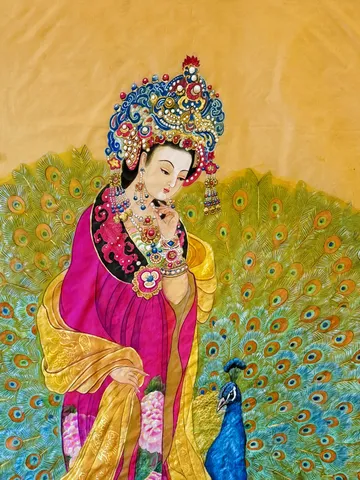
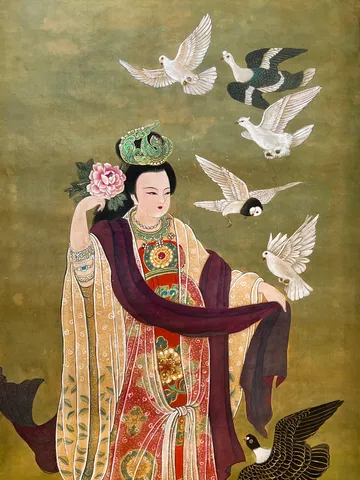
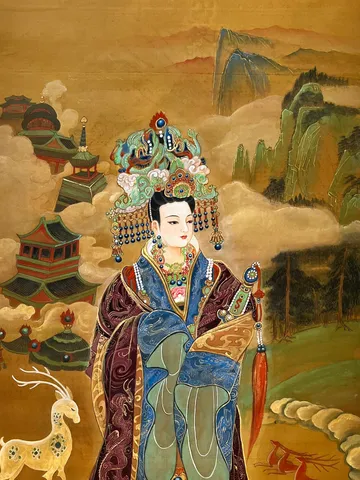
About this Portrait
| Artist | Xiang Li 李湘 |
| Medium | Chinese watercolor on silk, hand-painted on hand-cut silk |
| Dimensions | approx. 36 × 72 inches (91 × 183 cm) |
| Painted | 2016 |
| Subject | Empress Dowager Wang (Zhuangxian), consort of Emperor Shunzong |
| Collection | The Chinese Empresses Collection |
| Availability | Original held by the artist · Prints available |