Emperatriz He
Emperatriz He: consulta esta página de Emperatrices chinas en Xiang Li Art. El contenido principal está en inglés; la traducción completa está pendiente.
何皇后 · 宣穆皇后
“The Last One”
Made empress in a borrowed house because the capital had fallen. She surrendered the imperial seal to save her husband, watched him killed anyway, and was then made to stand in the hall and announce he had died of illness. Two years later they killed her too.
Her Story
She was the last empress of the Tang, and she was made empress in a provincial town because the capital was no longer safe.
By 896 Emperor Zhaozong had lost control of everything outside the palace walls. The warlord Li Maozhen marched on Chang’an; the court fled east to Huazhou and lived there under the protection of another warlord, which is where, in 897, he finally invested her as empress. It was a ceremony held in someone else’s house.
In 900 Zhaozong got very drunk and killed several eunuchs and palace attendants with his own hands. The surviving eunuchs decided they had had enough. They deposed him, shut him in a side palace, and came to Empress He for the imperial seal.
She gave it to them. There is a line recorded from that morning — she told them to spare the emperor’s life, and that she would do whatever they asked.
Do not harm the Emperor. Whatever you require, I will do it.
Empress He, surrendering the imperial seal to the eunuchs, 900 CE — Zizhi Tongjian, ch. 262
He was restored a year later by a rival faction, and in 903 the warlord Zhu Wen arrived, killed every eunuch in the palace, and took possession of the emperor himself.
In 904 Zhu Wen moved the court to Luoyang. He had Chang’an — the largest city in the world, capital of China for most of a thousand years — physically dismantled: the palaces and houses pulled down, the timber floated down the river to build his new capital. The population was marched east. It never recovered.
On the night of the twenty-second day of the eighth month, Zhu Wen’s men came over the palace wall at Luoyang. Zhaozong ran, in his nightclothes, around a pillar. They caught him.
Empress He came out and begged for her own life, and the officer in charge, a man named Jiang Xuanhui, let her live.
Then she was made to do the rest of it. She announced that the emperor had died of illness. She placed her thirteen-year-old son on the throne. She sat in the audience hall as empress dowager beside a boy who was a hostage, and said what she was told to say.
The following year Zhu Wen invited nine of Zhaozong’s other sons to a banquet at the Jiuqu Pool, strangled all nine, and threw the bodies in the water.
In 906 he decided she was a loose end. A charge was produced — that she had conspired with a palace servant against him — and she was killed at the Jishan Palace, and posthumously reduced to a commoner so that she could not be buried as an empress.
In 907 Zhu Wen took the throne and declared the Later Liang. Her son was poisoned the next year, aged sixteen.
The Tang had lasted two hundred and eighty-nine years. It ends with a woman being made to stand in a hall and tell a lie about how her husband died, and then being killed for having been there.
A later court restored her name and gave her the title Empress Xuanmu — “the proclaimed and solemn” — which is the only thing anyone was ever able to do for her.
A note on the sources
The last decade of the Tang is documented in unusual detail, because the men who ended it wanted the record to justify them and the men who came after wanted it to condemn them, and between the two versions a great deal survives. The killing of Zhaozong, the nine princes at the Jiuqu Pool, and the dismantling of Chang’an are all attested from more than one direction.
Empress He herself is given almost no interior life in any of it. She appears at the moments when someone needed something from her — the seal, the announcement, the seat in the hall — and then she is disposed of. This page cannot fix that; it can only say so.
- Liu Xu et al., Jiu Tang Shu (Old Book of Tang), ch. 52 — 945 CE
- Ouyang Xiu et al., Xin Tang Shu (New Book of Tang), ch. 77 — 1060
- Ouyang Xiu, Xin Wudai Shi (New History of the Five Dynasties) — c. 1073
- Sima Guang, Zizhi Tongjian, ch. 260–266 — 1084
The Emperor
Emperor Zhaozong of Tang 唐昭宗
Li Jie 李晔 · 867 – 904 · reigned 888 – 904
He was intelligent, well educated, and genuinely wanted to restore the dynasty, and he came to the throne about eighty years too late. By 888 the provinces belonged to warlords, the palace armies belonged to eunuchs, and the treasury was empty.
He tried anyway. He raised an army and attacked the strongest warlord in the north-west, and lost it. He tried to destroy the eunuchs, and they deposed him. He was restored, deposed again in all but name, and passed between Li Maozhen and Zhu Wen like a document.
He drank heavily in the last years, and in 900 killed several servants with his own hands, which is what triggered his first deposition.
Zhu Wen had him killed at Luoyang in 904. He was thirty-seven. He is the last Tang emperor anyone bothered to assassinate — his son was simply poisoned.
Connections
- The dowager who outlived seven reigns Empress Dowager Guo — dead in 848, fifty-eight years before this.
- The women in between The Last Seven Empresses — the consorts of the emperors between Xianzong and Zhaozong.
- Where the dynasty began Empress Taimu — chosen at the peacock screen, 289 years earlier.
- What came next The Five Dynasties and Ten Kingdoms — fifty-three years of division, five dynasties in the north, and Zhu Wen’s Later Liang first among them.
About this Portrait
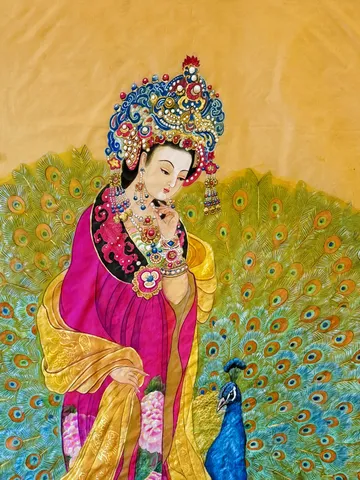
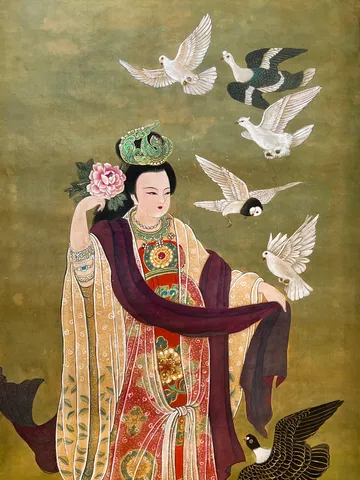
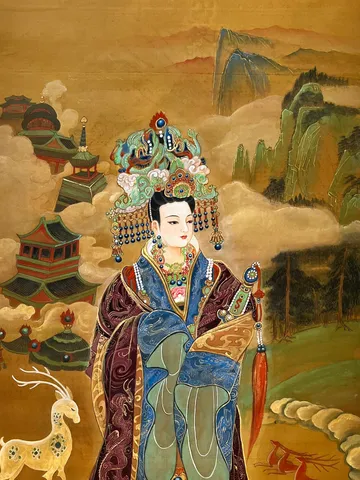
| Artist | Xiang Li 李湘 |
| Medium | Chinese watercolor on silk, hand-painted on hand-cut silk |
| Dimensions | approx. 36 × 72 inches (91 × 183 cm) |
| Painted | 2017 |
| Subject | Empress He (Xuanmu), consort of Emperor Zhaozong |
| Collection | The Chinese Empresses Collection |
| Availability | Original held by the artist · Prints available |