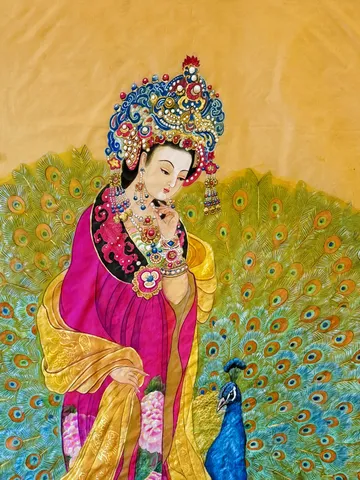
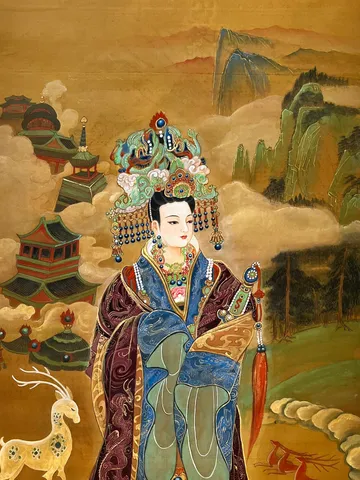
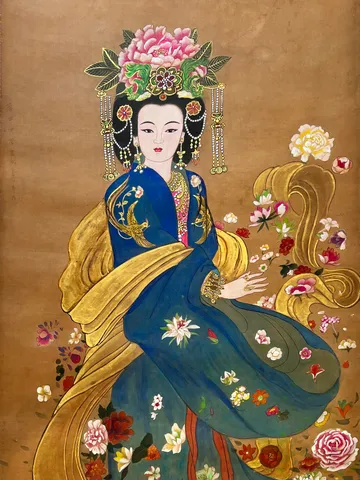
Emperatriz Zhangsun
La Emperatriz Zhangsun no dijo nada. Se retiró, se puso las vestiduras ceremoniales completas usadas solo para las ocasiones de estado más grandes, regresó, y formalmente se postró
长孙皇后 · 文德皇后
“The One Who Refused”
She stood with the soldiers at the Xuanwu Gate the morning her husband killed his brothers, and then spent ten years declining to give him a single opinion on government — while quietly saving the life of the one minister brave enough to tell him he was wrong.
Her Story
She married Li Shimin when she was thirteen and he was fifteen, ten years before either of them was anything.
On the fourth day of the sixth month of 626, her husband and his men waited in ambush at the Xuanwu Gate for his two brothers. She was there. The Old Book of Tang records that she went among the officers herself before it started and encouraged them, and that they were moved by it. Her husband killed both brothers, forced his father off the throne within two months, and became Emperor Taizong.
Two months after that, at twenty-five, she was empress. What she did with the position is the reason she is still the most admired woman in Chinese political history.
She refused to use it.
Taizong asked her opinion on government constantly. She would not give it. Her stated position was that a hen has no business announcing the dawn — the standard line — but she went further than the standard line, because she also refused it for her family. When Taizong wanted to make her brother Zhangsun Wuji chancellor, she argued against it for years, on the explicit grounds that consort clans destroy dynasties and she had read what happened to the Han.
What she did instead was intervene sideways, and she was extremely good at it.
The best-recorded instance concerns Wei Zheng, the minister whose job was effectively to tell the emperor he was wrong, and who did it several hundred times. One day Taizong came back from court incandescent and said he was going to kill that country bumpkin who kept humiliating him in front of everyone.
Empress Zhangsun said nothing. She withdrew, put on the full ceremonial robes worn only for the greatest state occasions, came back, and formally prostrated herself in congratulation.
I have heard that when the ruler is enlightened, his ministers are upright. Wei Zheng is upright — and so I congratulate Your Majesty.
Empress Zhangsun, in full court dress, after Taizong threatened to kill Wei Zheng — Zizhi Tongjian, ch. 194
Wei Zheng lived. He went on remonstrating for another seventeen years, and the record of those arguments — the Zhenguan Zhengyao — became the manual of good government read by every subsequent Chinese, Japanese and Korean court.
She wrote a book of her own, thirty volumes called Rules for Women, and gave instructions that it was never to be published. Taizong found it after she died, read it, published it anyway, and reportedly wept.
She was ill for years — the sources describe a respiratory condition — and died in 636, aged thirty-five. Her last requests were that her brother be kept out of high office, that no one be punished on her account, and that she be buried cheaply: no mound, no treasure, just a chamber cut into the rock of a mountain.
Taizong obeyed the last one in his own way. He chose Mount Jiuzong and had the tomb cut into the living rock, and it became the Zhaoling — the largest imperial tomb complex in Chinese history, with a hundred and ninety subordinate graves of ministers and generals arranged around it. He built a tower in the palace so he could see it, and had to be talked into taking the tower down.
He ignored the first request. Zhangsun Wuji became the most powerful man in the empire, and in 659 he was accused of treason, exiled, and forced to hang himself — by the faction of a young consort of her son’s who had begun as a fourteen-year-old in her husband’s harem.
Her name was Wu Zhao. Empress Zhangsun had been dead twenty-three years, and she had been right.
A note on the sources
Empress Zhangsun is the empress Confucian historians wanted to exist, and she is described accordingly — every anecdote about her is also a lesson. But she is unusual in that her restraint is corroborated by the administrative record rather than only by praise: her brother genuinely was kept out of the chancellorship while she lived, and genuinely was appointed the moment she died.
- Liu Xu et al., Jiu Tang Shu (Old Book of Tang), ch. 51 — 945 CE
- Ouyang Xiu et al., Xin Tang Shu (New Book of Tang), ch. 76 — 1060
- Sima Guang, Zizhi Tongjian, ch. 191–195 — 1084
- Wu Jing, Zhenguan Zhengyao (Essentials of Government of the Zhenguan Era) — c. 720
The Emperor
Emperor Taizong of Tang 唐太宗
Li Shimin 李世民 · 598 – 649 · reigned 626 – 649
Usually ranked the greatest emperor in Chinese history, and he reached the throne by ambushing his elder brother and younger brother at a palace gate, killing them both, having their ten sons executed, and giving his father two months to abdicate.
What followed was the Zhenguan era, the reign every later dynasty measured itself against. He cut taxes and the death penalty, rebuilt the examination system, kept ministers whose entire function was to contradict him, and expanded the empire deep into Central Asia — the Turkic khanates gave him the title Heavenly Khan. Chang’an became the largest city on earth.
He is also the emperor who began the practice of reading the court diaries about himself, which historians have been complaining about ever since, because the record of the Xuanwu Gate is the part he read.
His own line on it, quoting an older text, was that the people are water and the ruler is a boat: water carries the boat, and water capsizes it.
See also: Emperor Taizong.
Connections
- The consort who outlived her Wu Zetian — a fourteen-year-old in Taizong’s harem while Zhangsun was empress, and the woman whose faction destroyed her brother in 659.
- Her daughter-in-law Empress Wang — married to her son Gaozong, and deposed within four years of bringing Wu Zetian back to court.
- Her mother-in-law Empress Taimu (Dou) — Gaozu’s wife, who died before the dynasty was founded.
- The comparison Empress Ma (Mingde) of the Han — the other empress who spent a lifetime refusing office for her own family, six centuries earlier.
About this Portrait
| Artist | Xiang Li 李湘 |
| Medium | Chinese watercolor on silk, hand-painted on hand-cut silk |
| Dimensions | approx. 36 × 72 inches (91 × 183 cm) |
| Painted | 2013 |
| Subject | Empress Zhangsun, consort of Emperor Taizong |
| Collection | The Chinese Empresses Collection |
| Availability | Original held by the artist · Prints available |