Emperatriz Yin y Deng Sui (emperatriz Hexi)
La emperatriz Yin provenía de la mejor familia del imperio: era bisnieta del hermano de Yin Lihua. Se casó con el emperador He y fue hecha emperatriz en 96
阴皇后 · 邓绥(和熹皇后)
“Paper and Ink”
One was destroyed by a witchcraft charge. The other replaced her, refused every tribute the provinces offered, asked for paper instead — and then governed the empire for fifteen years as its last effective ruler.
Their Story
Two women, one emperor, and the same accusation that had worked twenty years earlier.
Empress Yin came from the best family in the empire: she was a great-granddaughter of Yin Lihua’s brother. She married Emperor He and was made empress in 96 CE. The histories call her beautiful, and then, without much charity, short, clumsy, and jealous.
Deng Sui arrived at court the same year, aged fifteen. She was the granddaughter of Deng Yu, Guangwu’s first minister, and she had been a strange child — reading histories at six, reciting the Book of Documents and the Analects at twelve, studying at night after her mother told her to stop and learn needlework. She was also unusually tall, about 166 cm, taller than most men of the period.
At court she was relentlessly, conspicuously humble. If she and the empress happened to wear the same colour she went and changed. She covered for Empress Yin’s mistakes in front of the emperor. She recommended other women to him, because his sons kept dying in infancy and he needed more.
None of it helped. Every act of deference made Emperor He admire her more, which is exactly what Empress Yin could not forgive.
Then he fell ill, and Empress Yin said out loud that if she became empress dowager she would have the entire Deng family killed. Deng Sui heard about it and prepared to take poison — better to die first than let her family be destroyed on her account — and a lady-in-waiting stopped her by lying and saying the emperor had recovered. He then actually did recover.
In 102 CE, Empress Yin and her grandmother were accused of using witchcraft to curse the imperial consorts. It is the same charge, in the same palace, that Empress Dou had used to destroy the Song sisters twenty years before, and it worked exactly as well. Empress Yin was deposed. She died that year, the sources say of grief. Deng Sui was made empress in November.
And then Deng Sui turned out to be the best ruler the Eastern Han would ever have.
She began by refusing things. Commanderies were forbidden to send her the customary tribute. Foreign gifts were declined. What she asked for instead, annually, was paper and ink.
She refused the tribute of the provinces and the gifts of foreign kingdoms, and asked each year only for paper and ink.
On Empress Deng Sui — Hou Hanshu, ch. 10
This was not a modest gesture. Cai Lun had presented his improved papermaking process to Emperor He in 105 CE, and it was Deng Sui who took it up — brought paper into the imperial administration, promoted the man who made it, and turned a court curiosity into the medium of Chinese government. There is a reasonable case that the world uses paper because a Han empress preferred it to jade.
Emperor He died in 106. She had no son; nor did anyone else who had survived. Two boys had been raised outside the palace in the hope of escaping whatever was killing the imperial infants. She chose the younger, a hundred days old, and he was emperor by nightfall. He died before the year was out. She then passed over the elder brother — who by now was clearly healthy and whom the officials wanted — and installed a twelve-year-old cousin instead, because a boy who had been passed over once would remember it.
She ruled for fifteen years, and the record is remarkable. She opened the imperial granaries twice in famine. She cut palace spending, ended the jade and ivory workshops, sent surplus attendants home, and reduced what the provinces owed. She extended the appeal period for capital sentences. She pardoned the surviving associates of the Dou clan, who had done nothing but be connected to the wrong family. She refused her brother’s proposal to abandon the northwest to the Qiang rebellion, and she was right. She prosecuted corruption inside her own family.
She made the historian Ban Zhao — who had finished her brother’s Book of Han and who was the most learned person in the empire — her teacher and her advisor, and kept her until she died in 116. She created posts for scholars, standardised the Five Classics, summoned seventy members of the imperial clan to study them, and examined them herself.
And she would not let go. When relatives and friends suggested she hand power to Emperor An, who was well past his majority, she was furious with them for asking. He was twenty-eight when she died in April 121 and had never governed a day.
The reckoning came within weeks. His wet nurse and his eunuchs, who had waited fifteen years, told him the empress dowager had plotted to depose him. He stripped the Deng family of everything and forced many of them to kill themselves; later in the year he relented, but by then it was done.
One more account was settled. Emperor An was the grandson of the Consort Song whom Empress Dou had framed for witchcraft in 82 CE — and the eunuch who had conducted that interrogation was Cai Lun. Summoned in 121 to answer for it, Cai Lun bathed, put on his best robes, and drank poison.
Deng Sui is generally counted the last effective ruler of the Han. Everything after her is the long unravelling.
A note on the sources
Deng Sui is unusually well documented for a Han empress, partly because she was a patron of the historians who wrote about her. The praise should be read with that in mind — but the administrative record is independent of it: the granary openings, the tribute reductions, the appeal reform and the abandonment of the Western Regions are all dated edicts, not character notes. Empress Yin, by contrast, survives only through the account of the woman who replaced her.
- Fan Ye, Hou Hanshu (Book of the Later Han), ch. 4 and ch. 10 pt. 1 — 5th century CE
- Sima Guang, Zizhi Tongjian, ch. 48–50 — 1084
- Rafe de Crespigny, Fire Over Luoyang: A History of the Later Han Dynasty 23–220 AD — Brill, 2017
- Alexander Monro, The Paper Trail: An Unexpected History of a Revolutionary Invention — 2017
The Emperor
Emperor He of Han 汉和帝
Born Liu Zhao 刘肇 · 79 – 106 CE · reigned 88 – 106 CE
The boy Empress Dou raised as her own, who at thirteen used the palace guard and the eunuch Zheng Zhong to break her brothers and take back his own government. He never learned, in her lifetime, that she was not his mother.
His reign was the high-water mark of Han reach abroad — Ban Chao held the Western Regions all the way to the Caspian, and an envoy was sent toward Rome — and the beginning of its financial exhaustion at home. It was also the reign in which Cai Lun presented paper.
He died at twenty-seven. Of the many sons born to him, almost none survived infancy, which is why his succession fell to a hundred-day-old baby and then to a cousin, and why his widow governed for fifteen years.
Connections
- Her ancestor by marriage Empress Guanglie (Yin Lihua) — Empress Yin was her great-niece, and Deng Sui’s mother was a Yin as well. The same two clans, four generations on.
- Her mother-in-law Empress Dou (Zhangde) — whose witchcraft charge against the Song consorts set the template used against Empress Yin, and whose ruined associates Deng Sui later pardoned.
- The model she followed Empress Ma (Mingde) — the plainness, the refused tributes, the prosecution of her own relatives. Deng Sui did all of it, and then kept power for fifteen years anyway.
- What came next Empress Yan Ji — the empress of the emperor Deng Sui installed and never released, who destroyed the Deng clan the moment she was gone.
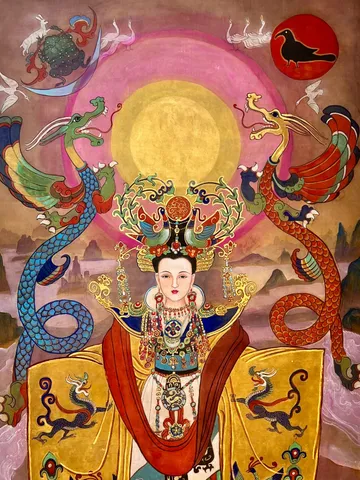
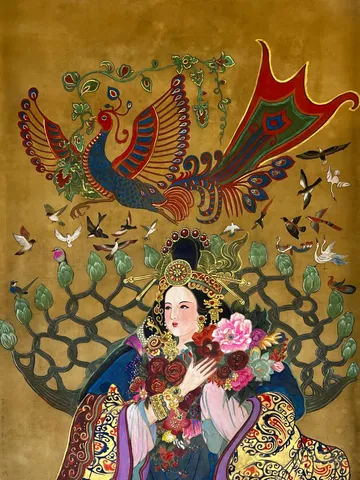
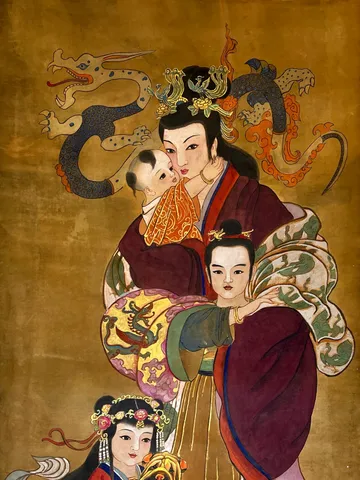
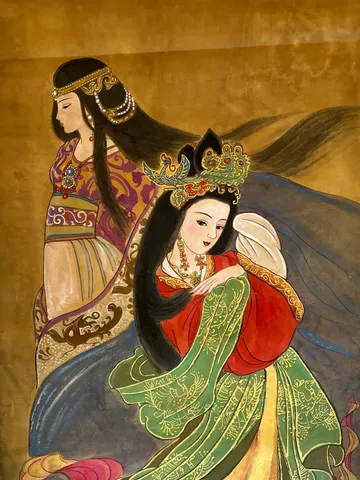
About this Portrait
| Artist | Xiang Li 李湘 |
| Medium | Chinese watercolor on silk, hand-painted on hand-cut silk |
| Dimensions | approx. 36 × 72 inches (91 × 183 cm) |
| Painted | 2014 |
| Subjects | Two empresses — both consorts of Emperor He |
| Collection | The Chinese Empresses Collection |
| Availability | Original held by the artist · Prints available |