Emperatriz Liu y emperatriz Dou
Emperatriz Liu y emperatriz Dou: consulta esta página de Emperatrices chinas en Xiang Li Art. El contenido principal está en inglés; la traducción completa está pendiente.
刘氏 · 窦氏
“The Empty Coffin”
They went to wish their mother-in-law a happy new year in 693 and were never seen again. Their husband went to court the next morning and said nothing. Twenty years later one of their sons became the greatest emperor of the Tang, and spent his reign searching for a grave that was never found.
Their Story
On the first day of the lunar new year in 693, the two principal consorts of the retired emperor went to the Jiaxiang Hall to pay their respects to the reigning sovereign, as protocol required.
They did not come out.
The reigning sovereign was Wu Zetian, and she was their mother-in-law.
Their husband was Ruizong, her fourth son, whom she had made emperor in 684 as a replacement for the third and then kept in a side palace where he was not permitted to attend his own court. In 690 she had taken the throne herself and demoted him to crown prince. He was thirty-one and had spent nine years being the reason the arrangement looked legal.
The accusation had come from a palace servant named Wei Tuan’er, who claimed the two women had used witchcraft to curse the empress. It was almost certainly invented — the servant had a grievance against the household — and it did not matter. Both women were killed inside the palace that day and buried somewhere in secret.
They went in to offer New Year greetings, and were killed within the palace. No one knew where they were buried.
On Empress Liu and Consort Dou, 693 CE — Jiu Tang Shu, ch. 51
The next morning Ruizong went to court and behaved exactly as usual. He did not ask where his wives were. He did not wear mourning. He said nothing at all, then or later, because a son of Wu Zetian who showed grief over women she had executed would be confessing to sympathising with traitors.
It worked. He survived. Two of his half-brothers did not.
Empress Liu had borne his eldest son. Consort Dou had borne his third — Li Longji, then eight years old, who was in the palace at the time and would spend the next twenty years watching.
In 710 Li Longji went over the palace wall and destroyed Empress Wei. In 712 he took the throne from his own father. And then he went looking for his mother.
He never found her. There were no records; the people who had done the burying were dead or would not speak. He offered rewards, opened investigations, and pursued it for years, and the ground gave nothing back.
In the end he did the only thing available. A zhaohun burial — a summoning of the soul — was performed at his father’s tomb: a coffin containing her clothes, interred with the full rites of an empress, with nothing inside it.
Both women were posthumously made empresses. Liu became Empress Suming, Dou became Empress Zhaocheng, and Emperor Xuanzong of Tang, who presided over the greatest era in Chinese history, spent his reign as the son of an empty coffin.
A note on the sources
This episode is recorded in both Tang histories and in the Zizhi Tongjian, and unusually for a Wu Zetian atrocity it is not disputed by modern scholarship — the killings are attested, the accusation is named and identifiable, and the failed search for the bodies is documented in the reign of the son who ordered it. The soul-summoning burial is a matter of court record.
- Liu Xu et al., Jiu Tang Shu (Old Book of Tang), ch. 51 — 945 CE
- Ouyang Xiu et al., Xin Tang Shu (New Book of Tang), ch. 76 — 1060
- Sima Guang, Zizhi Tongjian, ch. 205 — 1084
- N. Harry Rothschild, Wu Zhao: China’s Only Woman Emperor — Pearson, 2008
The Emperor
Emperor Ruizong of Tang 唐睿宗
Li Dan 李旦 · 662 – 716 · reigned 684 – 690 and 710 – 712
The fourth son of Wu Zetian and Gaozong, and the emperor who spent his life stepping aside. His mother made him emperor in 684 after deposing his brother, and for six years he lived in a separate palace, forbidden to hold court, sign edicts, or receive officials. In 690 she took the throne and demoted him to crown prince. In 698 she recalled his exiled brother and he asked to be demoted again, in his favour.
He was made emperor a second time in 710 by his son Li Longji, after the coup against Empress Wei — and abdicated in that son’s favour two years later, while still in good health.
Twice emperor, twice out, and he outlived nearly everyone. The histories treat him as passive; a fairer reading is that he was the only member of his family who correctly judged, every single time, what was survivable.
See also: Emperor Ruizong.
Connections
- The woman who killed them Wu Zetian — their mother-in-law, and the reigning emperor at the time.
- Consort Dou’s son Emperor Xuanzong — eight years old in the palace in 693, and emperor nineteen years later.
- His empress Empress Wang (Xuanzong) — who helped him take the throne and was deposed in 724 for a charm comparing her to Wu Zetian.
- Their sister-in-law Empress Wei — married to the brother Ruizong replaced, and in exile at Fangzhou the year this happened.
About this Portrait
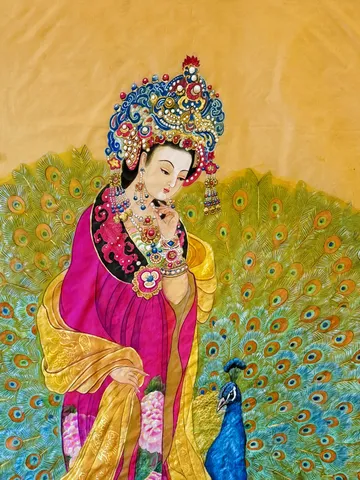
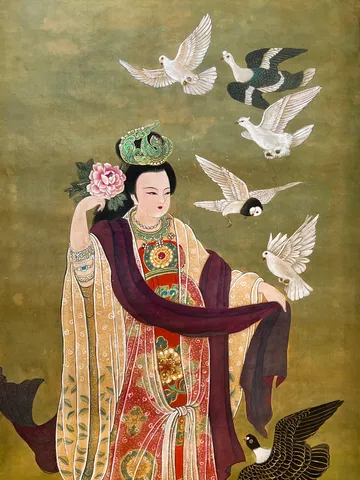
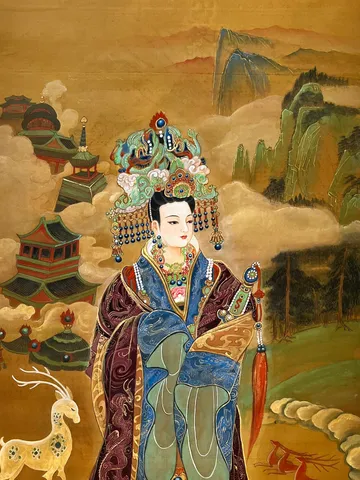
| Artist | Xiang Li 李湘 |
| Medium | Chinese watercolor on silk, hand-painted on hand-cut silk |
| Orientation | Horizontal composition |
| Painted | 2015 |
| Subjects | Two empresses — both consorts of Emperor Ruizong |
| Collection | The Chinese Empresses Collection |
| Availability | Original held by the artist · Prints available |