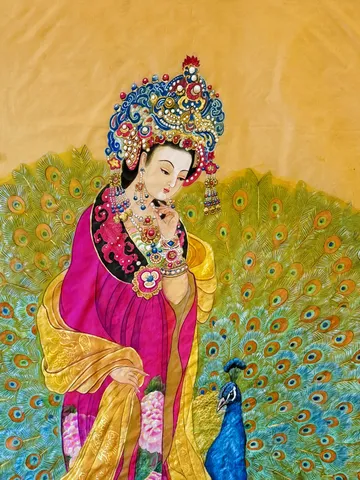
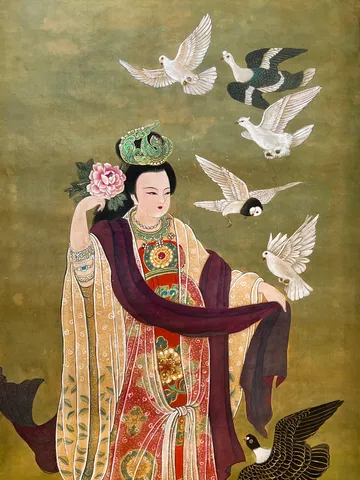
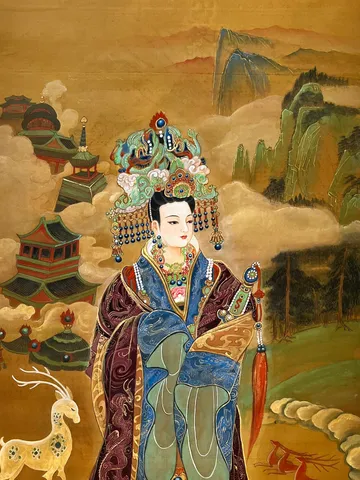
Emperatriz Ruizhen (Shen) y emperatriz Zhenyi (Dugu)
Conoce a Emperatriz Ruizhen (Shen) y emperatriz Zhenyi (Dugu) en la colección Emperatrices chinas de Xiang Li y explora su contexto histórico y sus vínculos con las mujeres de la China imperial.
沈氏 · 独孤氏
“Two Empty Graves”
One was taken prisoner when An Lushan sacked the capital, found alive, left behind, and lost again — her son searched for twenty-six years. The other died loved, and the emperor kept her coffin in the palace for three years because he would not put her in the ground.
Their Story
Emperor Daizong never appointed an empress. He had two women who mattered, and he lost both of them in ways that left nothing to bury.
Consort Shen — Empress Ruizhen
She was given to Li Chu — the future Daizong — while he was still Prince of Guangping, and she bore his eldest son in 742.
In 756 An Lushan’s army took Chang’an. The imperial family fled west; the palace women who could not be moved fast enough were rounded up and sent east to Luoyang as prisoners. She was among them.
The following year her husband commanded the army that retook Luoyang. He found her there, alive, in the rebel-held palace — and then, because the campaign was still running and the situation was unstable, he left her at Luoyang and marched on.
In 759 Luoyang fell again.
When it was recovered a second time she was not there, and no one could say what had become of her.
Her son Dezong came to the throne in 779 and spent the next twenty-six years looking for his mother. He established an office for it. He sent officials into every province. Women came forward claiming to be her — one was a former palace nurse who knew enough details to be convincing for a while, and when she was exposed the court expected an execution.
I would rather be deceived a hundred times than let one chance of finding her go by.
Emperor Dezong, pardoning a woman who had falsely claimed to be his lost mother — Zizhi Tongjian, ch. 226
She was never found. In 805, on the day his own reign ended, the search was formally closed. She was posthumously made Empress Ruizhen and buried with full imperial rites — a soul-summoning burial, a coffin containing her clothes, and nothing else.
Consort Dugu — Empress Zhenyi
She was the daughter of an officer of the imperial guard, she entered the palace after the rebellion, and Daizong loved her in a way the histories find slightly embarrassing to record.
She bore him a son and a daughter and was made Noble Consort. He wanted to make her empress; the court would not have it, on the usual grounds about her family.
She died in 775, and he could not do it.
He would not have her buried. Her coffin was kept in the palace — in the Neidian, where he could go to it — and it stayed there while officials submitted memorial after memorial pointing out that this was not permissible, that the rites required interment, that the dead must go into the ground.
It stayed there for three years.
He gave in eventually and had her buried at Zhuangling, with the posthumous title Empress Zhenyi. He died the following year and was interred beside her.
A note on the sources — and a correction
Correction: the earlier version of this page ran the heading “Empress Ruizhen” over a biography of Consort Dugu. They are two different women. Dugu is Empress Zhenyi; Shen is Empress Ruizhen. Xiang Li’s own file name for the painting — Dugu + Ruizhen — correctly treats them as a pair, and the two names have been separated here.
Consort Shen’s disappearance is exceptionally well documented for a Tang consort, because the search itself generated official paperwork for a quarter of a century. The three-year coffin is recorded plainly in both Tang histories, in the form of the memorials objecting to it.
- Liu Xu et al., Jiu Tang Shu (Old Book of Tang), ch. 52 — 945 CE
- Ouyang Xiu et al., Xin Tang Shu (New Book of Tang), ch. 77 — 1060
- Sima Guang, Zizhi Tongjian, ch. 220–236 — 1084
The Emperor
Emperor Daizong of Tang 唐代宗
Li Yu 李豫 · 726 – 779 · reigned 762 – 779
The eldest son of Suzong, and the general who actually retook Chang’an and Luoyang from An Lushan’s rebels. He came to the throne in 762 in the middle of a palace coup — Empress Zhang had summoned him to be arrested, and the eunuch Li Fuguo intercepted him at the gate.
He ended the rebellion in 763, and then spent the rest of his reign discovering that it had not really ended. The surrendered rebel commanders kept their armies and their provinces, and the north-east became a set of hereditary military governorships that Chang’an could not tax or control. Every subsequent Tang emperor inherited that problem.
He never appointed an empress. The two women on this page are the reason.
See also: Empress Liu and Empress Dou — the other Tang empresses buried without a body.
Connections
- The empress who tried to stop him Empress Zhang (Suzong) — who summoned Daizong to the palace in 762 to have him seized, and was killed for it.
- Consort Shen’s son’s wife Empress Wang (Dezong) — married to the emperor who spent his reign searching.
- The same ending Empress Liu and Empress Dou — killed by Wu Zetian in 693 and buried in secret; Xuanzong also searched, also failed, and also buried an empty coffin.
- What she lived through Emperor Xuanzong — the An Lushan rebellion began in his reign and cost Consort Shen her life.
About this Portrait
| Artist | Xiang Li 李湘 |
| Medium | Chinese watercolor on silk, hand-painted on hand-cut silk |
| Dimensions | approx. 36 × 72 inches (91 × 183 cm) |
| Painted | 2016 |
| Subjects | Two consorts of Emperor Daizong, both posthumously empresses |
| Collection | The Chinese Empresses Collection |
| Availability | Original held by the artist · Prints available |