Emperatriz Wang
Emperatriz Wang: consulta esta página de Emperatrices chinas en Xiang Li Art. El contenido principal está en inglés; la traducción completa está pendiente.
王皇后
“The Purple Coat”
She helped him seize the throne in two separate coups, and lost him because she could not have a child. When she felt it slipping she reminded him that her father had once sold his coat to buy flour for his birthday noodles. He wept — and deposed her two years later.
Her Story
She married Li Longji years before anyone imagined he would be emperor, and she was there for both of the coups that made him one.
In 710 he went over the palace wall with the Wanqi guards to destroy Empress Wei. In 713 he moved again, against his own aunt Princess Taiping. The Old Book of Tang records that Empress Wang took part in the planning of both, and that she was, in the phrase used, of great assistance.
She was made empress in 712. She had no children, and she never did.
By the early 720s Xuanzong’s attention had gone entirely to Consort Wu — a great-niece of Wu Zetian, which was awkward for everyone — who had borne him several children and was being spoken of as the next empress. Empress Wang could feel the ground going.
What she said to him then is the reason anyone remembers her.
She asked whether he had forgotten her father. Whether he remembered that when they were young and had nothing, and his birthday came, her father had taken off his purple coat and traded it for a bushel of flour, so that there would be noodles for him on the day.
Does Your Majesty not remember my father — how he took off his purple coat and traded it for a bushel of flour, so that you might have noodles on your birthday?
Empress Wang to Emperor Xuanzong — Jiu Tang Shu, ch. 51
Xuanzong wept, and for a while nothing more was said about deposing her.
It did not hold. In 724 her brother Wang Shouyi, trying to help, brought in a monk who cut a piece of wood from a thunder-struck tree, carved on it the names of heaven and earth and the emperor, and told her to wear it — it would give her a son, and, the charm said, she would be as Wu Zetian had been.
That last part was the end of her. It was discovered, and it was not merely superstition but a written comparison to the woman who had taken the throne. Her brother was ordered to kill himself. She was deposed and reduced to commoner, and she died in the inner palace a few months later, in 725.
The court’s reaction is unusual and worth recording: the histories say the palace mourned her, that people wept openly, and that Xuanzong himself came to regret it. He never made Consort Wu empress either — the officials blocked it on the grounds of her family — and after Consort Wu died he took her son’s wife, Yang Guifei, and never made her empress either.
So for the remaining thirty-one years of the longest reign in Tang history, the position simply stayed empty.
And the reign itself divides exactly at the point she left it. The years before are the Kaiyuan era — the summit of Chinese civilisation by most measures, with Li Bai and Du Fu writing, the population at its height, and the capital the largest city on earth. The years after are the slow slide into An Lushan’s rebellion, thirty million dead or displaced, and a dynasty that never recovered.
There is no causal link. It is simply where the line falls.
A note on the sources
The talisman case is well documented and was treated as a genuine legal matter rather than a pretext — which does not mean it was not also convenient. The detail that mattered legally was not the charm itself but the inscription comparing her to Wu Zetian, twenty years after Wu’s death and with the memory still raw at court.
The purple coat is the kind of anecdote that survives because someone repeated it, and it is recorded in the Tang histories without qualification. It is also the only surviving line of her own speech.
- Liu Xu et al., Jiu Tang Shu (Old Book of Tang), ch. 51 — 945 CE
- Ouyang Xiu et al., Xin Tang Shu (New Book of Tang), ch. 76 — 1060
- Sima Guang, Zizhi Tongjian, ch. 210–212 — 1084
- Denis Twitchett (ed.), The Cambridge History of China, Vol. 3 — 1979
The Emperor
Emperor Xuanzong of Tang 唐玄宗
Li Longji 李隆基 · 685 – 762 · reigned 712 – 756
Grandson of Wu Zetian, and the man who ended the thirty years of coups she had set in motion — by mounting two of his own, at twenty-five and twenty-eight.
The first half of his reign is the high-water mark of the Chinese empire. Forty-three years, the longest in Tang history: taxes reformed, the bureaucracy cleaned out, the frontier held from Korea to the Oxus, the capital at two million people, and Li Bai and Du Fu writing at the same time in the same city.
The second half is the catastrophe. He grew bored of governing, handed the state to Li Linfu and then to Yang Guozhong, and let a frontier general accumulate a third of the empire’s armies. In 755 An Lushan marched on the capital. Xuanzong fled toward Sichuan, and at the Mawei post station his own escort refused to go further until Yang Guifei was dead. He gave her to them. He abdicated within weeks and lived six more years as a retired emperor in a palace he was not allowed to leave.
See also: Emperor Xuanzong.
Connections
- The empress he overthrew Empress Wei — killed in the 710 coup that Empress Wang helped plan.
- Her rivalConsort Wu — Wu Zetian’s great-niece, who displaced her and was never allowed the title either.
- The woman who came afterYang Guifei — the most famous consort in Chinese history, never empress, killed by the imperial escort at Mawei in 756.
- Her successor Empress Zhang — married to Xuanzong’s son Suzong, and the first empress the Tang appointed in thirty-three years.
About this Portrait
| Artist | Xiang Li 李湘 |
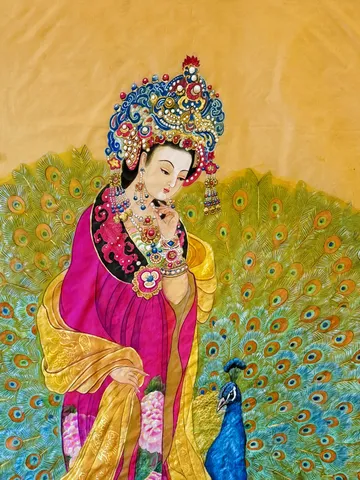
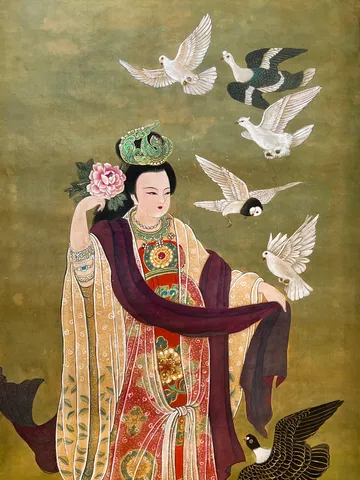
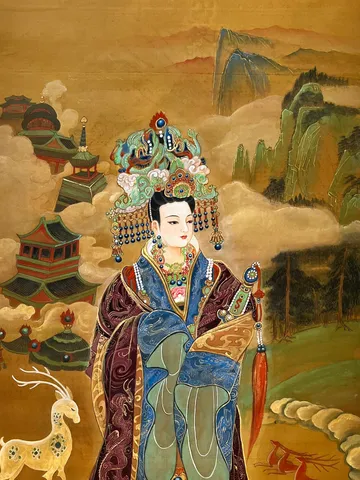
| Medium | Chinese watercolor on silk, hand-painted on hand-cut silk |
| Orientation | Horizontal composition |
| Painted | 2015 |
| Subject | Empress Wang, first consort of Emperor Xuanzong |
| Collection | The Chinese Empresses Collection |
| Availability | Original held by the artist · Prints available |