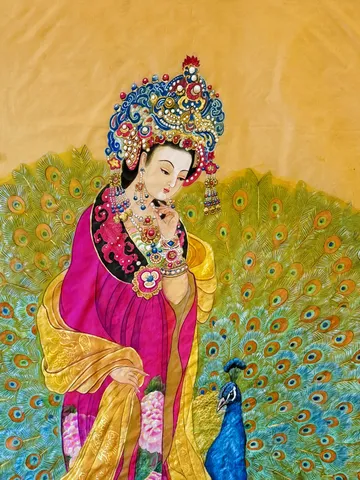
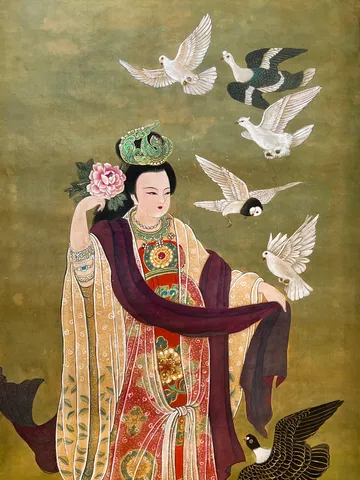
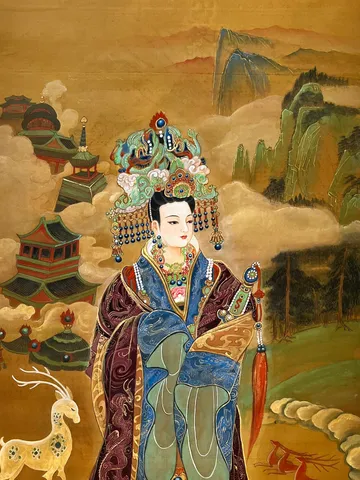
Emperatriz Wei
En 684 Zhongzong, recién en el trono, propuso hacer canciller a su suegro — el padre de la Emperatriz Wei. Un ministro se opuso. Él respondió con enfado que podía
韦皇后
“Fourteen Years at Fangzhou”
She spent fourteen years in exile talking her husband out of suicide every time a messenger arrived. He promised her that if he ever got the throne back she could do as she liked — and he kept the promise, and it killed them both.
Her Story
Her husband was emperor for six weeks.
In 684 Zhongzong, newly on the throne, proposed making his father-in-law — Empress Wei’s father — chancellor. A minister objected. He snapped that he could give the whole empire away if he chose, and what business was it of anyone’s. His mother deposed him within days.
They were sent to Fangzhou, a remote posting in the mountains, and they stayed there fourteen years.
This is the part of her life that makes the rest comprehensible. Wu Zetian was systematically eliminating the Tang imperial clan in those years, and every time a messenger arrived from the capital Zhongzong assumed it was the order to kill himself. The Zizhi Tongjian records that he several times prepared to do it on the spot, and that each time it was his wife who stopped him.
Her argument was not comforting. She told him that fortune and misfortune alternate, that the worst that can happen is death, and that there was no need to be in a hurry about it.
Fortune and misfortune follow upon each other. At worst it is death. Why be in such haste?
Empress Wei to Zhongzong in exile at Fangzhou — Zizhi Tongjian, ch. 205
He promised her that if he ever got the throne back, she could do whatever she liked and he would not interfere.
In 705 he got it back, and he kept the promise absolutely.
She sat behind a screen at court while he held audience — the same arrangement his mother had used. Her relatives filled the government. Wu Sansi, Wu Zetian’s nephew and reportedly Empress Wei’s lover, ran policy. Their daughter Princess Anle sold official appointments openly, submitting the paperwork with the name left blank for the buyer to fill in, and petitioned to be made crown princess — heir to the empire in her own right, which had no precedent even under Wu Zetian.
In 707 the actual crown prince, who was another woman’s son and was being told daily that he would not inherit, took the palace guard and killed Wu Sansi in his house. He then marched on the palace, hesitated at the gate, and his troops changed sides. He was killed the same night.
Zhongzong died suddenly in the summer of 710.
The histories say Empress Wei and Princess Anle poisoned him with cakes — the mother wanting to rule as Wu Zetian had, the daughter wanting to be named heir. Modern historians are sceptical; he was fifty-five, unwell, and the accusation was written by the people who overthrew her. What is certain is that she concealed the death for several days, brought her family’s troops into the capital, and then installed a fifteen-year-old nephew of her husband’s as emperor with herself as regent.
She lasted seventeen days.
On the twenty-first of July, Wu Zetian’s daughter Princess Taiping and Wu Zetian’s grandson Li Longji came over the palace wall with the Wanqi guards. Empress Wei ran for the guards’ camp and was cut down by the soldiers she was running to. Princess Anle was killed in her own rooms, at her mirror, painting her eyebrows.
Li Longji put his father on the throne, and then took it himself two years later as Emperor Xuanzong, and gave China the Kaiyuan era — the summit of the entire dynasty.
Empress Wei is the third woman in thirty years to have tried to do what Wu Zetian did. She is remembered as a grotesque, and the fourteen years at Fangzhou — when she talked a frightened man out of killing himself, over and over, in a house at the edge of the empire — are usually left out.
A note on the sources
Everything written about Empress Wei was written under Emperor Xuanzong, who came to the throne by killing her, and it shows. The poisoned cakes in particular should be treated with caution — it is the standard accusation, it appears without a named witness, and it was politically necessary for the men who had just stormed the palace. Her nepotism and the sale of offices are better attested and were probably as bad as described.
- Liu Xu et al., Jiu Tang Shu (Old Book of Tang), ch. 51 — 945 CE
- Ouyang Xiu et al., Xin Tang Shu (New Book of Tang), ch. 76 — 1060
- Sima Guang, Zizhi Tongjian, ch. 203–209 — 1084
- Denis Twitchett (ed.), The Cambridge History of China, Vol. 3: Sui and T’ang China — 1979
The Emperor
Emperor Zhongzong of Tang 唐中宗
Li Xian 李显 · 656 – 710 · reigned 684, and 705 – 710
The third son of Wu Zetian and Gaozong, and the only emperor in Chinese history to be deposed by his own mother and then succeed her.
His first reign lasted six weeks and ended because he said out loud that he could give the empire to his father-in-law if he wanted. Fourteen years of exile followed, then seven more back at court as his mother’s heir-in-waiting under permanent threat, and then the throne again at forty-nine.
He had been frightened for twenty-one years, and it defined how he governed. He gave his wife everything, refused to check his daughter, and let the men who had restored him be driven out one by one. He died in 710, aged fifty-five, and the dynasty spent the next two years in open street fighting between his relatives.
See also: Emperor Zhongzong.
Connections
- Her mother-in-law Wu Zetian — who deposed her husband, exiled them both for fourteen years, and whose career Empress Wei then tried to repeat.
- The empress who came before Empress Wang — destroyed by the same woman, fifty years earlier.
- Her successor Empress Wang (Xuanzong) — married to Li Longji, the young man who came over the wall and killed her.
- The comparison Empress Yan Ji of the Han — who also concealed an emperor’s death, installed a puppet, and lasted a matter of months.
About this Portrait
| Artist | Xiang Li 李湘 |
| Medium | Chinese watercolor on silk, hand-painted on hand-cut silk |
| Dimensions | approx. 36 × 72 inches (91 × 183 cm) |
| Painted | 2014 |
| Subject | Empress Wei, consort of Emperor Zhongzong |
| Collection | The Chinese Empresses Collection |
| Availability | Original held by the artist · Prints available |