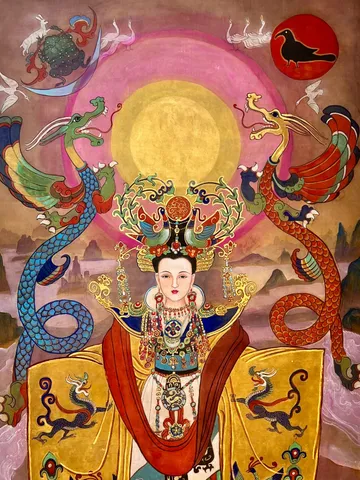
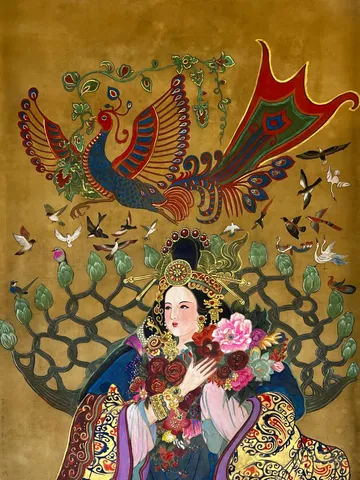
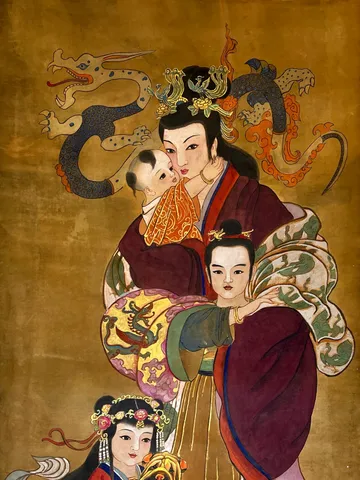
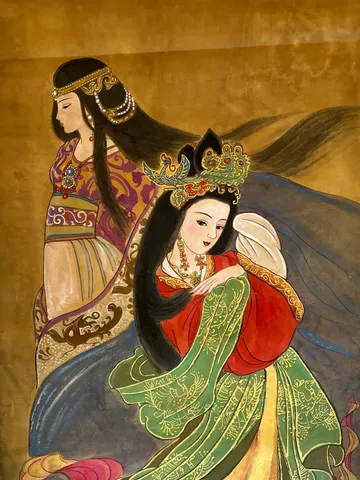
Emperatriz Guanglie (Yin Lihua) y Guo Shengtong
Conoce a Emperatriz Guanglie (Yin Lihua) y Guo Shengtong en la colección Emperatrices chinas de Xiang Li y explora su contexto histórico y sus vínculos con las mujeres de la China imperial.
阴丽华 · 郭圣通
“The One That Ends Well”
One wife he had wanted since boyhood, one he acquired with a treaty. She was offered the title and refused it for fifteen years — and when the other was finally deposed, nobody was poisoned, confined or destroyed. It happened once in four hundred years of Han.
Their Story
Before he was anyone, Liu Xiu said what he wanted from life. It has been quoted for two thousand years because it is so unimperial:
To serve, one should be Colonel of the City Gates. To marry, one should marry Yin Lihua.
To serve, one should be Colonel of the City Gates. To marry, one should marry Yin Lihua.
Liu Xiu, before he was Emperor Guangwu — Hou Hanshu, ch. 10
A middling police command and a particular girl from his home district. He was a farmer with a distant claim to the fallen Han house, and those were his ambitions.
He got her. In 23 CE, after winning the Battle of Kunyang against enormous odds, he married Yin Lihua. She was eighteen.
Within a year he married someone else as well. The war against the usurper Wang Mang was not going to be won by love, and Liu Xiu needed the armies of the north. Guo Shengtong was the niece of a regional warlord whose cavalry he could not do without, and the marriage bought them.
So there were two wives: one he had wanted since boyhood, one he had acquired with a treaty. In 25 CE he took the throne as Emperor Guangwu and restored the Han, and in 26 CE he had to choose an empress.
He wanted Yin Lihua. She refused.
Her stated reason was that she had no son yet and Guo Shengtong did, and that the succession mattered more than her position. It may also have been simple arithmetic — the northern armies were still needed. Either way she declined the highest rank available to a woman in the empire and proposed her rival for it. Guo Shengtong became empress, and her son was made crown prince.
They then lived alongside each other for fifteen years, and the histories record no poisonings, no witchcraft accusations, no dead infants. After the catalogue of the Western Han, the silence is startling.
In 41 CE Guangwu changed his mind. Guo Shengtong was deposed — the given reason was resentment and complaint, which in practice meant the political need for her family had passed — and Yin Lihua finally became empress, fifteen years after refusing.
And then nothing bad happened to anyone.
Guo Shengtong was not confined, not accused of sorcery, not ordered to drink poison. She was made Queen Dowager of Zhongshan and went to live in her son’s kingdom with full honours. Her brother was promoted. Her family kept their titles and her nephews were given offices. She died in 52 CE, eleven years later, and was buried with the rites of a queen.
Her son Liu Jiang, seeing the way things were going, asked repeatedly to be relieved of the position of crown prince. The request was granted, he was made Prince of Donghai, and he lived out a comfortable life. Yin Lihua’s son became Emperor Ming.
Yin Lihua was empress for sixteen years and empress dowager for seven more, and she used the position for almost nothing. She refused titles for her brothers. When Guangwu wanted to enfeoff her relatives she talked him out of it. Her family produced no marquesses in her lifetime and no faction after it — which, given that the Western Han had just been ended by exactly that mechanism, was the most consequential thing she ever did.
She died in 64 CE and was buried with him.
It is the one page in this collection where the reader can stop bracing. Two women who were placed in competition by a war, and who both survived it, and whose children both lived. It happened once in four hundred years of Han.
A note on the sources
The Hou Hanshu was compiled in the fifth century, four hundred years after these events, drawing on earlier court records now lost. It is unusually warm toward both women — Yin Lihua for her modesty, Guo Shengtong for accepting her demotion without complaint. Warmth in a Chinese official history is itself a kind of evidence: there was no faction left that needed either of them condemned.
- Fan Ye, Hou Hanshu (Book of the Later Han), ch. 10 — the Biographies of the Empresses — 5th century CE
- Sima Guang, Zizhi Tongjian — 1084
The Emperor
Emperor Guangwu of Han 汉光武帝
Born Liu Xiu 刘秀 · 5 BCE – 57 CE · reigned 25 – 57 CE
A farmer with a distant claim to the imperial house, who won the civil wars after Wang Mang’s collapse and restored the Han — moving the capital east to Luoyang and beginning what is called the Eastern Han. He is remembered for winning the Battle of Kunyang against odds of roughly forty to one, and for governing afterwards with unusual restraint: he reduced taxes, freed slaves, and repeatedly refused proposals for foreign wars.
Why he matters to their story: he made both marriages and he chose between them, and he did it without destroying anyone. Deposing an empress in the Han normally ended in poison. He gave his a kingdom instead.
Connections
- Her daughter-in-law Empress Ma (Empress Mingde) — married Yin Lihua’s son, Emperor Ming, and carried her example forward by refusing titles for her own family.
- Successors Empress Dou (Zhangde) and Empress Yin and Deng Sui — the Eastern Han empresses who followed, and under whom the consort-clan politics returned in force.
- The dynasty before Empress Xiaoping — the last empress of the Western Han, dead in the fire at Chang’an two years before Guangwu took the throne.
About this Portrait
| Artist | Xiang Li 李湘 |
| Medium | Chinese watercolor on silk, hand-painted on hand-cut silk |
| Dimensions | 36 × 72 inches (91 × 183 cm) |
| Painted | 2013 |
| Subjects | Two empresses — both consorts of Emperor Guangwu |
| Collection | The Chinese Empresses Collection |
| Availability | Original held by the artist · Prints available |