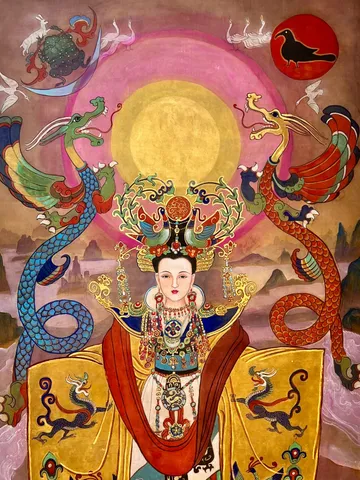
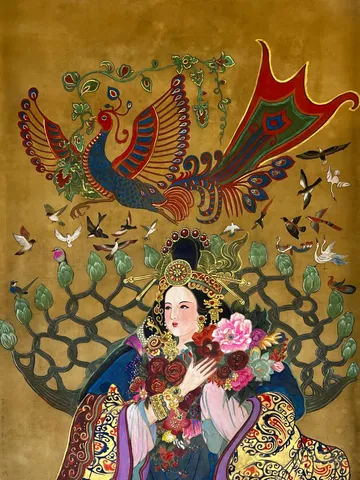
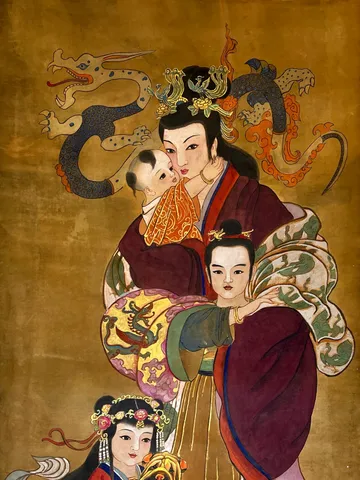
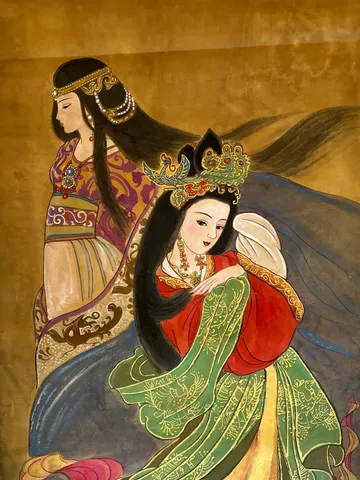
Emperatriz Xiaoping (emperatriz Wang)
Conoce a Emperatriz Xiaoping (emperatriz Wang) en la colección Emperatrices chinas de Xiang Li y explora su contexto histórico y sus vínculos con las mujeres de la China imperial.
王皇后 · 孝平皇后
“Ashamed to Face the Han”
The last empress of the Western Han, and the daughter of the man who ended it. She spent fourteen years refusing her father’s dynasty, and when it fell she walked into the fire rather than be rescued by her husband’s.
Her Story
She was the last empress of the Western Han, and her father was the man who ended it.
Wang Mang married his daughter to Emperor Ping in 4 CE. She was about eleven, the emperor about twelve. The reason was the same reason that had produced most of the marriages on these pages: whoever held the empress held the succession. The difference was that her father was not merely positioning a family — he was preparing to take the throne himself.
Two years later Emperor Ping was dead at fourteen. The Hanshu records that Wang Mang had presented him with poisoned wine. Whether or not that is true, it was believed, and it was believed by his widow.
She was thirteen. She had been empress for two years and would be a widow for seventeen.
Her father installed an infant as nominal emperor, made himself regent, and in 9 CE declared his own dynasty — the Xin. The Western Han ended after two hundred and fifteen years, and the imperial seal was taken from Wang Zhengjun, his aunt, who threw it at the floor rather than hand it over.
His daughter did much the same, more quietly, for the rest of her life.
Wang Mang gave her a new title — Illustrious Princess of the Imperial Clan — and tried to arrange a second marriage, since a young widow attached to the previous dynasty was politically useless and a remarried daughter could be useful again. She refused. She claimed illness whenever suitors were sent. She would not receive officials of her father’s dynasty, would not use its titles, and would not attend its ceremonies.
She lived inside the Xin dynasty for fourteen years as a silent, permanent objection to it, and she was the emperor’s daughter, so nothing could be done about her.
In 23 CE the Xin collapsed. Han loyalist armies broke into Chang’an, the palace complex was set alight, and Wang Mang was killed in the fighting — his body torn apart by soldiers.
She was nineteen. The rebels were restoring her husband’s dynasty, which meant she was in one sense being rescued. But she was also the usurper’s daughter, and she said that she could not bring herself to face the house of Han.
She walked into the fire.
I am ashamed to face the house of Han.
Recorded as her words before entering the burning palace, 5 October 23 CE
The Hanshu — written under the restored Han, by historians with every reason to condemn everything connected to Wang Mang — records her death without a word against her. She is one of the very few people associated with the usurpation whom the official history treats gently, and the reason is plain enough: she had spent her whole adult life refusing what her father had done, and she settled the account herself.
The Western Han begins with Lü Zhi, who took an empire and held it by force for fifteen years and was called a monster for it. It ends with a nineteen-year-old who was handed one and would not touch it.
A note on the sources
The Hanshu was written under the restored Han and is relentlessly hostile to Wang Mang — his biography is placed among the usurpers and rebels rather than the emperors. That it treats his daughter with sympathy is therefore meaningful rather than conventional. Her personal name was never recorded.
- Ban Gu, Hanshu (Book of Han), ch. 97 — c. 111 CE
- Ban Gu, Hanshu, ch. 99 — the Biography of Wang Mang
- Sima Guang, Zizhi Tongjian — 1084
The Emperor
Emperor Ping of Han 漢平帝
Born Liu Jizi 劉箕子, later Liu Kan 劉衎 · 9 BCE – 6 CE · reigned 1 BCE – 6 CE
Chosen at eight because he was young enough to be controlled and distant enough from the throne to have no faction. Wang Mang barred the boy’s mother and her relatives from the capital so that no rival consort clan could form. He died at fourteen, and the Hanshu says he was poisoned.
Why he matters to her story: the marriage lasted two years and she mourned him for seventeen. Her refusal to remarry, to use her father’s titles, or to acknowledge his dynasty was, as far as the record shows, loyalty to a boy she was married to at eleven.
Connections
- Great-aunt Empress Xiaoyuan (Wang Zhengjun) — whose sixty-one years at the centre of the Han gave the Wang family the position her father used. Both women ended by refusing him.
- Predecessor Empress Fu — demoted and driven to suicide by Wang Mang two years before this marriage.
- Predecessor Empress Zhao Feiyan — given the same sentence on the same day as Empress Fu.
- The other end of the dynasty Empress Lü Zhi — who seized an empire and held it. Two hundred and fifteen years apart, and the exact inverse.
About this Portrait
| Artist | Xiang Li 李湘 |
| Medium | Chinese watercolor on silk, hand-painted on hand-cut silk |
| Dimensions | 36 × 79 inches (91 × 201 cm) |
| Painted | 2012 |
| Collection | The Chinese Empresses Collection |
| Availability | Original held by the artist · Prints available |