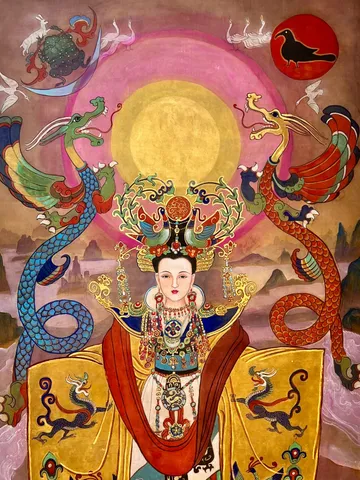
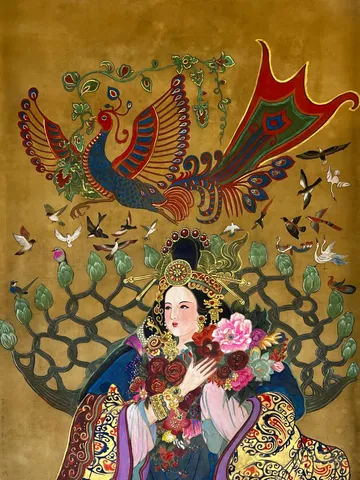
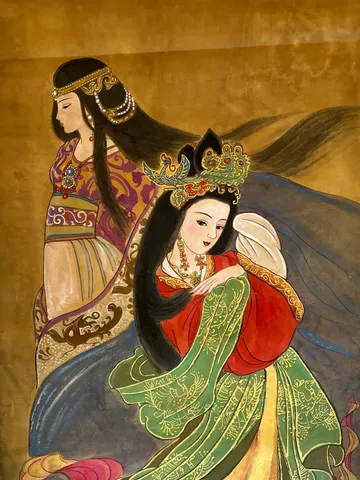
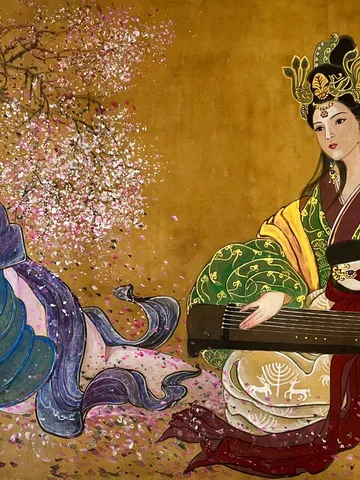
Emperatriz Dou (emperatriz Xiaowen)
Emperatriz Dou (emperatriz Xiaowen): consulta esta página de Emperatrices chinas en Xiang Li Art. El contenido principal está en inglés; la traducción completa está pendiente.
竇皇后
“The Clerk’s Mistake”
A palace maid sent to the wrong prince by an administrative error. She became empress, then the most powerful woman in the empire for fifty years, and held the Han to Daoism until the day she died.
Her Story
She owed the throne to a clerical error.
Dou Yifang entered the palace as an attendant under Empress Lü Zhi. When Lü Zhi decided to distribute surplus palace women among the imperial princes, five were allotted to each. Dou came from Guanjin, near the kingdom of Zhao, and she asked the eunuch handling the list to enter her name for Zhao so that she might be closer to home. He agreed, then forgot, and wrote her down for Dai instead — a poor frontier kingdom in the north.
She wept and refused to go. She was made to go anyway.
The Prince of Dai was Liu Heng, a minor son of Emperor Gaozu, obscure enough that Lü Zhi had never bothered to have him killed. That obscurity was what saved him. When the Lü clan fell in 180 BCE and the ministers looked for a Liu prince with no dangerous relatives and no faction of his own, they chose Liu Heng. He became Emperor Wen — and the woman who had been sent to the wrong kingdom became empress of the Han.
Emperor Wen’s reign, with his son’s, is remembered as the Rule of Wen and Jing: the period when the Han recovered from the Qin and from civil war. Taxes were cut repeatedly and at one point suspended altogether. Mutilating punishments were abolished. The court spent almost nothing on itself. The governing philosophy was Huang-Lao — a Daoist school holding that the best ruler does least, and that an empire recovers when the state stops interfering with it.
Empress Dou was its most committed adherent, and after Wen died in 157 BCE she was the one who enforced it.
Her son became Emperor Jing and she became empress dowager. She required the emperor, the princes and the members of the Dou clan to study the Laozi. When a Confucian scholar named Yuan Gu dismissed the text in her presence as “the talk of servants,” she had him thrown into a pen with a wild boar. Emperor Jing quietly passed him a sharp blade so that he could kill the animal and survive.
She lost her sight at some point in these years. It changed nothing about her authority.
In 141 BCE Jing died and her grandson took the throne as Emperor Wu — the emperor who would remake China, expand it to its greatest extent, and install Confucianism as the ideology of the state for the next two thousand years. He was fifteen. His grandmother was Grand Empress Dowager, and she was not finished.
When Wu’s Confucian advisers Zhao Wan and Wang Zang began dismantling the Huang-Lao settlement in 139 BCE, Dou had them investigated on corruption charges. Both killed themselves in prison. Wu’s reform programme stopped where it stood and did not resume until she died in 135 BCE.
She held the line for six years against the most forceful emperor in Chinese history, and won every one of them. The Confucian revolution that defines the Han began the season after her funeral.
It is worth holding the two ends of her life together. A young woman weeps because a clerk has written the wrong kingdom beside her name, and is sent north against her will. Fifty-five years later, an emperor waits for her to die before he can govern the way he wants.
A note on the sources
Dou is unusual among early Han empresses in having a substantial record of her own, largely because her Huang-Lao politics put her in direct conflict with the Confucian scholars who later wrote the histories. Their accounts are not neutral — the boar story is told to make her look brutal — but the conflict itself is well attested.
- Sima Qian, Shiji (Records of the Grand Historian), ch. 49 — c. 94–91 BCE
- Ban Gu, Hanshu (Book of Han), ch. 97 — c. 111 CE
- Sima Guang, Zizhi Tongjian — 1084
The Emperor
Emperor Wen of Han 漢文帝
Born Liu Heng 劉恆 · 203 – 157 BCE · reigned 180 – 157 BCE
A minor son of Gaozu by a low-ranking consort, given the poor northern kingdom of Dai and forgotten. That obscurity kept him alive through Lü Zhi’s purges and made him the safe choice when the ministers who destroyed the Lü clan needed an emperor with no powerful in-laws. He proved one of the most restrained rulers in Chinese history — cutting taxes, abolishing mutilating punishments, and refusing to build.
Why he matters to her story: the light-handed Daoist government Dou spent the rest of her life defending was built during his reign. She outlived him by twenty-two years and treated it as something to be protected.
Connections
- Predecessor Empress Lü Zhi — the woman who assigned her to a prince in the first place. Dou rose in the court Lü Zhi built and inherited the Huang-Lao policy she had begun.
- Daughter-in-law Empress Wang Zhi — mother of Emperor Wu, who came into her own only as Dou’s power ended.
- Grandson’s empresses Empress Chen Jiao and Empress Wei Zifu — Emperor Wu’s consorts, whose careers began only after Dou’s death.
About this Portrait
| Artist | Xiang Li 李湘 |
| Medium | Chinese watercolor on silk, hand-painted on hand-cut silk |
| Dimensions | 36 × 72 inches (91 × 183 cm) |
| Painted | 2012 |
| Collection | The Chinese Empresses Collection |
| Availability | Original held by the artist · Prints available |