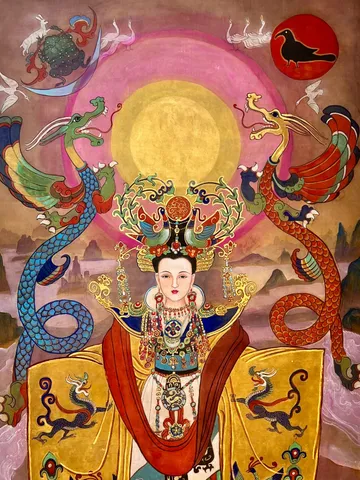
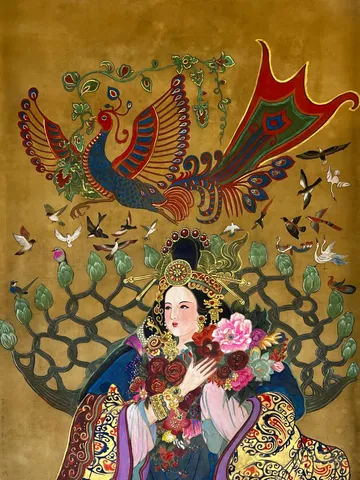
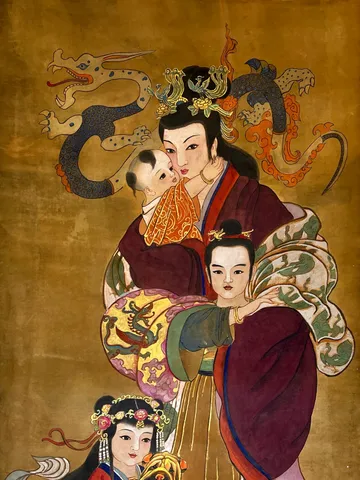
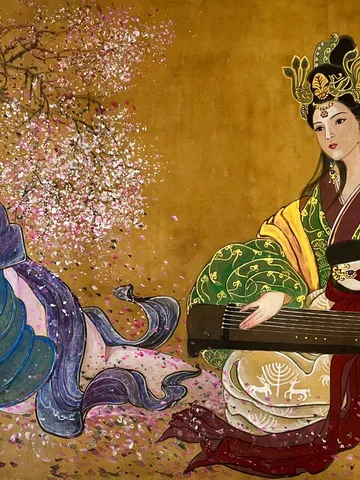
Emperatriz Bo y emperatriz Wang Zhi
Emperatriz Bo y emperatriz Wang Zhi: consulta esta página de Emperatrices chinas en Xiang Li Art. El contenido principal está en inglés; la traducción completa está pendiente.
薄皇后 · 王娡
“The Deposed and the Divorced”
Emperor Jing’s two empresses, and two firsts in Chinese history. Bo was the first empress ever deposed. Wang Zhi was the first who had already been married to another man — and she became the mother of Emperor Wu.
Their Story
Emperor Jing had two empresses. The first was removed for having no children. The second had a child already — by another man — and became the mother of the greatest emperor of the Han.
Empress Bo was married to Liu Qi while he was still crown prince, and she was chosen for her surname. She was a relative of Grand Empress Dowager Bo, mother of Emperor Wen, and the marriage was arranged to keep the Bo clan close to the throne for another generation. It was a dynastic arrangement, and it was not a success. Jing never cared for her. The marriage produced no children.
When Grand Empress Dowager Bo died in 155 BCE, the only reason for the marriage died with her. Four years later, in 151 BCE, Jing deposed his empress. Childlessness was the official reason.
It had never been done before. Empresses had been murdered, confined, driven out when their clans fell — but no emperor had simply removed one because he no longer wanted her. Empress Bo is the first deposed empress in Chinese history, and every deposition that follows in this collection descends from the precedent she made by being unwanted. She died in 147 BCE, four years after losing the title, and almost nothing else about her is recorded.
Wang Zhi arrived by a stranger route. She was born to Zang Er, granddaughter of a king of Yan, and she was married young to a commoner named Jin Wangsun, with whom she had a daughter.
Then her mother had her fortune told, and was informed that Wang Zhi would bear an emperor. Zang Er went to her son-in-law and demanded her daughter back. Jin Wangsun refused; his wife was taken from him anyway, and sent into the crown prince’s household. The daughter, Jin Su, was left behind.
Wang Zhi bore Liu Qi four children. The fourth was a son, Liu Che, born on the day his father took the throne — a coincidence read at the time as an omen and by everyone since as the beginning of a reign.
But Liu Che was not the heir. The crown prince was Liu Rong, son of Consort Li, and Wang Zhi’s route to the throne ran through an alliance rather than an accident. Princess Liu Piao, the emperor’s formidable elder sister, had offered her own daughter Chen Jiao to Liu Rong; Consort Li refused. Wang Zhi accepted the same offer for her son. The princess then set about turning her brother against Consort Li, and did it thoroughly. Liu Rong was demoted in 150 BCE. Consort Li died soon afterwards, of grief or of something less natural.
Four months after Empress Bo was deposed, Wang Zhi became empress. Her son became crown prince, and in 141 BCE he became Emperor Wu — under whom the Han expanded to its greatest extent, opened the Silk Road, and adopted Confucianism as the ideology of the state.
She lived until 126 BCE, long enough to see her son become the ruler her mother had been promised. There is no record that she ever saw the daughter she left behind, though Emperor Wu is said to have found his half-sister Jin Su later and brought her to court.
Put side by side, the two women are a study in the same system from opposite ends. Bo was placed on the throne by her family name and removed when the name stopped mattering. Wang Zhi had no useful name at all — she had been someone’s wife in a commoner household — and she climbed by reading the court exactly right. One was chosen and discarded. The other chose.
A note on the sources
Empress Bo has almost no record: she appears in the histories mainly as the precedent for depositions that came later. Wang Zhi has a fuller account, though it comes largely from Sima Qian, who was writing under her son and was later castrated on his orders — which is worth remembering when reading his portrait of the emperor’s family.
- Sima Qian, Shiji (Records of the Grand Historian), ch. 49 — c. 94–91 BCE
- Ban Gu, Hanshu (Book of Han), ch. 97 — c. 111 CE
- Sima Guang, Zizhi Tongjian — 1084
The Emperor
Emperor Jing of Han 漢景帝
Born Liu Qi 劉啟 · 188 – 141 BCE · reigned 157 – 141 BCE
Son of Empress Dou and Emperor Wen. His reign, with his father’s, is remembered as the Rule of Wen and Jing — low taxes, light government, and the recovery of the empire after the Qin. He also faced and crushed the Rebellion of the Seven States in 154 BCE, which ended the independence of the regional kingdoms and made the centralised empire his son inherited possible.
Why he matters to their story: both women held their position entirely at his discretion. He deposed one for not bearing children and elevated the other because she had borne the right one — and because his sister told him to.
Connections
- His mother Empress Dou — Grand Empress Dowager throughout Wang Zhi’s time as empress, and the real power at court until 135 BCE.
- Wang Zhi’s son’s wives Empress Chen Jiao and Empress Wei Zifu — Chen Jiao was the girl Wang Zhi accepted for her son in the alliance that won him the throne.
- Predecessor Empress Lü Zhi — Jing’s grandmother-in-law, and the woman who set the pattern of Han empresses ruling through their sons.
About this Portrait
| Artist | Xiang Li 李湘 |
| Medium | Chinese watercolor on silk, hand-painted on hand-cut silk |
| Dimensions | 36 × 72 inches (91 × 183 cm) |
| Painted | 2012 |
| Subjects | Two empresses — both consorts of Emperor Jing |
| Collection | The Chinese Empresses Collection |
| Availability | Original held by the artist · Prints available |