Guo Wei — Emperor Taizu of Later Zhou
Guo Wei — Emperor Taizu of Later Zhou: consulta esta página de Emperadores chinos en Xiang Li Art. El contenido principal está en inglés; la traducción completa está pendiente.
後周太祖
简体 后周太祖
“A common soldier who took the throne after the court killed his family”
The Later Han emperor had Guo Wei's entire household massacred while he was on campaign. He marched on Kaifeng, took the throne, and then governed better than anyone had in decades: taxes cut, corvée reduced, the worst of the military laws repealed. He left the state to an adopted son rather than a relative.
The Later Zhou's ten years are the foundation the Song was built on.
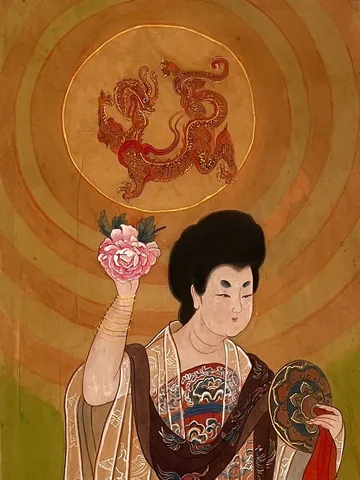
His wife had chosen him at a roadside inn when he was nobody, and the empresses of the Later Zhou share one silk with Empress Chai.
The empress of this reign
Painted on silk in gemstone mineral pigments by Xiang Li.
About this page
Written for this site to place Taizu's reign around the paintings. For the full biography, the dynastic histories and the scholarship behind them, start at Wikipedia.
Every Five Dynasties & Ten Kingdoms emperor
Later Liang
後梁 / 后梁 907 – 923| Reign | Emperor | Painted empresses |
|---|---|---|
| 907 – 912 | Taizu 後梁太祖 / 后梁太祖 Zhu Wen 朱溫 / 朱温 | |
| 912 – 913 | Zhu Yougui 朱友珪 Zhu Yougui 朱友珪 | — |
| 913 – 923 | Modi 後梁末帝 / 后梁末帝 Zhu Zhen 朱瑱 | — |
Later Tang
後唐 / 后唐 923 – 937| Reign | Emperor | Painted empresses |
|---|---|---|
| 923 – 926 | Zhuangzong 後唐莊宗 / 后唐庄宗 Li Cunxu 李存勗 | |
| 926 – 933 | Mingzong 後唐明宗 / 后唐明宗 Li Siyuan 李嗣源 | — |
| 933 – 934 | Min 後唐閔帝 / 后唐闵帝 Li Conghou 李從厚 / 李从厚 | — |
| 934 – 937 | Modi 後唐末帝 / 后唐末帝 Li Congke 李從珂 / 李从珂 | — |
Later Jin
後晉 / 后晋 936 – 947| Reign | Emperor | Painted empresses |
|---|---|---|
| 936 – 942 | Gaozu 後晉高祖 / 后晋高祖 Shi Jingtang 石敬瑭 | |
| 942 – 947 | Chudi 後晉出帝 / 后晋出帝 Shi Chonggui 石重貴 / 石重贵 | — |
Later Han
後漢 / 后汉 947 – 951| Reign | Emperor | Painted empresses |
|---|---|---|
| 947 – 948 | Gaozu 後漢高祖 / 后汉高祖 Liu Zhiyuan 劉知遠 / 刘知远 | |
| 948 – 951 | Yindi 後漢隱帝 / 后汉隐帝 Liu Chengyou 劉承祐 / 刘承祐 | — |