Emperatriz Zhou la Mayor, emperatriz Zhou la Menor (Tang del Sur)
Conoce a Emperatriz Zhou la Mayor, emperatriz Zhou la Menor (Tang del Sur) en la colección Emperatrices chinas de Xiang Li y explora su contexto histórico y sus vínculos con las mujeres de la China imperial.
周娥皇 · 周女英
“Sisters”
The elder rebuilt a piece of music that had been lost for two hundred years. She was dying of grief for her small son when she found out her fourteen-year-old sister had been in the palace with her husband, and turned her face to the wall. The sister became empress four years later.
Their Story
This is a story about music, a sister, a four-year-old, and the man who wrote it all down afterwards in poems that Chinese schoolchildren still learn.
Zhou Ehuang — the Elder
She married Li Yu at eighteen. She was a musician of serious accomplishment — she played the pipa well enough that the emperor gave her a legendary instrument as a gift, she designed a new dance, and she is credited with reconstructing the score of the Rainbow Skirt and Feathered Robe, the great Tang court composition that had been lost in the An Lushan rebellion two centuries earlier. She worked from a damaged fragment and rebuilt the rest.
She and Li Yu were, by every account including his own poetry, extremely happy.
In 964 their four-year-old son Zhongxuan died suddenly. She collapsed and did not recover.
And then, while she was dying, she discovered that her younger sister had been in the palace with her husband.
The girl was about fourteen and had come to court to visit her. The sources describe Zhou Ehuang turning her face to the wall and refusing to look at her again.
She died at twenty-nine. Li Yu wrote her a funerary text of over two thousand characters, signed it not with his imperial title but as the bereaved husband, and reportedly could not stand unaided at the burial.
Zhou Nüying — the Younger
She married him four years later, in 968, and became empress.
For seven years they held a court that was, in the middle of a collapsing kingdom, one of the most refined in Chinese history — and Li Yu wrote poems about her in it that are still in every anthology: the one about creeping to her lover in gold-threaded stockings, carrying her embroidered shoes in her hand.
In 975 the Song armies crossed the Yangtze and took Jinling. Li Yu surrendered and was taken north to Kaifeng, given the title Marquis of Violated Virtue, and kept there.
She went with him. The Song sources are discreet and the later ones are not: it was widely written that she was repeatedly summoned to the Song palace by Emperor Taizong, and that Li Yu knew.
In captivity he wrote the poems he is actually remembered for — not the courtly ones, the late ones. How much sorrow can one man hold? As much as a river of spring water flowing east.
How much sorrow can one man hold?
Li Yu, “Yu Meiren”, written in captivity at Kaifeng — the poem that got him killed, 978
As much as a whole river of spring water, flowing east.
The wine contained qianjizi — a poison that causes violent convulsions. He died that night, reportedly with his head bent back to his feet.
She survived him by a matter of months.
A note on the sources
Unusually for this collection, a great deal of the evidence here is the husband’s own writing. Li Yu’s funerary text for the elder sister survives, as do the poems about the younger — which is why we know things about this marriage that no dynastic history would have recorded.
The claim that the younger sister was summoned by the Song emperor comes from Song-era private writings rather than the official histories, and it may be gossip attaching itself to a defeated court. The poisoning of Li Yu is reported in several independent Song sources and is generally accepted.
- Ma Ling, Nan Tang Shu (History of the Southern Tang) — 12th century
- Lu You, Nan Tang Shu — 12th century
- Wang Zhi, Mo Ji — 11th century, for the poisoning
- Daniel Bryant, Lyric Poets of the Southern T’ang — UBC Press, 1982
The Emperor
Li Yu 李煜
937 – 978 · ruled the Southern Tang 961 – 976
He is the finest poet in the ci form the language has produced, and he was a catastrophic ruler, and the two facts are usually told as though the second explains the first.
He inherited a kingdom already paying tribute to the north, and governed it as a patron rather than a sovereign — the Southern Tang court under him was the centre of Chinese painting, calligraphy and poetry, and it was also disarmed, indebted and doomed. He dropped his imperial title and called himself merely the Lord of Jiangnan, hoping it would be enough.
It was not. The Song took Jinling in 975 and he was led north.
The poems he wrote in captivity changed Chinese literature. Before him the ci was a form for entertainers; after him it was the vehicle for the deepest personal feeling in the language, and every Song poet who followed wrote in his shadow.
He was poisoned on his forty-second birthday for a poem about missing his country.
Connections
- The northern court The empresses of the Later Zhou — Chai Rong took fourteen prefectures from the Southern Tang in 958.
- The dynasty that took them The Song empresses — Jinling fell in 975.
- Also of the Southern Tang Empress Song Fujin — wife of Li Bian, the founder, and Li Yu’s grandmother by marriage. (Her page is currently misfiled under the Jin dynasty and needs moving.)
- The comparison Empress Xianmu (Cao Jie) — the other consort who went into captivity with a deposed husband and outlived the dynasty.
About this Portrait
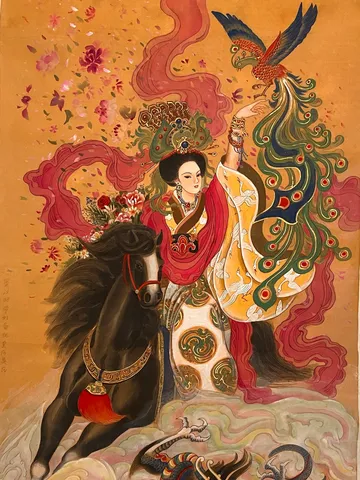
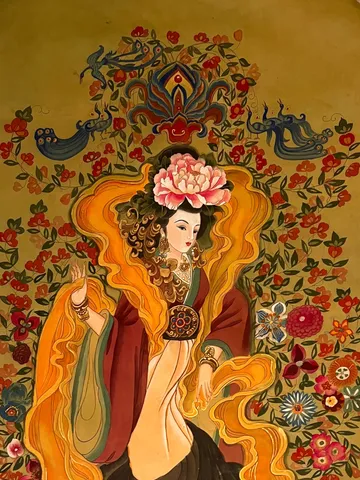
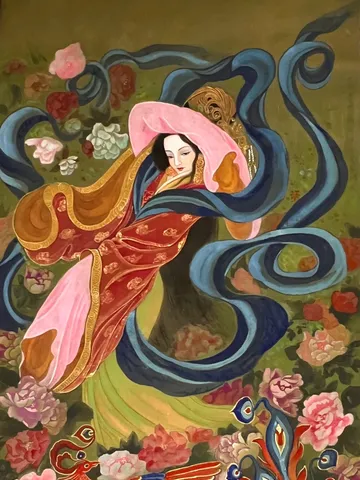
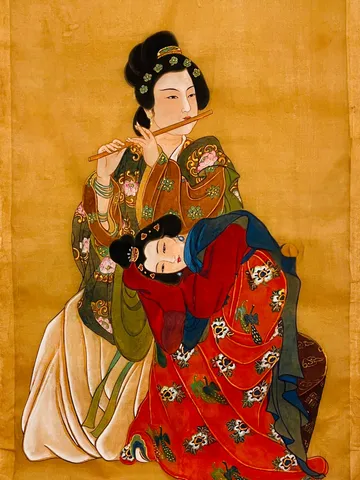
| Artist | Xiang Li 李湘 |
| Medium | Chinese watercolor on silk, hand-painted on hand-cut silk |
| Dimensions | approx. 36 × 72 inches (91 × 183 cm) |
| Painted | 2021 |
| Subjects | Two empresses — sisters, both consorts of Li Yu |
| Collection | The Chinese Empresses Collection |
| Availability | Original held by the artist · Prints available |