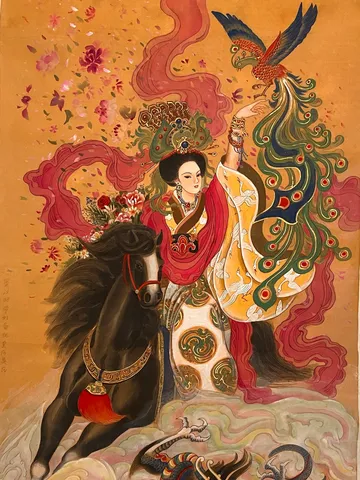
Emperatriz Liu (Tang Posterior)
Conoce a Emperatriz Liu (Tang Posterior) en la colección Emperatrices chinas de Xiang Li y explora su contexto histórico y sus vínculos con las mujeres de la China imperial.
刘皇后
“Three Silver Basins”
Taken from a sacked village at five, empress at about twenty-eight. When her father came to the palace gates to claim her she had him beaten and sent away. When the army came for its arrears she sent out three silver basins and said there was nothing more.
Her Story
She was five or six years old when soldiers took her. Her home village in Wei Prefecture was sacked, she was carried off with the plunder, and she ended up in the household of the Shatuo Turkic warlords who would become the Later Tang.
She grew up there and became the favourite of Li Cunxu — the greatest soldier of the age, a man who destroyed the Later Liang with a cavalry charge across a frozen river and who also wrote songs and performed on stage in his own palace under a stage name.
When he took the throne in 923 he wanted to make her empress. The court preferred another consort with a better claim. He did it anyway, in 924.
And then her father came to court.
An old man named Liu Shan presented himself at the palace gates, a village physician from Wei Prefecture, saying his daughter had been taken by soldiers twenty-odd years earlier and that he had heard she was now empress.
She had him beaten and driven away.
The reasoning was not cruelty in her own account of it: an empress of the Later Tang could not be the daughter of a country doctor. She had spent her life climbing out of exactly that, in a court where the Shatuo aristocracy already regarded her as unsuitable. To acknowledge him was to hand them the argument.
What she is actually condemned for is the money.
The dynasty was two years old and the army had not been paid. There was a mutiny brewing in the garrisons, and the ministers came to the palace and asked her to open the imperial treasury to cover the arrears — the treasury she personally controlled and had spent two years filling.
She refused. The chronicles record her sending out three silver basins and a few of her own children’s trinkets instead, and telling them there was nothing else.
She sent out three silver basins and some ornaments belonging to her children, and said that this was all there was.
On Empress Liu’s refusal to pay the army, 926 CE — Zizhi Tongjian, ch. 274
In the spring of 926 the garrisons rose. Li Cunxu marched out to face them, and one of his own commanders shot him with an arrow inside his palace at Luoyang; he died on the floor of a hall while the building burned around him, and a musician he had performed with piled instruments on the body and set light to them.
Empress Liu got out with her brother-in-law, took the treasure with her, cut off her hair and entered a convent at Taiyuan.
The new emperor sent men to her within weeks with an order to take her own life. She was about thirty.
The Later Tang lasted eleven more years.
A note on the sources
The Five Dynasties histories were written by Song scholars who needed the period to look like a lesson, and Empress Liu is one of the lessons — greed bringing down a dynasty in three years. That framing is doing work. The Later Tang collapsed because a Shatuo military elite had been welded onto a Chinese state without a functioning fiscal system, and no imperial treasury could have covered what the garrisons were owed.
The refusal is nonetheless attested in both Five Dynasties histories and in Sima Guang, and the detail of the three basins appears in all of them. The story of her father at the gate is in Ouyang Xiu, who plainly relished it.
- Xue Juzheng et al., Jiu Wudai Shi (Old History of the Five Dynasties), ch. 49 — 974
- Ouyang Xiu, Xin Wudai Shi (New History of the Five Dynasties), ch. 14 — c. 1073
- Sima Guang, Zizhi Tongjian, ch. 272–275 — 1084
The Emperor
Emperor Zhuangzong of Later Tang 后唐庄宗
Li Cunxu 李存勖 · 885 – 926 · reigned 923 – 926
A Shatuo Turk whose family had served the Tang for generations and taken its imperial surname. His father died leaving him three arrows and three enemies to destroy with them, and he destroyed all three.
He was, by common agreement, the finest field commander China produced in that century — he beat the Khitan, took the whole of the north, and finished the Later Liang in 923 by riding straight for Kaifeng while its army was elsewhere.
Then he stopped. He filled the court with actors and musicians, gave palace offices to performers, took the stage name Li Tianxia and appeared in his own productions, and let eunuchs and entertainers control access to him while the garrisons went unpaid.
He was killed in 926 by an arrow from one of his own guard commanders, and a musician he had acted alongside burned the body. Ouyang Xiu used his reign as the central example in his essay on how states are lost — not by hardship, but by ease.
Connections
- The dynasty he destroyed Empress Zhang Hui of the Later Liang.
- What came next Empress Li (Later Jin) — daughter of the general who succeeded him, and married to the man who gave away the north.
- The comparison Empress Lü Zhi — the other empress from nothing whose name the historians turned into a warning.
About this Portrait
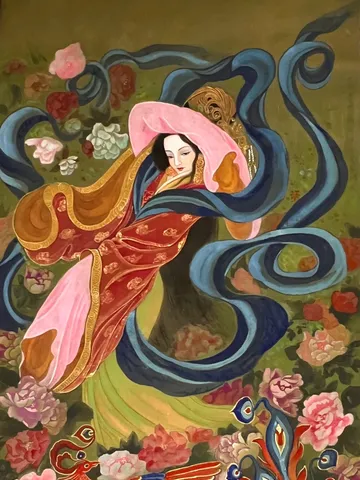
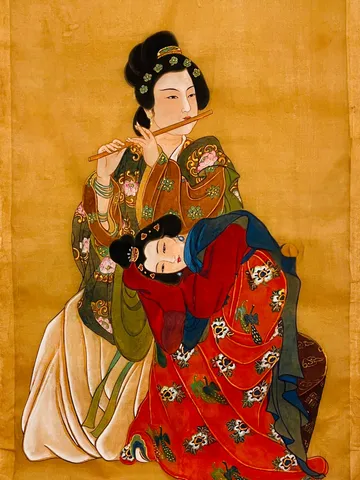
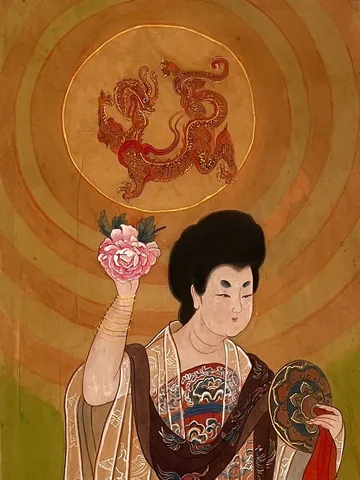
| Artist | Xiang Li 李湘 |
| Medium | Chinese watercolor on silk, hand-painted on hand-cut silk |
| Dimensions | approx. 36 × 72 inches (91 × 183 cm) |
| Painted | 2020 |
| Subject | Empress Liu, consort of Emperor Zhuangzong of Later Tang |
| Collection | The Chinese Empresses Collection |
| Availability | Original held by the artist · Prints available |