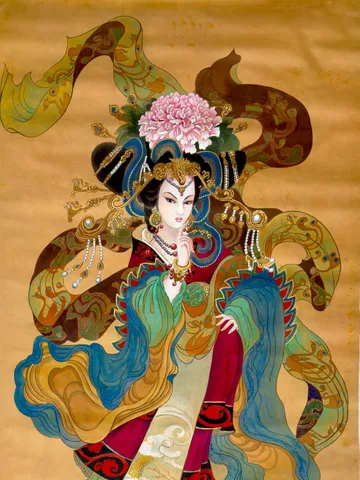
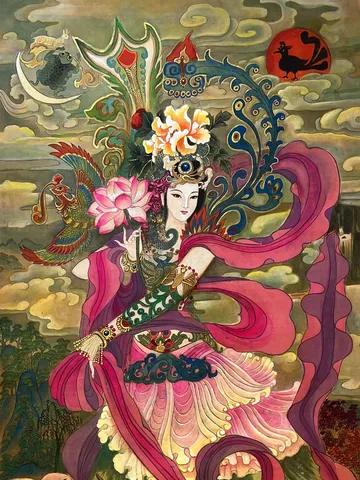
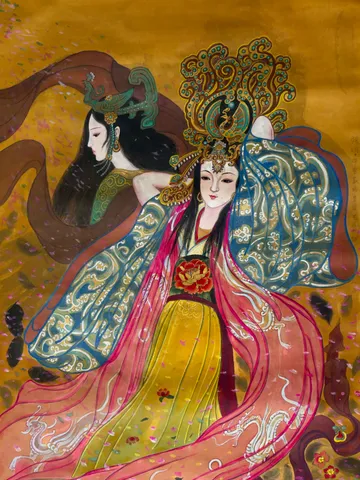
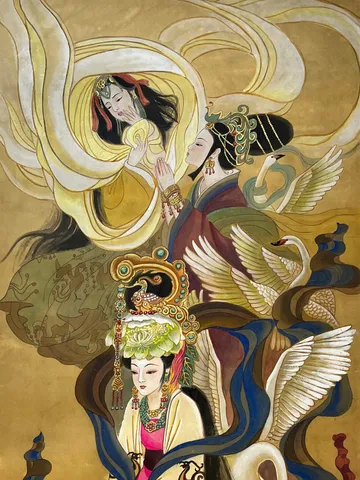
Las emperatrices de los Tres Reinos (Wu Oriental)
Conoce a Las emperatrices de los Tres Reinos (Wu Oriental) en la colección Emperatrices chinas de Xiang Li y explora su contexto histórico y sus vínculos con las mujeres de la China imperial.
东吴皇后
“Five Women on the Yangtze”
A woman who was loved for twenty years and given the title only once she was dead. A slave from the weaving rooms who became empress, asked how Empress Lü had ruled after her husband died, and was strangled in her sleep a few weeks later. And three more, across four emperors, in the kingdom that outlasted them all.
Their Story
Wu was the kingdom that lasted longest and is remembered least. It held the lower Yangtze and the coast, built the navy that won Red Cliffs, sent ships as far as Taiwan and probably to the Mekong, and outlived both its rivals — Shu fell in 263, Wei was swallowed by the Jin in 266, and Wu went on until 280.
Its five empresses cover fifty years and four emperors, and every one of them is a study in the same thing: what happens to a woman’s position when the succession is unstable and the men around it are frightened.
Bu Lianshi — the empress who was never empress
Sun Quan loved her for more than twenty years and could not make her empress, because his officials insisted the position belonged to the mother of his heir and he did not want the fight.
She was from the Bu clan of Huaiyin, a family of some standing, and the histories are unusually warm about her. She was not jealous. She recommended other women to him and spoke well of them, and the effect on a court full of rival consorts and rival princes was to keep the temperature down. She bore him two daughters — one of them Sun Luban, who grew up to be one of the most destructive political figures of the period, which is its own kind of irony.
She died in 238 without ever holding the title. Sun Quan gave it to her the moment she was dead, and the officials who had blocked it for two decades did not object to a posthumous appointment.
Pan Shu — from the weaving rooms
Her father was a low-ranking official who was executed for an offence nobody bothered to record. Under Han law that made his family state property, and Pan Shu and her elder sister were sent to the imperial weaving workshop as slaves.
She was so beautiful that the other women there kept away from her and called her a goddess. The story — from a later, unreliable, wonderful source — is that Sun Quan heard about her and sent a painter. She was miserable and refused to eat, so the portrait that came back showed a thin, sorrowing woman, and Sun Quan looked at it and said: if sorrow on her face can do this, what would her smile do? He sent a carriage.
She bore him Sun Liang in 243. After the vicious succession war between his elder sons, Sun Liang was named heir in 250 — and in 251 Sun Quan made her empress, the only one he ever created in his lifetime, having spent years refusing on principle to elevate a concubine. An amnesty was declared and the era name changed.
The Sanguozhi also says, flatly, that she was jealous and vindictive from the day she arrived to the day she died, and that she slandered a great many of the other consorts. Both things are in the same paragraph.
In early 252 Sun Quan fell mortally ill. Empress Pan sent to the Prefect of the Palace Writers to ask a specific question: how had Empress Lü governed the empire after the death of her husband?
The Emperor being gravely ill, the Lady sent to ask the Prefect of the Palace Writers how Empress Lü had held sole authority after her husband’s death.
On Empress Pan, weeks before she was strangled — Sanguozhi, ch. 50
She exhausted herself nursing him and fell ill. Her attendants waited until she was deeply asleep and strangled her, then reported that she had died of a sudden sickness.
The official version is that the servants could not bear the work of nursing two invalids, or that she had abused them. The thirteenth-century commentator Hu Sanxing did not believe a word of it. A woman who has just asked for the precedent on female regency, he pointed out, is not murdered by her own maids for being unpleasant — she is murdered by the men who would have to serve under her. He thought the Wu court had killed her and dressed it up, and that later historians simply copied down the dressing.
Six or seven people were executed in the investigation. Sun Quan died a few weeks later and she was buried with him.
Quan Huijie — 252 to 258
Sun Liang was ten when he inherited. His empress came from the Quan clan, one of the great families of the lower Yangtze, and the marriage was arranged by Sun Luban — Bu Lianshi’s daughter — who had married into that family and was busy converting it into a faction.
It worked for six years. In 258 the regent Sun Chen deposed Sun Liang, who was by then sixteen and had begun making plans of his own. Empress Quan went with him into demotion. Her clan collapsed with the reign; several of its leading men had already defected to Wei.
Empress Zhu — 258 to 264
She was the daughter of the minister Zhu Ju and of Princess Sun Luyu — which made her Sun Quan’s granddaughter, and her husband Sun Xiu her uncle. Both her parents had been destroyed in the same court feuding that consumed everyone else in this story; her mother was killed on her own sister Sun Luban’s accusation.
She was empress for six years while Sun Xiu, who was intelligent and bookish and thoroughly outmatched, tried to govern. He died in 264, aged twenty-nine, with Shu just fallen and the frontier collapsing, and the court passed over his sons for an adult candidate: his nephew Sun Hao.
Sun Hao made her empress dowager, and then within months demoted her to “consort of the late prince” and had her put to death. She was thirty. Her four sons were sent out of the capital and the two eldest were killed.
Teng Fanglan — the last empress of the Three Kingdoms
She married Sun Hao before he was emperor and became empress when he took the throne in 264. Her father Teng Mu was a court official who was eventually exiled for remonstrating with him.
Sun Hao is one of the genuinely monstrous rulers in Chinese history — the sources describe flayings, blindings, and courtiers executed for insufficient enthusiasm at drinking parties. He wanted to be rid of her more than once. What saved her, according to the histories, was that his mother would not permit it and the court astrologers kept finding the omens against it. So she kept the title and lost everything else: he gave other women empress’s seals and ribbons, and there were said to be several of them at once.
In 280 the Jin fleet came down the Yangtze, the iron chains strung across the river were burned through with rafts of fire, and Sun Hao surrendered. He was taken to Luoyang and made Marquis of Guiming — “the marquis who submitted to destiny” — and she went with him. The Three Kingdoms period ended that year.
She is the last empress in this room, and the only one of the five who was neither killed, demoted, nor honoured only after death. She survived because she was not worth the trouble.
A note on the sources — and two corrections
Correction 1. The earlier version of this page described Empress Pan as the wife of Sun Liang. She was not — she was Sun Liang’s mother, and the empress of the founding emperor Sun Quan. The page also said she was deposed and executed; she was neither. She was strangled in her sleep by her own attendants while still empress, and buried with her husband in the imperial tomb.
Correction 2. Empress Zhu’s dates were given as 262–264. She was empress from 258 to 264, and the significant part of her story happens afterwards: Sun Hao made her empress dowager and then had her killed in 265.
Wu’s records are the thinnest of the three kingdoms, and much of the colour here — the portrait sent to the weaving rooms, the ring in the wine cup — comes from the Shi Yi Ji, a fourth-century collection of court anecdotes that is delightful and not reliable. It is flagged as such where used.
- Chen Shou, Sanguozhi (Records of the Three Kingdoms), ch. 47 and ch. 50 — the Biographies of the Consorts of Wu — 3rd century CE
- Xu Song, Jiankang Shilu — 8th century CE
- Sima Guang, Zizhi Tongjian, ch. 75–81, with Hu Sanxing’s 13th-century commentary
- Cutter & Crowell, Empresses and Consorts — University of Hawaii Press, 1999
The Emperors
Sun Quan, Emperor Da of Wu 吴大帝
孙权 · 182 – 252 · King of Wu from 222, Emperor 229 – 252
He inherited the lower Yangtze at eighteen when his brother was assassinated, and held it for fifty-two years against everyone. He supplied the fleet that broke Cao Cao at Red Cliffs in 208, took Jing Province from his own ally Liu Bei in 219 by having Guan Yu killed, and then destroyed Liu Bei’s revenge army at Xiaoting in 222. He sent expeditions to Taiwan and embassies as far as Funan in the Mekong delta.
His last decade was a catastrophe of his own making. He allowed two of his sons to build rival factions, then destroyed both — one deposed, one ordered to kill himself — and left the throne to a nine-year-old. Everything on this page after 250 is the aftershock of that decision.
Then: Sun Liang (r. 252–258), deposed at sixteen. Sun Xiu (r. 258–264), able and short-lived. Sun Hao (r. 264–280), who surrendered to the Jin and ended the Three Kingdoms.
Connections
- The precedent Empress Pan asked about Empress Lü Zhi — four hundred and fifty years earlier, and still the reference case for a widow taking power. Asking the question may be what killed her.
- Their enemy and ally The Empresses of Shu Han — allies at Red Cliffs, enemies after Guan Yu, and gone seventeen years before Wu was.
- The kingdom to the north Empress Mao and Empress Guo — Cao Wei, whose own dynasty was taken by the Sima family that eventually took Wu too.
- What came after The empresses of Jin — the dynasty that reunified China in 280 and lost the north within forty years.
About this Portrait
| Artist | Xiang Li 李湘 |
| Medium | Chinese watercolor on silk |
| Dimensions | 24 × 36 inches (61 × 91 cm) |
| Painted | 2022 |
| Subjects | Five empresses of Eastern Wu, across four emperors |
| Collection | The Chinese Empresses Collection |
| Availability | Original held by the artist · Prints available |