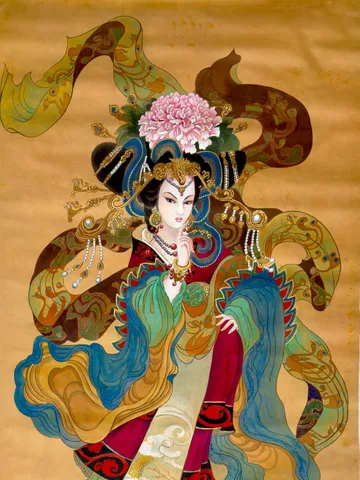
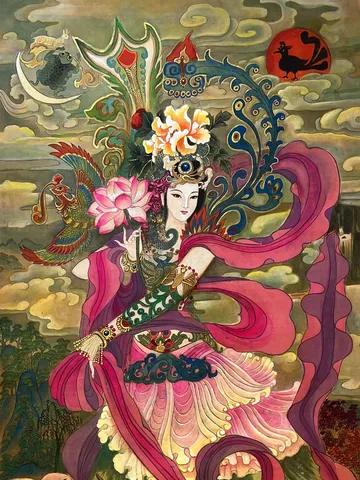
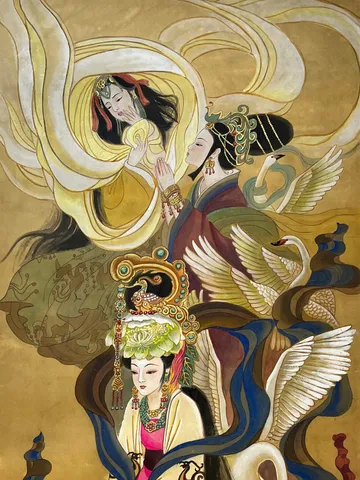
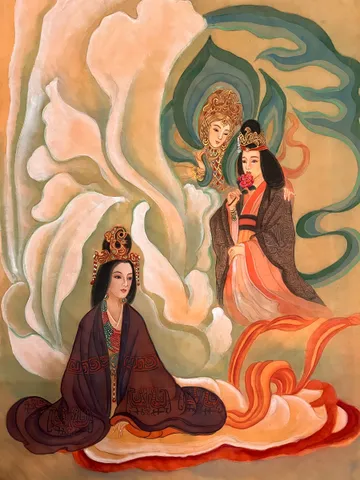
Emperatriz Mao y emperatriz Guo (Cao Wei)
Emperatriz Mao y emperatriz Guo (Cao Wei): consulta esta página de Emperatrices chinas en Xiang Li Art. El contenido principal está en inglés; la traducción completa está pendiente.
毛皇后 · 郭皇后
“A Carpenter’s Daughter and a Confiscated Rebel”
One was a carpenter’s daughter, executed for a single sarcastic question at breakfast. The other was seized as state property after her clan rebelled — and spent twenty-five years as the only legal authority standing between the Sima family and the throne.
Their Story
Cao Wei had a policy, and it was deliberate: take empresses from families with no power. It was meant to prevent another Han — no consort clans, no dowager regents, no century of coups. It worked completely. And when the Sima family came for the throne, there was nobody left to stop them.
These two women are what that policy looked like from the inside.
Empress Mao — the carpenter’s daughter
Her father was a carpenter in the Department of Public Works. That is the whole of her background — no clan, no office, no land.
Cao Rui, then Prince of Pingyuan, adored her. They shared a carriage, which at that court was a public statement. His principal wife, Lady Yu, came from a proper gentry family and expected to be made empress when he took the throne in 226. Instead, in late 227, he chose Mao.
Lady Yu went to the old empress dowager and said something that has been quoted ever since: the Cao family always sets up the base-born, and none of them has ever raised a woman on merit. If the beginning is not good, the end will not be good. This is what will destroy the state. She was sent away to Ye and never came back.
Mao’s family were showered with titles. Her father was made a marquis and a Grand Master, and Cao Rui ordered court officials to attend banquets at his house — where the old carpenter, wildly out of his depth, referred to himself throughout as this noble person. The court found it hilarious and said so.
Ten years later she lost his attention to Consort Guo.
In September 237 Cao Rui held a party in the rear palace with music and the senior consorts. Guo asked that the empress be invited. He refused, and ordered that nobody tell her about it.
The next day Mao saw him and said: Was yesterday’s party in the northern garden pleasant?
Was yesterday’s party in the northern garden pleasant?
Empress Mao to Cao Rui, September 237. He had her killed for it. — Sanguozhi, ch. 5
It is one sentence. It has been read for eighteen centuries as sarcasm, as hurt, as a woman letting him know she knew. What it meant to him was that somebody had talked. He executed more than ten of his attendants. Then he sent the order to his wife.
She died on 22 September 237. He buried her with the full honours of an empress a month later, and left her family in place with their titles.
Empress Guo — the last legal authority in Wei
She came from Xiping, out on the western frontier near modern Xining, from a clan powerful enough to matter locally. Sometime before 223 that clan joined a rebellion, and when it was put down she was confiscated — the word the Sanguozhi uses is the word for state property — and sent into the palace.
Cao Rui took her as a consort and favoured her greatly. She is the one who asked him to invite Empress Mao to the party in 237, which is worth noting, because the version of this story everyone knows comes from a fourteenth-century novel in which she is a schemer. In the actual record she tried to include her rival.
He did not make her empress until 16 January 239, when he was dying and could no longer get out of bed. He died six days later. He had no surviving sons; the throne went to his adopted heir Cao Fang, aged eight, under a joint regency of the Cao family general Cao Shuang and the veteran minister Sima Yi.
And so Empress Guo became empress dowager of a state whose entire constitutional design was that empress dowagers should have no power. Her relatives were given palace guard commands and marquisates. Her seal was required for anything to be legal. She had legitimacy and nothing else, and for twenty-five years everyone in China fought over the difference.
In February 249, while Cao Shuang was out of the capital visiting the tombs, Sima Yi seized the government — claiming an edict in her name. Cao Shuang surrendered on a promise of safety and was executed four days later along with his clan and his associates. From then on the Sima family ran Wei.
Someone in the palace then tried to destroy Sima Yi with flattery: he was offered the chancellorship with a pointed comparison to Huo Guang, and then the Nine Bestowments — the ceremonial package that had been given to exactly two men in Chinese history, Wang Mang and Cao Cao, both of whom used it to take a throne. It was an accusation dressed as an honour, offered ten times. He refused every time. Nobody knows who arranged it. Two modern historians think it may have been her.
In October 254 Sima Shi deposed Cao Fang and sent a kinsman of hers to tell her it was happening. She was furious. She was reminded that the palace was surrounded by troops. She asked to see Sima Shi and was refused an audience — by a subject, to a dowager. She gave up the seals, and the emperor she had raised was taken away, and she and his successor wept as he left.
Then she fought the one round she could win.
Sima Shi wanted to install Cao Ju, Prince of Pengcheng — a man of the previous generation, Cao Rui’s uncle. She refused to hand over the seal, and her argument was pure ritual law: if the throne passes upward to an uncle, then her husband is left with no heir at all, and that cannot be permitted. It was unanswerable, and Sima Shi had to accept it. She got her candidate instead: Cao Mao, thirteen years old, a grandson of Cao Cao and by all accounts brilliant. And when Sima Shi asked again for the seal, she declined again, politely — she had met the boy before, and she would prefer to hand it to him herself.
It bought six years. In 260 Cao Mao, aged nineteen, came to tell her he intended to move against Sima Zhao, took the palace guard into the street, and was cut down in the open. It is one of the only times in Chinese history an emperor was killed in a fight he started himself.
Within hours an edict appeared under her name describing Cao Mao as a debauched degenerate who had tried to shoot her and poison her, and demanding he be buried as a commoner — which allowed Sima Zhao to graciously restore him to a princely burial. The historians who have studied the text call it an outrageous fabrication. Another edict under her name accepted, as a woman unfit to understand such things, that the officer who actually did the killing should be executed for it.
Sima Zhao then downgraded her pronouncements from orders to mere regulations, and chose the next emperor without consulting her.
She died on 8 February 264. Rebellions against the Sima family had been raised twice in her name while she lived, and one more was raised a month after she died, on a forged edict from a woman already in her grave.
Sima Yan took the throne in 266, two years later. The Sanguozhi — written under his dynasty — is careful to record that the Simas consulted her before every major act. That was the point of her.
A note on the sources
Everything about Empress Guo’s last decade survives in documents issued under her name by the men who were overthrowing her dynasty, and modern scholarship treats most of them as forced or forged outright. Read carefully, that is itself the evidence: nobody bothers to forge the signature of a woman who does not matter. The Wei history was compiled under the Jin dynasty founded by the Simas, which is why it is at such pains to record that they consulted her.
- Chen Shou, Sanguozhi (Records of the Three Kingdoms), ch. 3–5 — 3rd century CE
- Pei Songzhi’s annotations, quoting the Weilüe, the Book of Wei and the Han–Jin Chunqiu — 5th century CE
- Sima Guang, Zizhi Tongjian, ch. 75–78 — 1084
- Cutter & Crowell, Empresses and Consorts — University of Hawaii Press, 1999
- Carl Leban & Albert Dien, “The Accession of Sima Yan, AD 265: Legitimation by Ritual Replication”, Early Medieval China 16 — 2010
The Emperor
Cao Rui, Emperor Ming of Wei 魏明帝
曹叡 · c. 204 – 239 · reigned 226 – 239
Son of Lady Zhen, whom his father executed, and raised by Guo Nüwang, whom he later buried in the same disgraceful manner. He came to the throne at about twenty-two and turned out to be a capable ruler — he held off Zhuge Liang’s repeated invasions from Shu, destroyed the breakaway regime in Liaodong, and knew how to pick generals.
He also spent enormous sums on palaces and gardens at Luoyang while his ministers begged him to stop, and the histories, written under the dynasty that replaced his, make much of it.
His real failure was the succession. He had no surviving sons, so the throne went to an eight-year-old adopted heir under a regency, and the regency split, and the Sima family won the split. He died at about thirty-five. Wei outlasted him by twenty-six years.
Connections
- Her predecessor Guo Nüwang (Empress Wende) — Cao Rui’s stepmother, empress dowager until 235, and the first of the three low-born Wei empresses Lady Yu warned about.
- Her rival Empress Zhen (Luo Shen) — Cao Rui’s birth mother, executed by his father in 221.
- Her adopted son’s empresses Empress Zhen, Empress Zhang and Empress Wang — the three consorts of Cao Fang, the boy Empress Guo raised and could not save.
- What replaced them The empresses of Jin — the dynasty the Sima family founded two years after Empress Guo’s death.
About this Portrait
| Artist | Xiang Li 李湘 |
| Medium | Chinese watercolor on silk, hand-painted on hand-cut silk |
| Dimensions | approx. 36 × 72 inches (91 × 183 cm) |
| Painted | 2016 |
| Subjects | Two empresses — both consorts of Cao Rui |
| Collection | The Chinese Empresses Collection |
| Availability | Original held by the artist · Prints available |