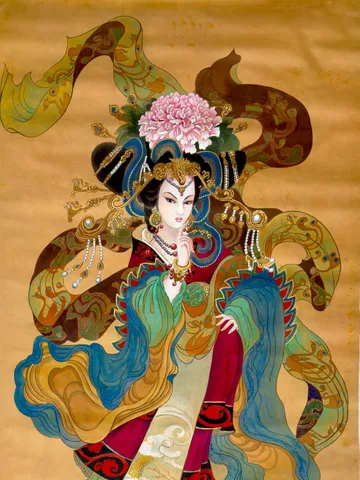
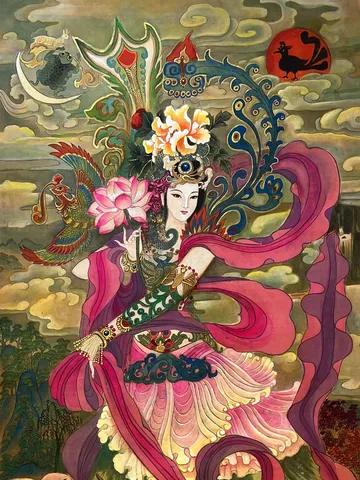
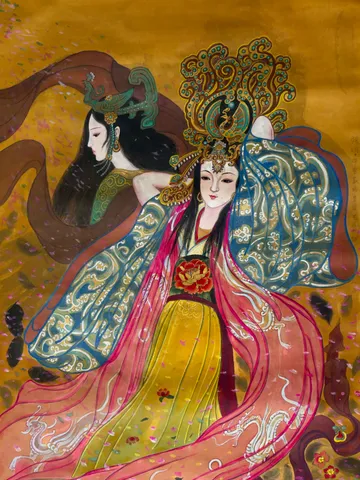
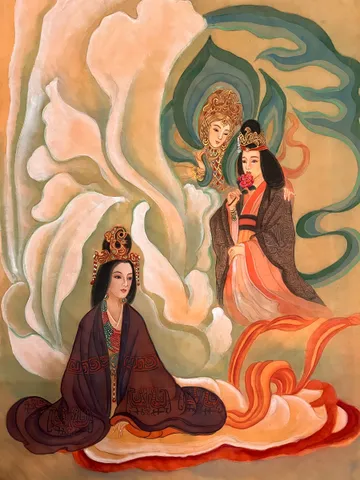
Emperatriz Huai (Zhen), emperatriz Zhang, emperatriz Wang (Cao Wei)
Emperatriz Huai (Zhen), emperatriz Zhang, emperatriz Wang (Cao Wei): consulta esta página de Emperatrices chinas en Xiang Li Art. El contenido principal está en inglés; la traducción completa está pendiente.
甄皇后 · 张皇后 · 王皇后
“Three Names, No Names”
Married to an emperor who was installed at eight and deposed at twenty-two. One died young, one was removed when her father’s coup failed, one lasted five months. Their personal names were never written down, and the first one’s posthumous title is a single character because her husband was disgraced before he could give her the second.
Their Story
Three empresses in eleven years, to one emperor who never governed a day. Not one of their given names survives. Between them they account for about two hundred characters in the official history, and almost every one of those characters is a date.
This page is mostly about what is missing from it.
Empress Zhen — Empress Huai, 243 to 251
She was a great-niece of Lady Zhen — granddaughter of Lady Zhen’s brother — which made the marriage a quiet piece of family repair: the clan of the woman Cao Pi had executed, restored to the throne two generations later.
She was made empress on 29 May 243. Cao Fang was about eleven. Her own age is not recorded.
In summer, the fourth month, on the yimao day, the Lady Zhen was established as Empress.
The complete first mention of Empress Huai — Sanguozhi, ch. 4, entry for 243 CE
She died on 22 August 251 and was buried with an empress’s honours a month later.
That is the entire biography. But there is one detail in it worth stopping on. Her posthumous name is Huai — a single character, where an empress’s posthumous name normally has two. The convention was that an empress shared one character with her husband’s posthumous name. Cao Fang was deposed three years after she died, and a deposed emperor is not given one. So there was no character to share, and hers stayed half-finished forever.
Her identity in the record is literally incomplete because of what was later done to a man she was married to at eleven.
Empress Zhang — 252 to 254
Her grandfather had governed Liang Province; her father Zhang Ji was a commandery administrator. She was made empress around March 252, when Cao Fang was about twenty, and her father was promoted to senior minister on the strength of it.
By then Sima Yi was dead and his son Sima Shi held the state. Cao Fang was an adult emperor with no power at all, and the people around him began to plan.
In early 254 the official Li Feng, the empress’s father Zhang Ji, and the celebrated Xiahou Xuan agreed to replace Sima Shi — one version has them planning to kill him at a palace ceremony held to promote one of Cao Fang’s concubines. It was discovered in March. Li Feng was killed; the three men and their entire clans were executed.
One month later, Cao Fang was made to depose his wife.
The record then stops. Nothing is said about what became of her. She was almost certainly not killed with her family — she is simply never mentioned again, which in these chronicles usually means confinement and a long quiet life that nobody thought worth writing down.
Empress Wang — five months in 254
Her father was Wang Kui, director of imperial transportation. She was made empress in May or June of 254, four to six weeks after her predecessor was removed.
In October, Sima Shi deposed her husband.
She had been empress for about five months. She presumably went with him and became Princess of Qi. The Sanguozhi says nothing further about her at all — not a date, not a death, nothing.
A note on the sources — and on this page’s title
Correction: earlier versions of this page and of The Complete Edition of Chinese Empresses named the three women as Empress Zhang, Empress Wang and Empress Bian. That is wrong. Cao Fang’s three empresses were Zhen (Empress Huai), Zhang and Wang; Empress Bian belongs to a later Wei emperor. Xiang Li’s own file name for the painting — Empress Huai, Lady Zhang and Lady Wang — had it right all along.
The larger problem is that Chen Shou, writing under the dynasty that deposed Cao Fang, had no reason to record much about his consorts, and none of them left descendants who might have wanted them remembered. What survives is the bare chronicle entries: made empress on this day, deposed on that one.
- Chen Shou, Sanguozhi (Records of the Three Kingdoms), ch. 4 and ch. 5 — 3rd century CE
- Sima Guang, Zizhi Tongjian, ch. 75–76 — 1084
- Cutter & Crowell, Empresses and Consorts — University of Hawaii Press, 1999
The Emperor
Cao Fang, Prince of Qi 曹芳
232 – 274 · reigned 239 – 254
Nobody is certain whose son he was. He appeared at court as a small child, was adopted by Cao Rui — who had no surviving sons of his own — and became emperor at eight under a regency shared between the imperial kinsman Cao Shuang and the veteran minister Sima Yi.
The regency lasted ten years and ended in February 249, when Sima Yi waited for Cao Shuang to take the emperor out of the capital to visit the family tombs, closed the gates behind them, and seized the government. Cao Shuang surrendered on a promise of safety and was executed with his entire clan four days later. From that day the Cao emperors were the Sima family’s property.
Cao Fang tried twice, or was said to have tried, and both attempts collapsed before they began. In October 254 Sima Shi deposed him. He was twenty-two. He lived another twenty years as Prince and then Duke of Shaoling, and died in 274 — eight years after the dynasty he had briefly ruled ceased to exist.
Connections
- Her great-aunt Empress Zhen (Luo Shen) — the same clan, restored to the throne two generations after Cao Pi executed her.
- The dowager who could not save him Empress Mao and Empress Guo — Empress Guo was Cao Fang’s adoptive mother, and it was her seal Sima Shi needed to depose him.
- Her father-in-law’s stepmother Guo Nüwang (Empress Wende) — the first empress of Wei, and the first of the low-born consorts the dynasty deliberately chose.
- What followed The empresses of Jin — the Sima dynasty, founded twelve years after Cao Fang’s deposition.
About this Portrait
| Artist | Xiang Li 李湘 |
| Medium | Chinese watercolor on silk, hand-painted on hand-cut silk |
| Dimensions | approx. 36 × 72 inches (91 × 183 cm) |
| Painted | 2016 |
| Subjects | Three empresses — all consorts of Cao Fang |
| Collection | The Chinese Empresses Collection |
| Availability | Original held by the artist · Prints available |