Emperatriz Luo Shen (Cao Wei, Tres Reinos)
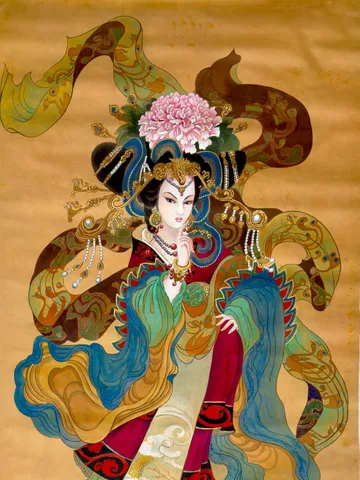
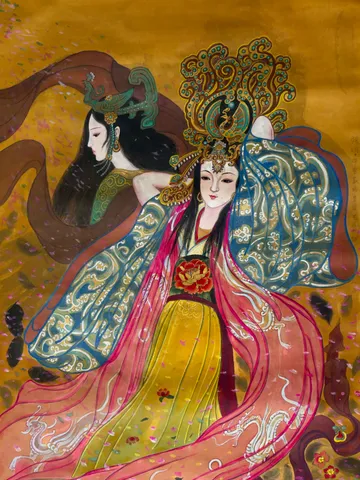
Emperatriz Luo Shen - La Diosa del Río Luo
甄氏 · 文昭皇后
“The Goddess of the Luo River”
Taken from a defeated warlord’s household at eighteen, ordered to kill herself at thirty-eight for complaining, and buried with her mouth stuffed so she could not accuse anyone in the next world. Four centuries later she was given the name of a river goddess in a poem she probably had nothing to do with — and that is the name that lasted.
Her Story
The most famous beauty in Chinese literature has no name.
The histories call her Lady Zhen, Madam Zhen, Empress Zhen — the clan name and nothing else. Luo Shen, the name on this painting, means “Goddess of the Luo River,” and it was attached to her four hundred years after she died.
She was born in 183 in what is now Hebei, the youngest of eight, into a family that had held office since the Western Han. Her father died when she was three. The stories told about her childhood are the kind that get told about women who turn out to matter: at eight she refused to go out on the balcony with her sisters to watch trick riders, asking whether that was a thing a girl should be looking at; at nine she started using her brothers’ ink and paper, and when they teased her about wanting to be a lady scholar she said that virtuous women learn from the successes and failures of the past, and how was she supposed to do that without reading.
At around ten, with famine outside and rich families selling their jewellery for grain, she talked her family out of profiteering. Her argument was that in a collapsing world, owning treasure is itself the crime — better to give the surplus grain to the neighbours. The household agreed and did it.
She was married to Yuan Xi, second son of the warlord Yuan Shao, and stayed behind at Ye to look after her mother-in-law when he left to govern the north.
In September 204, Cao Cao took Ye. The city was sacked, the population massacred, and the women of the Yuan household were handed to the soldiers. Cao Cao’s eighteen-year-old son Cao Pi went straight to Yuan Shao’s residence, where he found the widow and her daughter-in-law sitting in the hall. Lady Zhen was so frightened she pushed her face into her mother-in-law’s lap.
Madam Liu, what is this? Tell that lady to lift her head.
Cao Pi at the sack of Ye, September 204 — Weilüe, cited in the Sanguozhi
The old woman took her chin and raised it, and Cao Pi looked at her and asked his father for her.
She was still married. Her husband was alive, three provinces away, and would be killed three years later.
She bore Cao Pi a son and a daughter, and by every account she behaved impeccably in a house where behaving impeccably was survival. She encouraged his other women. She urged him to take more concubines so he would have more heirs. When he decided to divorce a consort named Ren she wept and argued against it, on the grounds that people would assume it was her doing — and he sent Ren away anyway.
In 220 Cao Pi took the Han throne. The deposed emperor handed over two daughters as concubines, Guo Nüwang was ascendant, and Lady Zhen — left behind at Ye while the court moved to Luoyang — was never made empress.
She complained. That is the entire recorded offence.
On 4 August 221 he sent a messenger to Ye ordering her to kill herself. She was thirty-eight.
The Han–Jin Chunqiu adds what happened to her body: buried with her hair pulled forward over her face and rice husks packed into her mouth, so that in the next world she could neither see her accuser nor speak against him.
Her son Cao Rui was seventeen. Five years later he became emperor, made her Empress Wenzhao, and built her a temple. When Guo Nüwang died, he had her buried in exactly the same way — hair over the face, husks in the mouth.
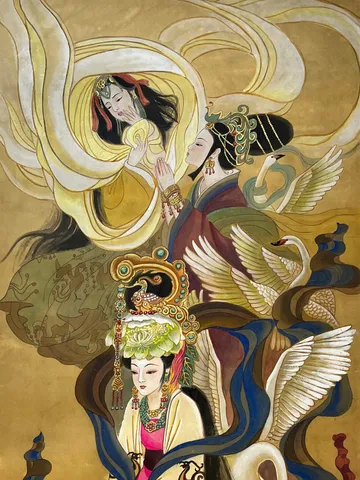
The name came much later. Cao Pi’s brother Cao Zhi, the finest poet of the age, wrote the Rhapsody on the Goddess of the Luo, about a river spirit glimpsed and lost. By the Tang, an anonymous note had appended a story: that Cao Zhi had loved his brother’s wife, that he met her ghost, and that the poem was originally titled Moved by Lady Zhen. It is almost certainly fiction. It is also why she is one of the few women of this period whom everyone can picture, and why she has a name at all.
What survives of her, in other words, is a poem she has no verifiable connection to, and a nameless entry in a history compiled by the dynasty that killed her.
A note on the sources
Chen Shou’s original biography of her is short and contains none of the virtuous anecdotes above. They were added two centuries later by Pei Songzhi from the Book of Wei and the Weilüe — both official Cao Wei histories, written to make her look worthy of the son who became emperor. Pei included them and then said plainly that he doubted them, and that Chen Shou had been right to leave them out. He also observed that the official account of her death — that she died of illness, having modestly declined the position of empress three times — cannot be reconciled with the record of a messenger sent to make her take her own life.
- Chen Shou, Sanguozhi (Records of the Three Kingdoms), ch. 5 — 3rd century CE
- Pei Songzhi’s annotations, quoting the Book of Wei, the Weilüe and Xi Zuochi’s Han–Jin Chunqiu — 5th century CE
- Robert Joe Cutter, “The Death of Empress Zhen: Fiction and Historiography in Early Medieval China”, JAOS 112:4 — 1992
- Rafe de Crespigny, A Biographical Dictionary of Later Han to the Three Kingdoms — Brill, 2007
The Emperor
Cao Pi, Emperor Wen of Wei 魏文帝
曹丕 · 187 – 226 · reigned 220 – 226
Cao Cao’s eldest surviving son, and the man who ended the Han. In 220 he staged the abdication of Emperor Xian with full ceremonial correctness — and it was his own sister, Empress Cao Jie, who threw the imperial seal on the floor rather than hand it to his envoys.
He was a serious writer as well as a ruler. His Discourse on Literature is the earliest surviving work of Chinese literary criticism, and it argues that writing outlasts office and empire — which, in his case, turned out to be true.
He was also relentless with his own family. He kept his brother Cao Zhi, the better poet, under surveillance and moved from fief to fief for the rest of his life. He died at thirty-nine having reigned six years, and the Wei he founded lasted only forty-five before another family took it the same way he had taken the Han.
Connections
- Her rival and successor Guo Nüwang (Empress Wende) — who displaced her, raised her son, and was eventually buried exactly as she was.
- Her sister-in-law Empress Xianmu (Cao Jie) — Cao Pi’s sister and the last Han empress, who refused to give up the seal that made him emperor.
- Her son’s empresses Empress Mao and Empress Guo — the consorts of Cao Rui, the boy who avenged her.
- The world she came from Empress Song and Empress He — the last Eastern Han empresses, and the collapse that put her in Yuan Shao’s household in the first place.
About this Portrait
| Artist | Xiang Li 李湘 |
| Medium | Chinese watercolor on silk, hand-painted on hand-cut silk |
| Dimensions | approx. 36 × 72 inches (91 × 183 cm) |
| Painted | 2016 |
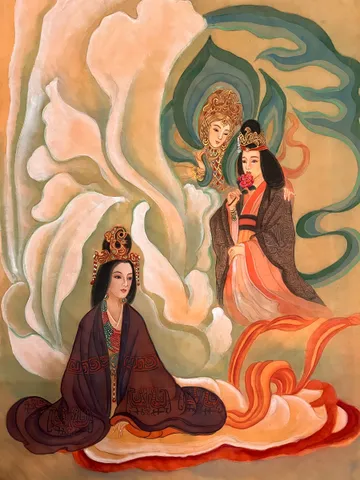
| Subject | Empress Zhen, known as Luo Shen |
| Collection | The Chinese Empresses Collection |
| Availability | Original held by the artist · Prints available |