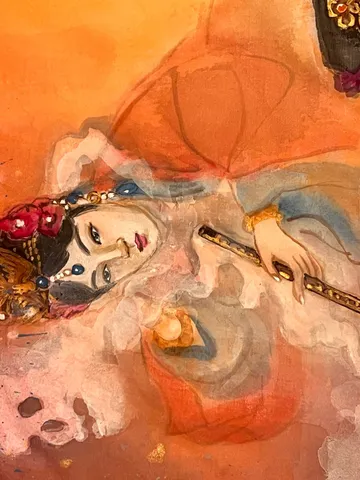
Emperatriz viuda Cixi
Conoce a Emperatriz viuda Cixi en la colección Emperatrices chinas de Xiang Li y explora su contexto histórico y sus vínculos con las mujeres de la China imperial.
慈禧太后 · 叶赫那拉·杏贞
“1835 – 1908 · ruler of China for forty-seven years”
She entered the palace at sixteen as a fifth-rank concubine and left it only as a corpse. In between she deposed a regency council, chose two emperors, crushed a reform movement, declared war on eight nations at once, abolished the examination system that had run China for thirteen centuries, and outlived every man who tried to stop her.
Her Story
The girl who was chosen
She was born in Beijing in 1835 into a Manchu family of the Bordered Blue Banner — respectable, not grand. Her father was a mid-ranking official who was at one point dismissed for failing to deliver tax silver. There was no fortune, no faction, nothing that would ordinarily produce a ruler.
In 1851 she was one of sixty girls selected in the triennial draft that supplied the emperor’s household. She entered as Guiren — Noble Lady — the fifth rank, well down a hierarchy of eight. The Xianfeng Emperor had a large harem, a weak constitution, and very little interest in governing.
In April 1856 she bore him a son. He had no other surviving male child, and would never have one. Everything that followed rests on that single fact. She was promoted within days.
1860 — the year the palace burned
The Second Opium War brought a British and French expeditionary force to the gates of Beijing. In October 1860 they burned the Yuanmingyuan, the Old Summer Palace — three days of fire across an estate of two hundred buildings, gardens, libraries and workshops that had taken a century and a half to build. Xianfeng had already fled to the hunting lodge at Rehe, beyond the Wall.
He never came back. He died there in August 1861, aged thirty. His will named an eight-man regency council to govern for the five-year-old heir, led by the Manchu grandee Sushun. It named the boy’s mother to nothing.
The Xinyou Coup
What she did next took about ten weeks and was executed with a coolness nobody in the court had thought her capable of.
She allied with the senior empress, Ci’an — the late emperor’s principal wife, and by rank her superior — and, crucially, with Prince Gong, Xianfeng’s brother, who had been left behind in Beijing to negotiate with the foreigners and was therefore excluded from the council. The two dowagers held the imperial seals, which the council needed for every edict.
The funeral cortege travelling back to Beijing was slow and heavy. The dowagers went ahead by a faster road with the child. When Sushun arrived, Prince Gong’s men were waiting. He was beheaded in a public market; two princes of the council were permitted the silk cord and took their own lives; the rest were stripped of office.
The two women then instituted chuilian tingzheng 垂帘听政 — “attending to government from behind the curtain.” The boy emperor sat on the throne. Behind him hung a screen of yellow silk. Behind the screen sat his mother and his stepmother, and the decisions came from there.
I have often thought that I am the cleverest woman who ever lived. I have heard much about Queen Victoria — but her life cannot compare with mine.
Attributed to Cixi by Der Ling, Two Years in the Forbidden City, 1911
The long regency
She was twenty-six and had almost no formal education. Contemporaries noted that her written characters were shaky and that officials drafting edicts had to work around her spelling. She learned the machinery of the state on the job, from memorials, in a room she was not officially in.
The years that followed are called the Tongzhi Restoration, and they were more successful than the dynasty had any right to expect. The Taiping rebellion — the bloodiest civil war in human history, perhaps twenty million dead — was finally put down in 1864. The Self-Strengthening Movement built arsenals, shipyards, a translation bureau, a modern customs service. Chinese students were sent to America.
The credit belongs largely to the provincial officials she backed — Zeng Guofan, Li Hongzhang, Zuo Zongtang. Her particular skill was choosing them and keeping them, and knowing when a man was too strong to remove and had to be balanced instead.
Choosing the next emperor
The Tongzhi Emperor came of age, reigned in his own name for two years, and died of smallpox in January 1875 at eighteen. He left no son. His wife, Empress Xiaozheyi, was pregnant.
By the succession rules the throne should have passed to a boy of the next generation down, who would have been Tongzhi’s ritual son and Cixi’s ritual grandson — which would have ended her regency. Instead, in a night meeting of the imperial clan, she installed her three-year-old nephew Zaitian, who was of the same generation as Tongzhi. The move was a clear breach of ritual law and everyone present knew it. One censor later committed suicide at Tongzhi’s tomb in protest.
The child became the Guangxu Emperor. Cixi’s regency continued for another thirteen years. Empress Xiaozheyi died seventy-four days after her husband, pregnancy and all.
The Hundred Days
Ci’an died suddenly in 1881, aged forty-four, and Cixi ruled alone. In 1889 she formally retired to the rebuilt Summer Palace — the reconstruction of which is said, on contested evidence, to have consumed funds earmarked for the navy. Six years later the navy was destroyed by Japan at the Yalu River, and China lost Taiwan.
That defeat radicalised the Guangxu Emperor. In the summer of 1898 he issued, in a hundred and three days, more than a hundred edicts: a modern university, a restructured examination, abolished sinecures, a new army, a budget. The scale of it terrified the Manchu establishment, and the establishment went to the Summer Palace.
On 21 September 1898 Cixi returned to the Forbidden City, resumed the regency, and placed the emperor under house arrest on Yingtai, a small island in the lake at Zhongnanhai, reached by a single causeway. He was twenty-seven. He remained there, in one form or another, for the remaining ten years of his life. Six of the reformers were executed without trial; two escaped to Japan.
1900
The Boxers — the Militia United in Righteousness — began as an anti-Christian, anti-foreign peasant movement in Shandong. Cixi’s court, having failed at reform and at war alike, decided to use them. In June 1900 she declared war on Britain, France, Germany, Russia, Japan, Italy, Austria-Hungary and the United States simultaneously. The foreign legations in Beijing were besieged for fifty-five days.
It was the worst decision of her life and the empire paid for it for a generation. An eight-nation relief force took Beijing in August. The court fled west to Xi’an disguised as peasants.
As they left, on Cixi’s order, the Guangxu Emperor’s favourite — Consort Zhen, the Pearl Concubine, twenty-four years old, who had argued that the emperor should stay in Beijing — was thrown down a well in the northeast corner of the Forbidden City. The well is still there and is still shown to visitors.
The Boxer Protocol of 1901 imposed an indemnity of 450 million taels of silver, one for every subject of the empire, payable over thirty-nine years.
The last reforms
Here is the part that sits least comfortably with the caricature. Having crushed the reformers in 1898, Cixi came back from Xi’an in 1902 and enacted most of their programme herself.
She restructured the army on Japanese lines, created ministries, sent a constitutional commission to Europe, America and Japan, and announced in 1906 that China would become a constitutional monarchy. She issued an edict against foot-binding. And in 1905 she abolished the imperial examination system — the mechanism by which China had selected its officials since 605 CE, thirteen hundred years, the most durable institution of the Chinese state.
It was too late and too fast, and it dissolved the class of scholar-officials whose careers depended on the dynasty. Six years later the dynasty was gone.
Two deaths, one day apart
The Guangxu Emperor died on 14 November 1908, aged thirty-seven. Cixi died the following afternoon, aged seventy-two. She had spent the morning arranging the succession: the two-year-old Puyi, who would be the last emperor, and whose wife Wanrong would be the last empress.
The coincidence was remarked on immediately and doubted for a century. In 2008, on the hundredth anniversary, Chinese forensic teams tested Guangxu’s hair, bones and clothing. The arsenic concentration was around two thousand times normal — a lethal dose, ingested shortly before death. He was murdered. Who ordered it is not provable, but he was in her custody, he was thirty-four years younger than her, and he had said what he would do to her people once she was gone.
Her last recorded words were a warning against ever again allowing a woman to hold supreme power, and against permitting eunuchs to interfere in government. Both statements are exactly what one would expect the official record to contain, which is a fair summary of the difficulty of writing about her at all.
In 1928 the warlord Sun Dianying dynamited her tomb at the Eastern Qing Tombs and stripped it. The pearls from her burial crown are said to have ended up on Soong Mei-ling’s shoes.
A note on the sources
Cixi is the most written-about woman in Chinese history and much of what was written is unreliable in a specific, traceable way. The English-language image of her — poisoner, nymphomaniac, monster — derives largely from China Under the Empress Dowager (1910) by J. O. P. Bland and Edmund Backhouse. Backhouse was later shown to be a serial forger; the diary he presented as his central source was his own invention.
The corrective swing has its own problems. Jung Chang’s 2013 biography credits her with deliberately building modern China and has been criticised by specialists for reading intent into the record. The scholarly middle ground is best represented by Luke Kwong on the 1898 coup and by Sterling Seagrave on the Backhouse forgeries.
The arsenic finding is not contested: it was published by the Chinese Academy of Sciences with the Beijing Public Security Bureau in 2008 and the methodology is public.
- Zhao Erxun et al., Qing Shi Gao — 1928
- Sterling Seagrave, Dragon Lady: The Life and Legend of the Last Empress of China — Knopf, 1992
- Luke S. K. Kwong, A Mosaic of the Hundred Days — Harvard, 1984
- Jung Chang, Empress Dowager Cixi — Cape, 2013
- Report on the cause of death of the Guangxu Emperor, Chinese Academy of Sciences / CCTV — 2008
Connections
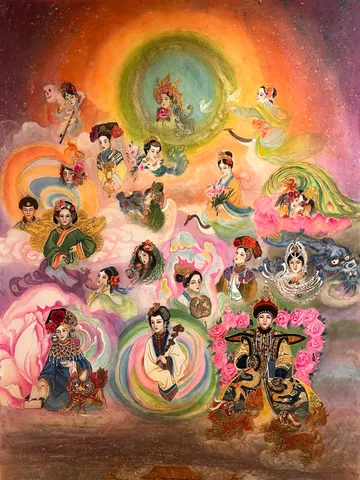
- The rest of the dynasty The empresses of the Qing — the group painting, from Bumbutai to Wanrong.
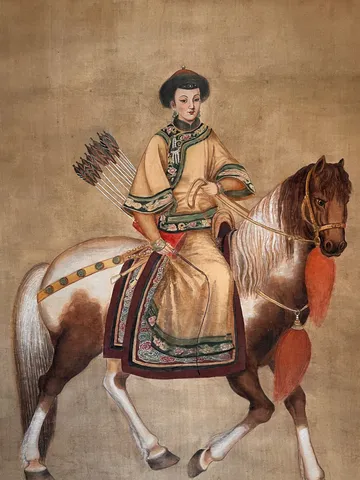
- The other Qing painting Primary Consort Minhui.
- Her nearest ancestor in kind Wu Zetian — the only woman to rule China in her own name. Cixi never took that step, and said so.
- And the first Empress Lü Zhi — who invented the role of the dowager who governs, two thousand years earlier.
About this Painting
| Artist | Xiang Li 李湘 |
| Medium | Chinese watercolor on silk |
| Subject | Empress Dowager Cixi |
| Painted | 2023 |
| Collection | The Chinese Empresses Collection |
| Availability | Original held by the artist · Prints available |