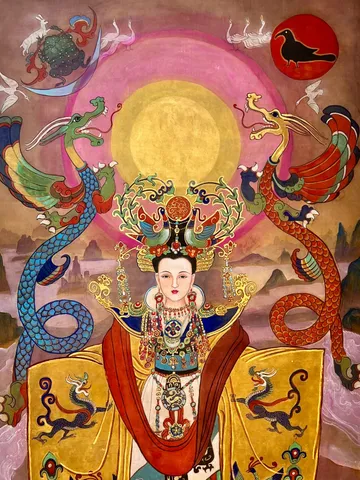
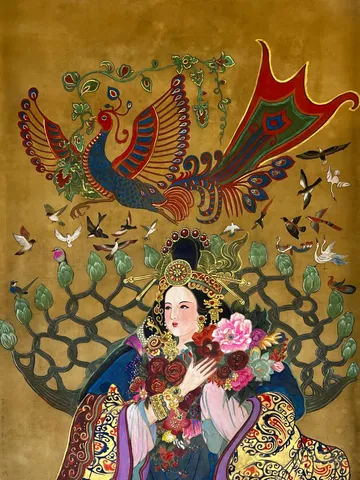
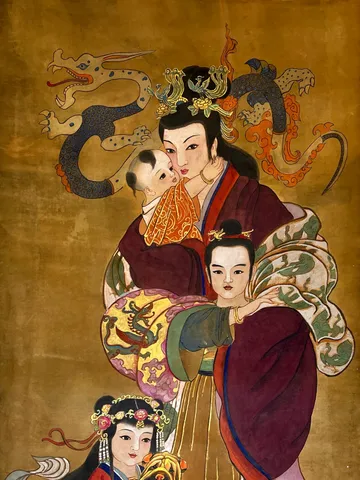
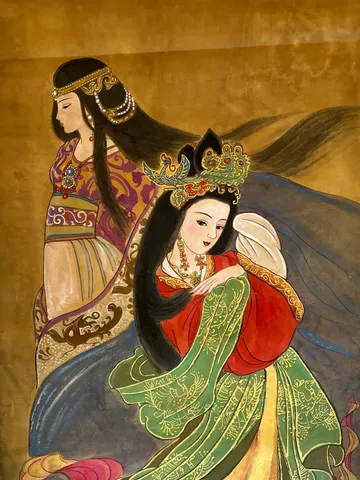
Xu Pingjun, Huo Chengjun y emperatriz Wang
Había sido criado en un hogar de gente común — un bisnieto del Emperador Wu cuya rama familiar completa fue aniquilada en la catástrofe de brujería de
許平君 · 霍成君 · 王皇后
“The Old Sword”
Emperor Xuan’s three empresses. The first was poisoned for holding a title someone else wanted. The second was the poisoner’s daughter. The third was chosen because she was harmless — and outlived them both by fifty years.
Their Story
Emperor Xuan asked his court to find his old sword. It was the most delicate political message in Han history, and everybody understood it.
He had been raised in a commoner household — a great-grandson of Emperor Wu whose entire branch of the family was wiped out in the witchcraft catastrophe of 91 BCE. He grew up poor, in the care of a jailer who had pitied him as an infant. Before anyone imagined he would be emperor, he married a woman named Xu Pingjun, the daughter of a minor palace official.
When Huo Guang put him on the throne in 74 BCE, the court immediately proposed that he make Huo Guang’s daughter empress. Refusing outright was not survivable. So instead the new emperor issued an edict asking his officials to search for a sword he had carried in his days of poverty, because he was fond of it and missed it.
The ministers read it correctly. He was telling them he wanted his first wife. Xu Pingjun was made empress. The phrase 故劍情深 — “deep feeling for the old sword” — has meant faithfulness to a first love in Chinese ever since.
It bought her three years. In 71 BCE, Huo Guang’s wife Lady Xian bribed the court physician Chunyu Yan to poison her while she was recovering from childbirth. Xu Pingjun died at about eighteen. The murder was concealed for years and the emperor did not learn of it until after Huo Guang was dead.
Huo Chengjun became empress the following year — the daughter the court had wanted all along, installed over the body of the woman her mother had killed.
She held the position for four years and used them badly. Xu Pingjun’s son Liu Shi had been made crown prince, and Huo Chengjun tried repeatedly to poison him so that a son of her own might inherit. The attempts failed because the boy’s food was tasted first — a precaution his father had ordered, having buried one wife already.
When Huo Guang died in 68 BCE the family’s protection died with him. The truth about Xu Pingjun’s murder came out, the Huo clan was exterminated in 66 BCE, and Huo Chengjun was deposed and confined. She killed herself twelve years later.
Then Emperor Xuan did something unusual. Rather than choose a third empress for her family, her beauty or her fertility, he looked for a woman who had no children of her own and was known to be kind — and made Empress Wang in 64 BCE for the sole purpose of raising and protecting his murdered wife’s son.
It worked. She had no ambitions, no faction, and no reason to want the boy dead. Liu Shi survived to become Emperor Yuan. Empress Wang lived on as empress dowager and then grand empress dowager, dying in 16 BCE, nearly fifty years after her elevation, having done exactly the one thing she was chosen to do.
The three of them together are the whole machinery of a Han succession laid bare. The first empress was loved and was killed for occupying a position someone else wanted. The second was installed by the family that killed her and destroyed herself trying to finish the job. The third was selected precisely because she was harmless, and outlasted them both by half a century.
A note on the sources
The murder of Xu Pingjun was concealed at the time and only emerged after Huo Guang’s death, when the Huo family fell. That means the account we have was written by the winners of that struggle — which does not make it false, but does mean the Huo women are described by people with reason to condemn them.
- Ban Gu, Hanshu (Book of Han), ch. 8 (Emperor Xuan), ch. 68 (Huo Guang) and ch. 97 — c. 111 CE
- Sima Guang, Zizhi Tongjian — 1084
The Emperor
Emperor Xuan of Han 漢宣帝
Born Liu Bingyi 劉病已, later Liu Xun 劉詢 · 91 – 48 BCE · reigned 74 – 48 BCE
Born in prison. His grandfather was the crown prince destroyed in the witchcraft crisis of 91 BCE, and he survived infancy only because a jailer named Bing Ji hid him and paid wet nurses out of his own pocket. He grew up among commoners, which is why he understood the empire better than any emperor of the dynasty, and his reign is generally reckoned the Han at its most competent — the Xiongnu submitted, taxes were low, and officials were chosen for ability.
Why he matters to their story: all three marriages were about the same problem — how to protect an heir in a court where empresses were killed for their position. His “old sword” edict, and his eventual choice of a deliberately powerless third empress, were both attempts to solve it.
Connections
- Predecessor Empress Shangguan — Grand Empress Dowager throughout Xuan’s reign, and Huo Chengjun’s niece. Both women were installed by Huo Guang using the same method.
- Her son’s empress Empress Xiaoyuan (Wang Zhengjun) — married Xu Pingjun’s son, Emperor Yuan. A different woman from Empress Wang on this page, one generation later.
- Ancestor Empress Wei Zifu — Xuan’s great-grandmother, whose destruction in 91 BCE is why he was born in a prison.
About this Portrait
| Artist | Xiang Li 李湘 |
| Medium | Chinese watercolor on silk, hand-painted on hand-cut silk |
| Dimensions | 36 × 72 inches (91 × 183 cm) |
| Painted | 2012 |
| Subjects | Three empresses — all consorts of Emperor Xuan |
| Collection | The Chinese Empresses Collection |
| Availability | Original held by the artist · Prints available |