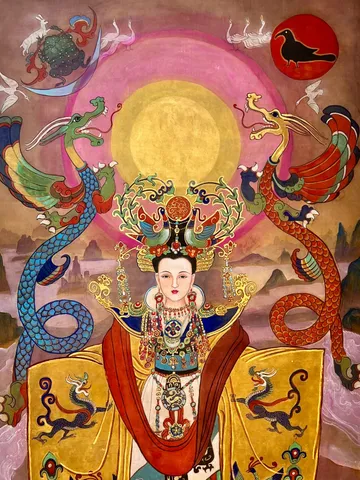
Emperatriz Shangguan
Emperatriz Shangguan: consulta esta página de Emperatrices chinas en Xiang Li Art. El contenido principal está en inglés; la traducción completa está pendiente.
上官皇后
“The Seal”
Empress at six. Her father executed at nine by her own grandfather. At fifteen she signed the edict deposing an emperor — and she held the rank of Grand Empress Dowager for thirty-seven years without ever holding power for a single day.
Her Story
She was made empress at six years old, and by nine her entire paternal family had been executed by her maternal grandfather.
Her father was Shangguan An. Her mother was the eldest daughter of Huo Guang, the regent who governed the Han for twenty years after Emperor Wu’s death. The marriage that produced her was an alliance between two of the most powerful men in the empire, and she was the alliance made flesh.
In 84 BCE, when she was five, her paternal grandfather Shangguan Jie married her to Emperor Zhao, who was eleven. She was created empress the following spring. Neither child had any say in it, and the point of it was not the marriage — it was that whoever controlled the empress controlled access to the emperor.
Four years later the alliance collapsed. The Shangguan faction conspired with Princess Eyi and the emperor’s elder brother to assassinate Huo Guang and take the throne. Huo Guang found out first. In 80 BCE her father and her paternal grandfather were executed along with the whole Shangguan clan.
She was nine years old, and she was spared — not out of mercy, but because she was Huo Guang’s granddaughter too. The family that had made her empress was destroyed by the family that let her keep the title.
Emperor Zhao died in 74 BCE at twenty-one, without children. She was fifteen, and she became empress dowager.
What happened next is the strangest passage in her life. Huo Guang brought in a prince of Changyi, Liu He, to take the throne. Within twenty-seven days Huo Guang decided he was unfit — the charges ran to more than a thousand acts of misconduct — and moved to remove him. But a regent could not depose an emperor. Only an empress dowager could.
So the edict deposing Liu He was issued in the name of a fifteen-year-old girl, and Liu He was sent back to Changyi without a title. It remains one of very few times in Chinese history that a reigning emperor was formally removed, and it was done under the seal of a teenager who had been placed in the palace as a bargaining chip and had watched her father executed six years earlier.
The next emperor was Xuan, a great-grandson of Wu who had been raised in a commoner household after the witchcraft catastrophe of 91 BCE destroyed his branch of the family. Shangguan — eighteen years old, twice a widow of the imperial system if not of a marriage — became grand empress dowager.
She held that rank for thirty-seven years. She was grand empress dowager while still a teenager, and she was still grand empress dowager as a woman in her fifties, having outlasted her husband, the emperor who was deposed in her name, the emperor who followed him, and the regent grandfather who had killed her father.
She died in 37 BCE, aged about fifty-two, and was buried with Emperor Zhao — the boy she had been married to when she was five and who had died before either of them was old enough to have known each other properly.
The record gives her no personality at all. There is no account of what she thought about the destruction of her family, or the deposition she authorised, or the four reigns she sat through. She is present at the centre of Han politics for four decades as a seal, a signature, a name required to make things legal. It is the most complete example in this collection of what the position could be: absolute formal authority, and no power whatsoever.
A note on the sources
Her personal name was never written down. Everything preserved about her concerns things done in her name by other people — chiefly her grandfather Huo Guang, whose biography is where most of her life is recorded.
- Ban Gu, Hanshu (Book of Han), ch. 68 (Huo Guang) and ch. 97 — c. 111 CE
- Sima Guang, Zizhi Tongjian — 1084
The Emperor
Emperor Zhao of Han 漢昭帝
Born Liu Fuling 劉弗陵 · 94 – 74 BCE · reigned 87 – 74 BCE
Emperor Wu’s youngest son, made heir at seven after the witchcraft crisis of 91 BCE destroyed the crown prince and Empress Wei Zifu. His mother was executed before his accession so that no dowager could rule through him. He reigned for thirteen years under Huo Guang’s regency, presided over the reversal of his father’s ruinous war economy, and died at twenty-one without an heir.
Why he matters to her story: they were married as children to bind two regent families together, and both spent their lives as instruments of Huo Guang’s government. Neither of them ever governed anything.
Connections
- Predecessor Empress Wei Zifu — her husband became heir only because Wei Zifu’s son was destroyed in 91 BCE.
- Successors Xu Pingjun, Huo Chengjun and Empress Wang Zhengjun — Huo Chengjun was her aunt, placed on the throne by the same grandfather using the same method.
- Parallel Empress Zhang Yan — the other Western Han child empress, married at about ten and equally powerless.
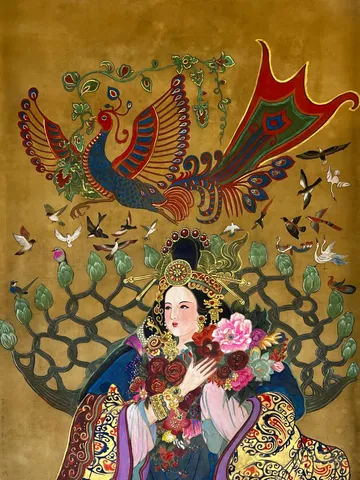
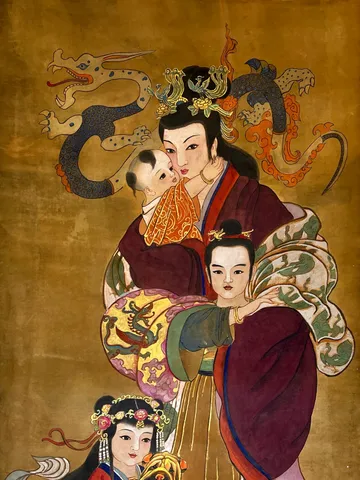
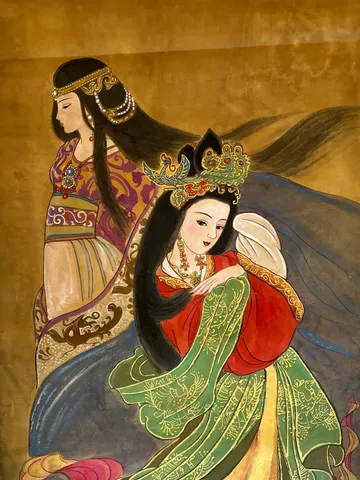
About this Portrait
| Artist | Xiang Li 李湘 |
| Medium | Chinese watercolor on silk, hand-painted on hand-cut silk |
| Dimensions | 36 × 72 inches (91 × 183 cm) |
| Painted | 2012 |
| Collection | The Chinese Empresses Collection |
| Availability | Original held by the artist · Prints available |