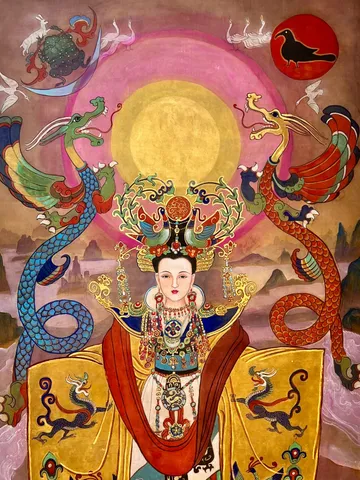
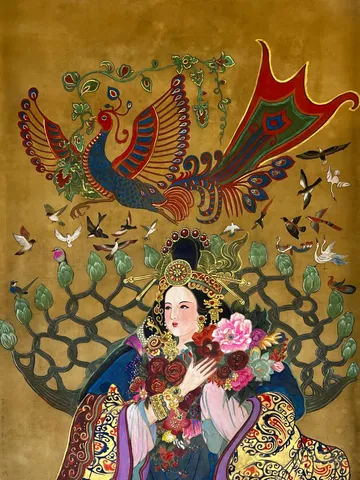
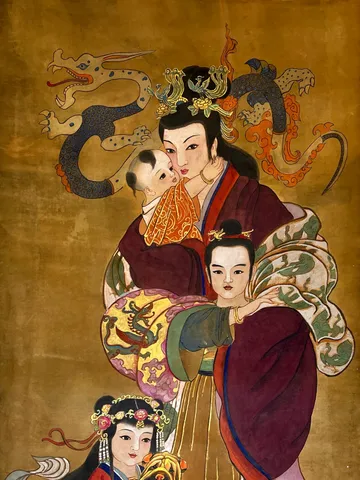
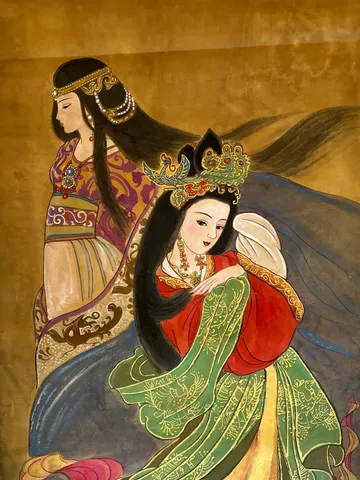
Emperatriz Xu
La Emperatriz Xu provenía de la familia de Xu Pingjun — la emperatriz envenenada dos generaciones antes por ocupar una posición que alguien más quería — y ella era
許皇后
“Blamed for the Eclipse”
Court astronomers argued in writing that the sun had darkened because the emperor loved a childless wife too much. She was deposed on a charge the histories call false, and killed nine years later over letters in which she was the one being cheated.
Her Story
She was blamed for an eclipse.
Empress Xu came from the family of Xu Pingjun — the empress poisoned two generations earlier for occupying a position someone else wanted — and she was married to Liu Ao while he was still crown prince. By every indication the marriage was a happy one, which in this collection is rare enough to be worth stating plainly. When he became Emperor Cheng in 33 BCE she was made empress, and for a decade he had no serious interest in anyone else.
She bore him a son and a daughter. Both died in infancy, and there were no more.
That was the whole of the problem. An empress without a living son had no future, and in the political theology of the Han her body was not a private matter — it was a component of cosmic order. When a solar eclipse occurred, officials submitted memorials explaining it: the emperor’s excessive favour toward a childless empress had disturbed the balance of yin and yang. Court astronomers argued, in writing, that the sun had gone out because of her.
The pressure worked. Her allowances were cut, her household reduced, and the emperor’s attention moved on — to Zhao Feiyan and her sister, newly arrived from a princess’s household.
In late 18 BCE the Zhao sisters accused Empress Xu and Consort Ban of using witchcraft to curse the emperor’s other women. The Hanshu records the accusation as false. It did not matter. Xu’s sister Xu Ye was executed, and on 8 January 17 BCE the empress was deposed and confined to a subsidiary palace.
Consort Ban survived the same charge by asking to be transferred to serve the empress dowager, removing herself from the court entirely. She was a poet, and the poem she is remembered for compares a discarded woman to a silk fan put away at the end of summer — no longer needed once the weather turns.
Fresh-cut white silk, clear as frost and snow — shaped into a fan of joined perfection. Yet I fear the coming of autumn, when cold winds drive out the summer heat: laid aside in a lacquer box, the love that was, cut off midway.
Consort Ban, “Song of Resentment” — accused alongside Empress Xu, and the great-aunt of the historian who recorded it
Nine years later Empress Xu was still alive in confinement, and still trying. She had been corresponding with Chunyu Zhang, a well-placed cousin of the imperial family, who had taken large sums from her on the promise of getting her reinstated. He had no intention of doing so.
In 8 BCE it was Wang Mang — then a rising and impeccably virtuous young official — who discovered the letters and brought them to the emperor. Some were suggestive enough to read as an affair. Chunyu Zhang was executed. The deposed empress was ordered to drink poison.
The exposure destroyed Chunyu Zhang, who had been Wang Mang’s chief rival within the Wang family, and it was the making of Wang Mang’s reputation. Seventeen years later he took the throne and ended the dynasty. His path to it runs directly through a woman writing letters from a locked palace, trying to get her life back.
She had been deposed for a crime she did not commit, and killed for a correspondence in which she was the one being defrauded.
A note on the sources
There is an unusual personal thread here. Consort Ban — accused alongside Empress Xu and cleared — was the great-aunt of Ban Gu, who wrote the Hanshu, and of Ban Zhao, who completed it. The family that produced the official history of the Han had a direct stake in this episode, which may be why the account states so firmly that the witchcraft charge was fabricated.
- Ban Gu, Hanshu (Book of Han), ch. 97 — c. 111 CE
- Ban Gu, Hanshu, ch. 10 — the Annals of Emperor Cheng
- Consort Ban, Yuan ge xing 怨歌行 — “Song of Resentment”
- Sima Guang, Zizhi Tongjian — 1084
The Emperor
Emperor Cheng of Han 漢成帝
Born Liu Ao 劉驁 · 51 – 7 BCE · reigned 33 – 7 BCE
Son of Wang Zhengjun. He handed government to his mother’s family and withdrew from it. Five of his uncles were made marquesses on a single day, and the office of Commander-in-Chief passed from one Wang to another for the rest of the dynasty. He died at about forty-five without an heir.
Why he matters to her story: he loved her, then allowed the court to make her childlessness a cosmological failing, then let her be deposed on an accusation his own historians call false — and finally ordered her death. Nothing in her life happened without his consent.
Connections
- Great-aunt Xu Pingjun — Emperor Xuan’s first empress, poisoned in 71 BCE. Two women of the same family, two generations apart, both destroyed for occupying the position.
- Successor Empress Zhao Feiyan — made the accusation that deposed her, and took the title four months later.
- Mother-in-law Empress Xiaoyuan (Wang Zhengjun) — whose nephew Wang Mang found the letters that killed her.
About this Portrait
| Artist | Xiang Li 李湘 |
| Medium | Chinese watercolor on silk, hand-painted on hand-cut silk |
| Dimensions | 36 × 72 inches (91 × 183 cm) |
| Painted | 2012 |
| Collection | The Chinese Empresses Collection |
| Availability | Original held by the artist · Prints available |