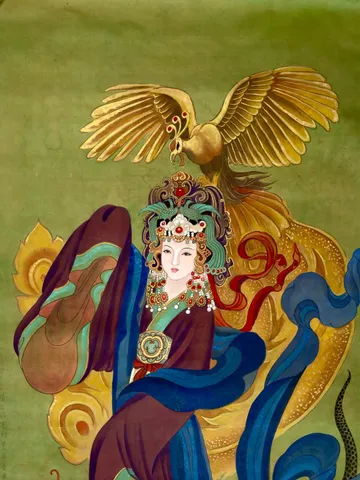
Emperatriz Xiao
Emperatriz Xiao: consulta esta página de Emperatrices chinas en Xiang Li Art. El contenido principal está en inglés; la traducción completa está pendiente.
萧皇后
“Given Away at Birth”
Born in an unlucky month and handed to relatives. Empress of the Sui at thirty-seven. After her husband was strangled by his own guards she passed through a mutineer, a warlord and the Turkic khaganate — and came home at sixty-three to be looked after by the emperor who had destroyed her dynasty.
Her Story
She was born a princess of the Western Liang in the second month of the year, and in the south that was considered unlucky, so her parents gave her away. She was raised by an uncle, and then by an aunt, in ordinary households. She learned to read and to work.
Then Empress Dugu went looking for a wife for her second son, and the diviners kept rejecting the Liang princesses one after another until they reached the one nobody had kept.
She married Yang Guang around 582. She was about fifteen; he was about thirteen.
For nearly twenty years she was the model consort, and that was the strategy — his mother would only accept an heir who was visibly faithful to his wife, so he was visibly faithful to his wife. It worked. His elder brother was deposed in 600, and in 604 Yang Guang became Emperor Yang and she became empress.
And then the man she had spent two decades helping to build turned out to be Emperor Yang of Sui, whose name in Chinese has become a byword.
He completed the Grand Canal, which is one of the great engineering works in human history and is still in use. He did it by conscripting several million labourers, of whom an enormous proportion died. He rebuilt Luoyang the same way. He invaded Korea three times and lost three armies. By 613 the empire was in open revolt.
She wrote him a poem about it. It is titled Rhapsody on Curbing Extravagance, and it is a formal literary remonstrance — the only tool available to her — telling him that he was destroying the dynasty. He read it, praised the writing, and did nothing.
In 616 he took the court south to Jiangdu on the Yangtze and stayed there, and would not hear reports from the north. The histories say he took to looking in a mirror and remarking that it was a fine head, and wondering who would cut it off.
A fine head. I wonder who will cut it off.
Emperor Yang of Sui at Jiangdu, shortly before his own guards strangled him — Zizhi Tongjian, ch. 185
In 618 his own guards, who were northerners and wanted to go home, mutinied. They strangled him with a silk scarf. Empress Xiao and the palace women stripped the boards from the beds to make him a coffin.
Then the eleven years begin.
She was taken by the general who had led the mutiny, and travelled north with him. When he was defeated a few months later she was taken by the warlord who beat him, Dou Jiande, and lived in his camp. When word reached the Eastern Turks that a Sui empress was in China, the khatun of the Turks — who was a Sui princess herself, and Empress Xiao’s sister-in-law — sent envoys to demand her.
Dou Jiande handed her over. She rode north out of China with her grandson, into the steppe.
She lived among the Turks for about a decade.
In 630 the Tang general Li Jing destroyed the Eastern Turkic Khaganate in a winter campaign, and Emperor Taizong sent for her. She came back to Chang’an at sixty-three, and he settled her in the capital and provided for her for the rest of her life.
She died there in 647, aged eighty. Taizong ordered that she be buried with Yang Guang at Jiangdu, with the rites of an empress, and had the posthumous name Min conferred on him for the occasion — the emperor who had overthrown the Sui arranging a proper funeral for the empress of it.
She had been a Liang princess, a Sui empress, a rebel general’s prize, a warlord’s hostage, a guest of the Turkic khaganate, and a pensioner of the Tang. Four dynasties and a steppe empire, and she outlived all of them.
A note on the sources
Her biography in the Sui Shu is short and respectful, and she is one of the very few figures of the period the Tang historians had no reason to attack — she had remonstrated with Yang Guang, she was a victim of what followed, and their own founding emperor had taken her in. Her tomb was excavated at Yangzhou in 2013, alongside Yang Guang’s, which confirmed the joint burial the histories describe.
The decade among the Turks is the least documented stretch and the most extraordinary. What is certain is that she left China with the Turkic embassy and returned with the Tang army eleven years later.
- Wei Zheng et al., Sui Shu (Book of Sui), ch. 36 — 636 CE
- Li Yanshou, Bei Shi (History of the Northern Dynasties) — 659
- Sima Guang, Zizhi Tongjian, ch. 180–193 — 1084
- Excavation report, tomb of Emperor Yang and Empress Xiao, Yangzhou — 2013
The Emperor
Emperor Yang of Sui 隋炀帝
Yang Guang 杨广 · 569 – 618 · reigned 604 – 618
The most notorious ruler in Chinese history, and not a stupid one. He was a capable general who took the south for his father at twenty, a serious poet, and a genuine visionary about infrastructure.
He built the Grand Canal — seventeen hundred kilometres linking the Yangtze to the Yellow River, still the longest artificial waterway on earth and still carrying freight. It permanently changed the economic geography of China and every later dynasty depended on it. He built it in six years with conscript levies numbering in the millions, and the death toll was catastrophic.
He also rebuilt Luoyang, extended the Great Wall, toured the empire in a fleet of dragon boats hauled by teams on the banks, and invaded Korea three times, losing over three hundred thousand men in the first campaign alone.
By 616 the country was in revolt and he had retreated to Jiangdu and stopped listening. His guards strangled him in 618. The posthumous name his conqueror gave him, Yang 炀, means something close to “he who abandoned propriety and destroyed the people.”
Connections
- Her mother-in-law Empress Wenxian (Dugu Qieluo) — who chose her, and who chose her husband as heir.
- The empress who followed Empress Taimu — wife of Li Yuan, the Sui general who took the throne in 618. She had died in 613 and did not see it.
- The emperor who took her in Empress Zhangsun’s husband, Emperor Taizong, who brought her back from the steppe in 630 and buried her with full honours in 647.
- The comparison Empress Xianmu (Cao Jie) — the other empress made to preside over the end of her own dynasty, four centuries earlier.
About this Portrait
| Artist | Xiang Li 李湘 |
| Medium | Chinese watercolor on silk, hand-painted on hand-cut silk |
| Dimensions | approx. 36 × 72 inches (91 × 183 cm) |
| Painted | 2018 |
| Subject | Empress Xiao, consort of Emperor Yang of Sui |
| Collection | The Chinese Empresses Collection |
| Availability | Original held by the artist · Prints available |