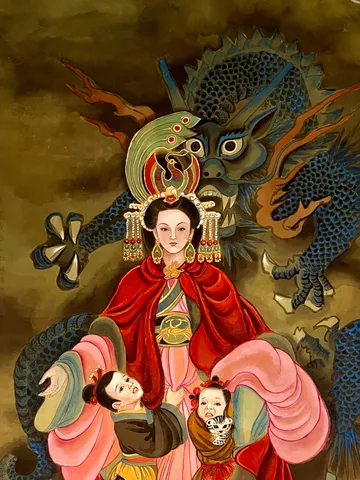
Emperatriz Wenxian
Conoce a Emperatriz Wenxian en la colección Emperatrices chinas de Xiang Li y explora su contexto histórico y sus vínculos con las mujeres de la China imperial.
独孤伽罗 · 文献皇后
“The Two Sages”
At fourteen she made her husband swear he would never father a child by another woman, and he never did — the only emperor in Chinese history of whom that is true. She rode to the palace gates with him every morning and the court called them the Two Sages. Then she chose the wrong son.
Her Story
She was fourteen when she married Yang Jian, and she made him promise, before the wedding, that he would never have a child by another woman.
He kept it. Emperor Wen of Sui is the only emperor in Chinese history with no children by any woman other than his wife. All five of his sons and all his daughters were hers. In a system entirely constructed around the imperial harem, that is not a domestic detail — it is a structural anomaly, and it was her doing.
Her father was a Northern Zhou general who was executed when she was a girl. She was a Xiongnu-descended aristocrat of the north-western military caste, and she was, by universal agreement of the sources, formidably intelligent.
When Yang Jian took the throne from his infant grandson in 581 and founded the Sui, she was there for the decision — she is recorded sending him a message during the crisis telling him that he was riding a tiger and could not dismount.
What followed was one of the great reigns. The Sui reunified China after two hundred and seventy years of division, rebuilt the tax and land systems, recodified the law, and began the Grand Canal. And Empress Dugu was present for the government of it in a way no consort had been since Wu Zetian’s time — she rode to the palace gates with him each morning, waited while he held court, sent officials in with her opinions, and rode home with him. The court called them the Two Sages.
She was also implacable. When she discovered that her husband had slept with a palace maid — the granddaughter of a man his own regime had executed — she waited until he left for the day and had the girl killed.
He came back, was told, and rode out of the palace alone into the mountains, without escort, for twenty li, and had to be chased down by two of his chief ministers and talked into coming back. He is reported to have said, in the middle of the field: I am the Son of Heaven, and I am not free.
I am the Son of Heaven, and I am not free.
Emperor Wen of Sui, having ridden alone into the hills after his wife killed one of his concubines — Zizhi Tongjian, ch. 179
They reconciled. She apologised; he apologised; the ministers were given a banquet. And nothing changed.
Her one catastrophic act was the succession.
The heir was her eldest son Yang Yong, who was competent and unremarkable and had a favoured concubine rather than a favoured wife — which Empress Dugu took as a personal betrayal of everything she had built her marriage on. Her second son, Yang Guang, understood this perfectly. He lived with conspicuous frugality, kept only his wife’s company in public, let the dust settle visibly on his musical instruments, and made sure his mother heard about all of it.
She campaigned for two years. In 600 Yang Yong was deposed and Yang Guang made heir.
She died in 602. Her husband died in 604 — some sources say Yang Guang killed him — and Yang Guang became Emperor Yang: the ruler who worked several million men to death on the Grand Canal and the Great Wall, lost three armies in Korea, and got the dynasty destroyed inside fourteen years.
The Sui had reunified China and it lasted thirty-seven years. The historians blame Yang Guang. They also, without much subtlety, blame the woman who chose him.
A note on the sources
The Sui Shu was compiled under the Tang, by a court that needed the Sui’s collapse to look inevitable — and the standard explanation for a dynasty’s failure was a woman’s interference. Empress Dugu’s jealousy is therefore given enormous weight, and her judgement almost none.
The verifiable parts are striking on their own. The absence of any child by another woman is a matter of the imperial genealogy. The joint attendance at court is recorded as protocol. The removal of Yang Yong is dated. What the histories add is the causal claim that the first thing produced the last, and that is an argument, not a fact.
- Wei Zheng et al., Sui Shu (Book of Sui), ch. 36 — 636 CE
- Li Yanshou, Bei Shi (History of the Northern Dynasties), ch. 14 — 659
- Sima Guang, Zizhi Tongjian, ch. 175–179 — 1084
- Arthur F. Wright, The Sui Dynasty: The Unification of China — Knopf, 1978
The Emperor
Emperor Wen of Sui 隋文帝
Yang Jian 杨坚 · 541 – 604 · reigned 581 – 604
He reunified China. That sentence is doing a great deal of work: the country had been split for two hundred and seventy years, since the fall of the Western Jin, and no one had managed it. In 589 his armies crossed the Yangtze and took the last southern dynasty, and the division was over.
He then rebuilt the state from the ground up. The Sui code became the basis of the Tang code and through it the law of half of East Asia. He revived the examinations, standardised the currency, built granaries that were still full of usable grain fifty years later, and started the Grand Canal.
He was also suspicious, thrifty to the point of meanness, and increasingly harsh — he had officials beaten to death in his presence at court. And he was, by his own account in a field twenty li outside his own capital, not a free man.
He died in 604. There is a persistent and unresolved suggestion that his son killed him.
Connections
- Her daughter-in-law Empress Xiao — married to the son she chose, and carried across half of Asia after his murder.
- Her granddaughterEmpress Yang Lihua of the Northern Zhou was her eldest daughter — the empress whose position Yang Jian used to take the throne in the first place.
- What came next Empress Taimu — whose husband Li Yuan served the Sui, and overthrew it.
- The comparison Wu Zetian — the other consort to hold joint court with an emperor, seventy years later, and the only one to go further.
About this Portrait
| Artist | Xiang Li 李湘 |
| Medium | Chinese watercolor on silk, hand-painted on hand-cut silk |
| Dimensions | approx. 36 × 72 inches (91 × 183 cm) |
| Painted | 2018 |
| Subject | Empress Wenxian (Dugu Qieluo), consort of Emperor Wen of Sui |
| Collection | The Chinese Empresses Collection |
| Availability | Original held by the artist · Prints available |