Kublai Khan — Emperador Shizu de Yuan
Kublai Khan — Emperador Shizu de Yuan: consulta esta página de Emperadores chinos en Xiang Li Art. El contenido principal está en inglés; la traducción completa está pendiente.
元世祖
“Grandson of Genghis, and the first non-Chinese ruler of all China”
He took the Mongol succession by war, declared the Yuan in 1271, and finished the conquest of the Song in 1279 — the first time in Chinese history the whole country was ruled from outside. He moved the capital to Dadu, modern Beijing, and governed through a four-tier caste order with Mongols at the top and southern Chinese at the bottom.
The two invasions of Japan and the campaigns into Vietnam and Java all failed, expensively. What survived him was the capital, the Grand Canal extension that feeds it, and a China administered as one of several Mongol realms.
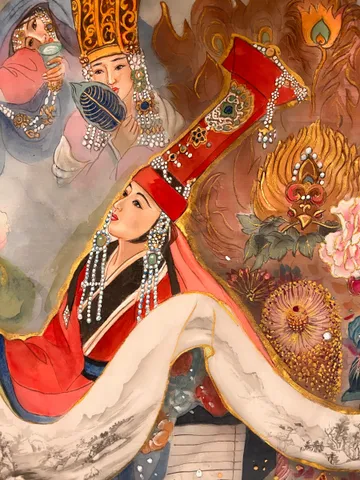
Chabi, his principal wife, was Nestorian Christian in upbringing, sat in on government, and is credited with restraining the treatment of the conquered Song court. She shares a silk with Nambui, who succeeded her.
The empress of this reign
Painted on silk in gemstone mineral pigments by Xiang Li.
About this page
Written for this site to place Kublai's reign around the paintings. For the full biography, the dynastic histories and the scholarship behind them, start at Wikipedia.
Every Yuan emperor
| Reign | Emperor | Painted empresses |
|---|---|---|
| 1260 – 1294 | Kublai 元世祖 Kublai 忽必烈 | |
| 1294 – 1307 | Chengzong 元成宗 Temür 鐵穆耳 / 铁穆耳 | |
| 1307 – 1311 | Wuzong 元武宗 Khayishan 海山 | |
| 1311 – 1320 | Renzong 元仁宗 Ayurbarwada 愛育黎拔力八達 / 爱育黎拔力八达 | |
| 1320 – 1323 | Yingzong 元英宗 Shidebala 碩德八剌 / 硕德八剌 | |
| 1323 – 1328 | Taiding 泰定帝 Yesün Temür 也孫鐵木兒 / 也孙铁木儿 | |
| 1328, one month | Tianshun 天順帝 / 天顺帝 Ragibagh 阿速吉八 | — |
| 1328 – 1332 | Wenzong 元文宗 Tugh Temür 圖帖睦爾 / 图帖睦尔 | |
| 1329, 184 days | Mingzong 元明宗 Kusala 和世㻋 | |
| 1332, 53 days | Ningzong 元寧宗 / 元宁宗 Rinchinbal 懿璘質班 / 懿璘质班 | |
| 1333 – 1368 | Huizong (Shun) 元惠宗 · 元順帝 / 元惠宗 · 元顺帝 Toghon Temür 妥懽帖睦爾 / 妥懽帖睦尔 |