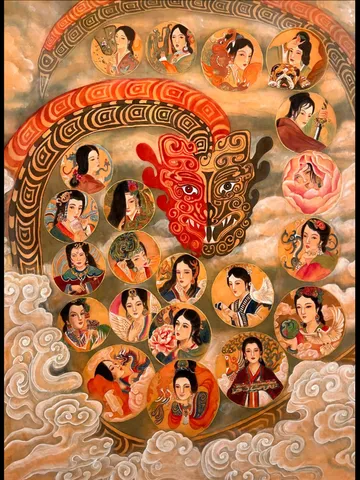
北魏诸皇后
了解李湘《中国皇后》系列中的北魏诸皇后,探索其历史背景及与中国历代宫廷女性的联系。
北魏皇后
“The Rule That Killed Them”
For a hundred and forty-eight years the Northern Wei operated a law with no parallel anywhere else in Chinese history: when a woman’s son was named heir, she was put to death. Not exiled, not demoted — executed, as policy, precisely because she had succeeded.
Their Story
The Northern Wei were Xianbei, from the steppe, and they took the throne of northern China as conquerors. What they built over the next century and a half — the Yungang grottoes, the Longmen caves, the equal-field land system that the Sui and Tang inherited whole — is one of the great cultural achievements of Chinese history.
They also institutionalised the killing of mothers.
The rule was called 子贵母死: when a prince was designated heir, his mother was required to die. The stated justification was Han precedent — Emperor Wu of Han had executed the mother of his young heir to prevent a regency like Empress Lü’s. The Tuoba took a one-off act of paranoia and made it law, and applied it for over a century.
The consequences were not what anyone intended. Because birth mothers were dead, imperial children were raised by wet nurses and by the reigning empress dowager — and so power at the Northern Wei court passed not to consort clans but to foster mothers, who had no sons to lose and could not be removed by the rule. The two most powerful figures in the dynasty’s history reached that position exactly this way.
The empresses themselves were selected by an ordeal: each candidate had to personally cast a small gold statue. If the casting failed, heaven had declined her, and she could not be empress. At least one woman — a Later Qin princess, brought in as a bride with full honours — simply could not do it, and was styled a consort for the rest of her life instead.
The Empresses
Empress Murong慕容氏 · Empress Daowu 道武皇后 Consort Yao姚氏 · Empress Zhaoai 昭哀皇后 Empress Dowager Feng冯太后 · Empress Wenming 文明皇后 Empress Feng Miaolian冯妙莲 Empress Feng Run冯润 Empress Yu于氏 · Empress Shun 顺皇后 Empress Dowager Hu胡太后 · the Divine Tortoise regent Empress Gao高氏 Empress Gao高氏Empress Murong 慕容氏 · Empress Daowu 道武皇后
consort of Emperor Daowu · empress from 400
The youngest daughter of an emperor of the Later Yan, captured at Zhongshan in 397 when the Wei took the city.
In 400 she and a rival were both required to cast the gold figure. Hers succeeded and the other woman’s did not, and so she became the first empress of the dynasty. She is last mentioned in 402.
Consort Yao 姚氏 · Empress Zhaoai 昭哀皇后
d. 420 · consort of Emperor Mingyuan
A princess of the Later Qin, married in 415 and received with the full honours of an empress — and then she could not complete the golden statue.
She was styled an imperial consort instead, though treated as empress inside the palace, and she declined a later offer to regularise it. She was honoured as empress after her death in 420.
Empress Dowager Feng 冯太后 · Empress Wenming 文明皇后
442 – 490 · the most powerful figure in the dynasty
She is the reason the Northern Wei matters. A Han Chinese girl from a family destroyed in a purge, taken into the palace as a slave, she became empress to Emperor Wencheng and — having no son — survived the rule that killed the others.
When he died in 465 she seized the government from a regent by having him arrested in open court, and then governed for twenty-five years, through her stepson and her grandson.
What she did with it changed China. The equal-field system, redistributing land to households by head; the three-elders system of local registration; salaries for officials, who had previously been expected to live off what they could extract. The Sui and Tang inherited all three and ran on them for three hundred years.
She raised her grandson Xiaowen herself, and he completed what she started.
Empress Feng Miaolian 冯妙莲
consort of Emperor Xiaowen · empress 493, deposed 496
A niece of Empress Dowager Feng, married to Xiaowen in 493 and made empress. She was undermined within three years by her own elder half-sister, who had been the emperor’s concubine earlier and came back.
Accusations were made — including that she opposed the sinicisation policy — and she was deposed in 496 and became a Buddhist nun.
Empress Feng Run 冯润
d. 499 · consort of Emperor Xiaowen · empress 496
The elder sister, who replaced her. She had been dismissed from the palace years earlier for illness and returned to displace her own sibling.
She had an affair with a palace attendant named Gao Pusa, which became known while the emperor was away on campaign. He returned, interrogated her, and left her in place rather than face the scandal — but instructed that she was to die with him. When he died in 499 she was compelled to take poison.
Empress Yu 于氏 · Empress Shun 顺皇后
c. 488 – 1 December 507 · consort of Emperor Xuanwu
Promoted for her beauty and character by her powerful uncle, and made empress in 501 at about thirteen. The sources describe her as quiet and tolerant and, pointedly, not jealous.
She bore a son in 506 and died the following year, aged nineteen. Contemporaries believed she had been poisoned by the woman who succeeded her.
Empress Dowager Hu 胡太后 · the Divine Tortoise regent
d. 528 · consort of Emperor Xuanwu · regent 515 – 528
She is the woman who broke the rule. When she became pregnant, her attendants urged her to abort — because if the child was a boy and became heir, she would be killed. She refused, and said aloud that she would rather die than let the dynasty go without an heir.
The child was a boy. Emperor Xuanwu suspended the practice for her, and it was never enforced again.
She then took the regency for him and held it for thirteen years — building the Yongning Pagoda at Luoyang, said to be the tallest wooden structure ever raised in China, and sending the monk Song Yun to India for scriptures.
It ended appallingly. Her son grew up and turned against her; in 528 he died suddenly, poisoned, and she was widely blamed. She put an infant on the throne and then, when that was rejected, a different infant. The frontier general Erzhu Rong marched on Luoyang, took her and the child emperor to the Yellow River, and had them thrown into it. He then killed some two thousand officials of the court on the riverbank.
The dynasty split within six years and never recovered.
Empress Gao 高氏
consort of Emperor Xiaowu · married 533
The eldest daughter of the warlord Gao Huan, married to the emperor Gao Huan had just installed.
The marriage lasted about a year before her husband fled west to a rival warlord without her. No divorce was ever declared. After he was killed she was married off to a prince and given a princess’s title.
Empress Gao 高氏
consort of Emperor Xiaojing of Eastern Wei · married 539
Gao Huan’s second daughter, married to the emperor of the eastern successor state.
When her brother founded the Northern Qi in 550 her husband was demoted, and she was made Princess Taiyuan. She tried to protect him. In 552 he and their three sons were forced to kill themselves, and she was married to one of her brother’s officials.
A note on the sources
The Wei Shu was compiled in 554 by Wei Shou, who was so free with praise and blame that contemporaries called it the filthy history and several families petitioned to have it revised. It was, twice. What survives is therefore partisan — but the institutional facts on this page, the mother-death rule and the golden statue test, are described without embarrassment because they were simply how things were done.
- Wei Shou, Wei Shu (Book of Wei), ch. 13 — the Biographies of the Empresses — 554 CE
- Li Yanshou, Bei Shi (History of the Northern Dynasties), ch. 13 — 659
- Sima Guang, Zizhi Tongjian, ch. 107–157 — 1084
- Jennifer Holmgren, “Women and Political Power in the Traditional T’o-pa Elite”, Monumenta Serica 35 — 1981
Connections
- The southern half The twenty empresses of the Southern Dynasties — the rival courts across the Yangtze.
- What the Wei became The Northern Qi and Northern Zhou empresses — the two states the dynasty split into.
- The precedent for the rule Empress Lü Zhi — whose regency, six centuries earlier, was the stated reason for killing these women.
- Where it led Empress Wenxian — a Xianbei-descended aristocrat of exactly this world, whose husband reunified China in 589.
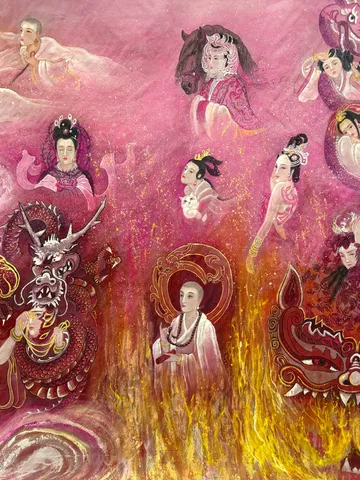
About this Painting
| Artist | Xiang Li 李湘 |
| Medium | Chinese watercolor on silk |
| Painted | 2019 |
| Subjects | The empresses of the Northern Wei |
| Collection | The Chinese Empresses Collection |
| Availability | Original held by the artist · Prints available |