东晋十一位皇后
了解李湘《中国皇后》系列中的东晋十一位皇后,探索其历史背景及与中国历代宫廷女性的联系。
东晋皇后
“The Court in Exile”
A dynasty that lost the north, fled across the Yangtze, and held the south for a hundred and three years with an emperor who could not speak, a general who wanted the throne, and one woman who governed the empire three separate times and gave it back every time.
The Eleven
 Yu MengguEmpress Yuanjing 元敬皇后
d. 312
 Yu WenjunEmpress Mingmu 明穆皇后
297 – 328
 Du LingyangEmpress Chenggong 成恭皇后
321 – 341
 Chu SuanziEmpress Kangxian 康献皇后
324 – 384
 He FaniEmpress Muzhang 穆章皇后
339 – 404
 Wang MuzhiEmpress Aijing 哀靖皇后
d. 365
 Yu DaolianEmpress Xiao 孝皇后
d. 366
 Li LingrongEmpress Dowager Xiaowuwen 孝武文皇后
d. 400
 Wang FahuiEmpress Xiaowuding 孝武定皇后
360 – 380
 Wang Shen’aiEmpress Anxi 安僖皇后
384 – 412
 Chu LingyuanEmpress Gongsi 恭思皇后
384 – 436
Yu Menggu 虞孟母 — Empress Yuanjing 元敬皇后

d. 312 · consort of Emperor Yuan
She never lived to see the dynasty she is counted the first empress of. She married Sima Rui while he was a prince in the north, bore him no sons, and died in 312 — four years before Chang’an fell and five before her husband was proclaimed emperor at Jiankang, on the far side of the Yangtze, with half of China already lost.
He gave her the title posthumously. She is the beginning of the Eastern Jin by paperwork rather than by presence.
Yu Wenjun 庾文君 — Empress Mingmu 明穆皇后

297 – 328 · consort of Emperor Ming
She was empress for three years and empress dowager and regent for three more, governing for her small son Emperor Cheng through her brother Yu Liang.
That was the problem. Yu Liang was rigid, arrogant and frightened of the frontier generals, and in 327 he summoned the general Su Jun to court in order to strip him of his army. Su Jun marched on the capital instead, took it, and sacked it.
Yu Wenjun was in the palace when it fell. She died in 328, aged thirty-one — of grief and terror, the histories say, watching what her family’s policy had brought into the city.
Du Lingyang 杜陵阳 — Empress Chenggong 成恭皇后

321 – 341 · consort of Emperor Cheng
Married at sixteen to the boy emperor his mother had ruled for. She was empress for five years and died in 341 at twenty, childless.
Her husband died the following year at twenty-one. Both of them had spent their entire lives as instruments of other people’s factions and neither left an heir, which is how the throne passed sideways and kept passing sideways for the next eighty years.
Chu Suanzi 褚蒜子 — Empress Kangxian 康献皇后

324 – 384 · consort of Emperor Kang
She governed the empire three separate times, for three different emperors, across forty years. No other woman in Chinese history did that.
She was empress for two years. Her husband Emperor Kang died in 344 and their son took the throne at two, so she became regent — and she did it in the open, holding audience behind a white silk screen in the main hall, which is where the phrase for a dowager regency comes from.
She gave power back when he came of age in 357. He died at nineteen. She came back, ruled for his successor, gave it back again in 365. He died too. Then the throne went to a cousin, and then that cousin was deposed by the warlord Huan Wen — who needed a legal instrument and came to her, and she signed, because the alternative was Huan Wen taking the throne himself.
In 373 Huan Wen died still short of it, and Chu Suanzi returned for a third regency for the boy Emperor Xiaowu. Two years into it, in 383, the entire northern empire of Former Qin came south with an army the sources put at eight hundred thousand men. The Jin met them at the Fei River with about a tenth of that and destroyed them, and the south survived for another two centuries.
She handed the government back and died the year after, aged sixty. She never once refused to return power, and she never once refused to take it up again when asked.
The Empress Dowager sat behind a white silk curtain and the Emperor sat before it, and so the affairs of the empire were decided.
On the first regency of Chu Suanzi, 344 CE — Jin Shu, ch. 32
He Fani 何法倪 — Empress Muzhang 穆章皇后

339 – 404 · consort of Emperor Mu
Married to Emperor Mu at fourteen; widowed at twenty-two when he died in 361. She had no children.
Then she lived another forty-three years — through four more emperors, Huan Wen’s coup, the Fei River campaign, and the beginning of the collapse — as a dowager with a title and a residence and no part in any of it. She was still alive in 404, when the general Huan Xuan briefly usurped the throne and the Jin very nearly ended twenty years early.
Wang Muzhi 王穆之 — Empress Aijing 哀靖皇后

d. 365 · consort of Emperor Ai
Empress for four years. Her husband Emperor Ai was a devotee of the Daoist alchemists and spent his reign eating cinnabar preparations intended to make him immortal. They poisoned him. He stopped attending to government in 364 and died in 365, aged twenty-four.
She died a few months after him.
Yu Daolian 庾道怜 — Empress Xiao 孝皇后

d. 366 · consort of the Deposed Emperor
She died in 366, two years before her husband Sima Yi became emperor — and five years before Huan Wen deposed him on the extraordinary public accusation that he was impotent and that his three sons were not his.
The charge was almost certainly manufactured to justify the coup. But it was made about her marriage, after her death, and it is the reason she is remembered at all. Her posthumous title was granted and then withdrawn when her husband was demoted.
Li Lingrong 李陵容 — Empress Dowager Xiaowuwen 孝武文皇后

d. 400 · consort of Emperor Jianwen
She was a weaver in the palace workshops, and the histories describe her as tall and very dark-skinned — the women around her called her Kunlun, the term the Chinese of this period used for dark-skinned people from the far south and the sea routes beyond it. Her origins are genuinely unknown.
Emperor Jianwen was in his forties and his sons kept dying. A diviner was brought in and told to walk through the household and identify the woman who would bear an emperor. He walked past the consorts and the ladies-in-waiting and stopped in the weaving rooms, and pointed at her.
She bore two sons and a daughter. One of the sons became Emperor Xiaowu; the other became Emperor Jianwen’s heir’s heir. Every subsequent Jin emperor descends from her.
She was honoured as empress dowager in 386 and died in 400, having gone from the loom to the ancestress of the dynasty on the word of one fortune-teller.
Wang Fahui 王法慧 — Empress Xiaowuding 孝武定皇后

360 – 380 · consort of Emperor Xiaowu
Married at fifteen to Li Lingrong’s son. She drank, heavily and publicly, and her father was summoned and told to control her. She died at twenty.
Her husband drank too, and it killed him — in 396 he made a joke to a favourite consort about replacing her with someone younger, went to sleep, and she had him smothered with bedclothes. No one was ever charged.
Wang Shen’ai 王神爱 — Empress Anxi 安僖皇后

384 – 412 · consort of Emperor An
She was the granddaughter of Wang Xizhi — the greatest calligrapher in Chinese history, whose Preface to the Orchid Pavilion Gathering is the most revered piece of writing ever produced in the language. Her father Wang Xianzhi was the second greatest.
She was married at twelve to Emperor An, who could not speak, could not dress himself, and could not tell summer from winter. The Jin Shu says so plainly.
She was empress for sixteen years while the dynasty came apart around a man who did not know it was happening — Huan Xuan usurped the throne and lost it, the general Liu Yu took the government, the court fled the capital twice. She died in 412, aged twenty-eight. Her husband was strangled six years later on Liu Yu’s order.
Chu Lingyuan 褚灵媛 — Empress Gongsi 恭思皇后

384 – 436 · consort of Emperor Gong
The last empress of the Jin. She was a great-grandniece of Chu Suanzi, which closes the dynasty with the same family that had held it together at the Fei River.
Her husband Sima Dewen was put on the throne in 419 by Liu Yu, who had just had the previous emperor strangled, purely so that there would be someone to perform an abdication. It took eighteen months. In 420 Sima Dewen copied out the abdication document himself and reportedly said that the Jin had been finished for a long time and he did not mind.
They were confined together at Moling. Liu Yu sent men with poison; Sima Dewen refused it on Buddhist grounds. So they waited until Chu Lingyuan had been drawn out of the room by her own brothers, went in, and smothered him with a blanket.
She lived on until 436 as Princess of Lingling — sixteen years past the end of the dynasty she had been the last empress of.
A note on the sources
The Jin Shu was compiled in 648 under Tang supervision from a dozen earlier histories of varying quality, and its Eastern Jin chapters are noticeably thinner than its Western Jin ones — several of these women get a paragraph each. Where a life is short here, it is because the record is short, not because the page has been trimmed.
Chu Suanzi is the exception. She has a full biography, and it is worth reading in translation: three regencies, three voluntary retirements, and a signature on a deposition she plainly did not want to give.
- Fang Xuanling et al., Jin Shu (Book of Jin), ch. 32 — the Biographies of the Empresses — 648 CE
- Sima Guang, Zizhi Tongjian, ch. 88–119 — 1084
- Charles Holcombe, In the Shadow of the Han — University of Hawaii Press, 1994
- Albert Dien & Keith Knapp (eds.), The Cambridge History of China, Vol. 2: The Six Dynasties — 2019
Connections
- The dynasty they fled from The Four Empresses of the Western Jin — Luoyang fell in 311 and Chang’an in 316. What survived crossed the Yangtze and became this court.
- What replaced them The Southern and Northern Dynasties — Liu Yu took the throne in 420 and founded the Liu Song, beginning a hundred and sixty years of division.
- The comparison Deng Sui — the other great regent-empress, who ruled for fifteen years and would not let go. Chu Suanzi let go three times.
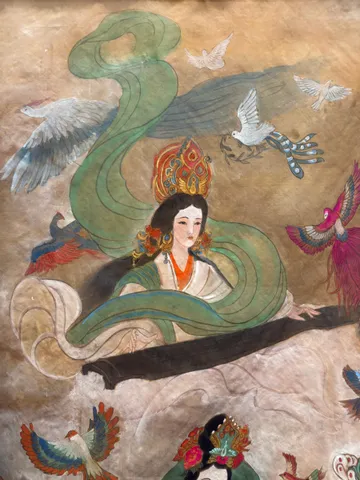
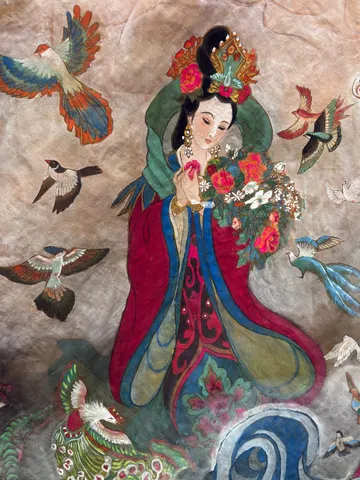
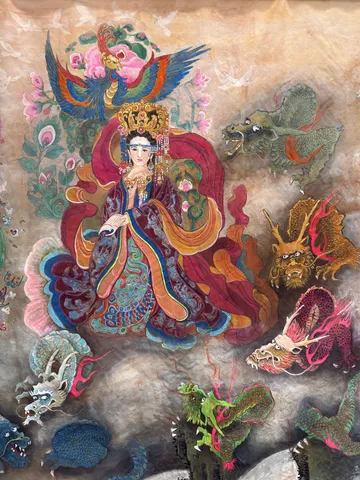
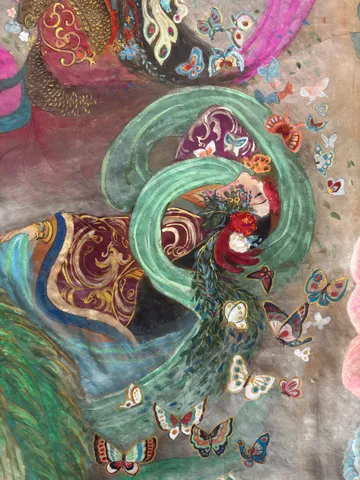
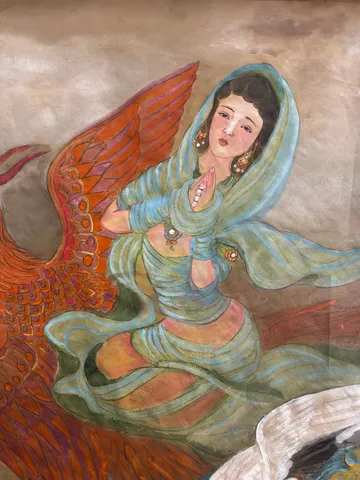
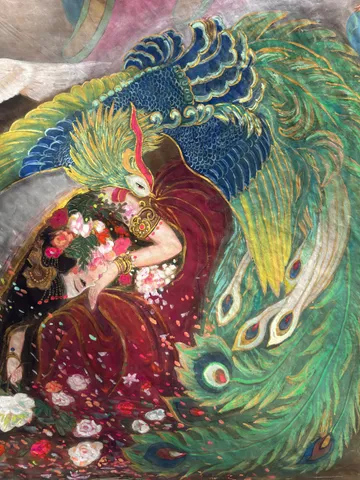
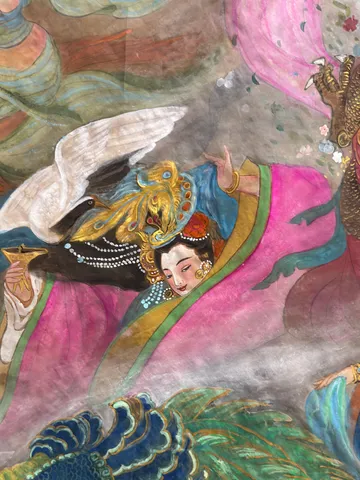
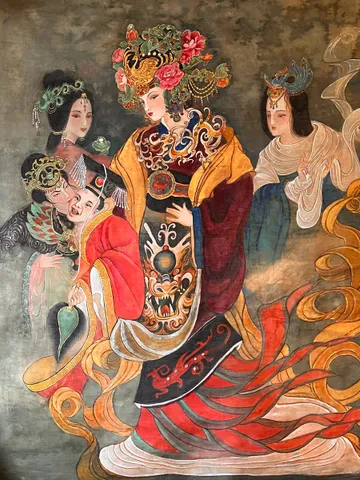
About this Painting
| Artist | Xiang Li 李湘 |
| Medium | Chinese watercolor on silk, hand-painted on hand-cut silk |
| Format | Handscroll — the eleven figures run left to right across a single long silk |
| Painted | 2018 |
| Subjects | All eleven empresses of the Eastern Jin |
| Collection | The Chinese Empresses Collection |
| Availability | Original held by the artist · Prints available |