北齐与北周诸皇后
了解李湘《中国皇后》系列中的北齐与北周诸皇后,探索其历史背景及与中国历代宫廷女性的联系。
北齐皇后 · 北周皇后
“Five Empresses at Once”
Two short, violent states carved out of the wreck of the Northern Wei. One produced an emperor who appointed five empresses simultaneously — the only time in Chinese history — and all five ended their lives as Buddhist nuns. The other collapsed so completely that its empress dowager and its empress were reduced to selling themselves in the streets of the capital that conquered them.
Their Story
When the Northern Wei broke apart in 534 it left two successor states glaring at each other across the Yellow River, and for forty years they fought. The Northern Qi was richer, held the plain, and was ruled by the Gao family. The Northern Zhou held the west, was poorer, and was ruled by the Yuwen.
The Qi lost — not to the Zhou’s strength but to its own emperors, who were, one after another, alcoholic, violent and unwell in ways the histories describe with unusual frankness. The Zhou swallowed it in 577, and was itself taken from the inside four years later by the father of one of the women on this page.
Northern Qi 北齐Lou Zhaojun 娄昭君 · Empress Wuming 武明皇后
501 – 562 · the matriarch of the Gao clan
She was the daughter of a very rich northern family, and she chose her own husband. Watching from the city wall she saw a poor soldier on guard duty below and said that this was the man — then sent her maids to him with her own money so that he could afford the betrothal gifts.
The soldier was Gao Huan, who became the most powerful man in northern China, made and unmade emperors of the Eastern Wei, and founded the house that became the Northern Qi.
She bore him six sons and two daughters. Two of her sons and two grandsons ruled as emperors of the Northern Qi, and she outlived enough of them to depose one grandson personally. She is the closest thing the dynasty had to a stable centre, and it fell apart within fifteen years of her death.
Empress Li Zu’e 李祖娥 · Empress Zhaoxin 昭信皇后
consort of Emperor Wenxuan (Gao Yang, r. 550 – 559)
A Han Chinese woman from a scholarly family, married to Gao Yang before he took the throne, and by all accounts genuinely loved by him — he refused the court’s pressure to replace her with a Xianbei bride.
Gao Yang was also, in his last years, one of the most alarming rulers in Chinese history: he drank continuously, and the Bei Qi Shu records him dismembering a favourite concubine and playing her thighbone as an instrument at a banquet.
After he died in 559 his brother Gao Zhan took the throne — and raped her, threatening her son’s life to force it. She bore a daughter. When he learned of it he beat her nine-year-old son to death in front of her with the handle of a whip; she killed the infant; he beat her nearly to death and had her body thrown into a ditch.
She survived. She became a nun, and she outlived the dynasty.
Empress Hulü 斛律氏
consort of Gao Wei (r. 565 – 577) · deposed 572
The daughter of Hulü Guang, the general who was holding the frontier against the Northern Zhou and was, on the evidence, the only reason the Qi still existed.
The Zhou chancellor solved that problem by having a children’s rhyme circulated in the Qi capital hinting that Hulü Guang would take the throne. It worked. He was summoned and killed in 572.
His daughter was deposed the same day and sent to a convent. Five years later the Northern Zhou took the Qi. Their emperor, entering the ruined palace, is said to have remarked that if Hulü Guang had lived he would never have got there.
Empress Hu 胡氏
consort of Gao Wei · briefly Left Empress
A niece of the empress dowager, introduced into Gao Wei’s household to keep the family’s hold on the palace.
She was raised to Left Empress in the dynasty’s peculiar dual arrangement, ruling the harem alongside her chief rival as Right Empress, and was discarded within months when the emperor lost interest.
Looking at it now, this is far more enjoyable than being an empress dowager. In the palace you are surrounded by rules; here you have your freedom, and you choose your own company.
The Empress Dowager Hu of Northern Qi to Empress Mu Sheli, in Chang’an after the fall — Bei Qi Shu, ch. 9
Empress Mu Sheli 穆舍利
consort of Gao Wei · the last empress of the Northern Qi
She entered the palace as a low-ranking maid, became Gao Wei’s obsession, displaced both of his previous empresses in turn, and was given every luxury the treasury could still produce while the state disintegrated around her.
In 577 the Northern Zhou armies took Ye. She was captured with the rest of the royal family and taken west to Chang’an.
What happened afterwards is recorded, and it is the reason the Northern Qi is remembered as a moral fable. She and her mother-in-law, the empress dowager, were left destitute in the conquering capital and made their living as prostitutes. The older woman is reported to have said to her: Looking at it now, this is far more enjoyable than being an empress dowager. In the palace you are surrounded by rules; here you have your freedom, and you choose your own company.
Northern Zhou 北周Yang Lihua 杨丽华 · Empress Tianyuan 天元皇后
561 – 609 · consort of Emperor Xuan
Eldest daughter of Yang Jian and Dugu Qieluo, married to the Zhou heir at thirteen.
Her husband, Emperor Xuan, was violent and unstable, and she is recorded standing her ground when he raged at her — including once when he ordered her to kill herself, and she refused, and her mother came to the palace and knelt until he relented.
When he died at twenty-one her father took the regency for her seven-year-old stepson, and within a year had taken the throne and founded the Sui.
She never forgave him. The histories say she was openly bitter about it for the rest of her life — she had been empress of a dynasty her own father dismantled. She was made a Sui princess, and died in 609 while travelling with her brother, Emperor Yang.
Zhu Manyue 朱满月 · Empress Tianyuan Dadi
547 – 586 · consort of Emperor Xuan · mother of the last Zhou emperor
She began as a slave in the palace laundry. She bore Yuwen Yun his eldest son, and when that boy was made the child emperor Jing she was raised to empress alongside the others.
Her son was deposed by Yang Jian and murdered at eight years old. She withdrew completely, took vows as the nun Chanjie, and spent the rest of her life praying for him.
Yuchi Chifan 尉迟炽繁 · Empress Tianzuo
566 – 595 · consort of Emperor Xuan
She was already married — to a Zhou prince — when the emperor decided he wanted her. He had her husband forced into suicide and took her into the palace.
After the dynasty fell she became the nun Dayuan, and died in her late twenties in the early years of the Sui.
Chen Yueyi 陈月仪 · Empress Tianzhong
565 – 650 · consort of Emperor Xuan
Daughter of a Chen dynasty official who had defected north. She was raised to empress in the same year as the others, aged about fourteen.
She took vows after the fall and lived, remarkably, into the Tang — dying in 650, sixty-nine years after the dynasty she had been empress of ceased to exist.
Yuan Leshang 元乐尚 · Empress Tianyou
consort of Emperor Xuan
Elevated alongside her close companion Chen Yueyi as part of the five-empress arrangement.
She entered a convent as the nun Huashao after the Sui took the throne, and outlived most of her co-empresses.
A note on the sources — and a correction
Correction: the entry for Empress Hu in The Complete Edition of Chinese Empresses attributes the remark about being a prostitute to her, and describes Empress Mu as her daughter-in-law. That is a conflation of two different women. The speaker was Empress Dowager Hu, Gao Wei’s mother; Empress Hu was his consort and her niece, and Empress Mu was his other consort — a co-empress, not a daughter-in-law. The line belongs to the mother.
The Bei Qi Shu was written under the Tang by a historian whose father had served the Northern Qi, and it is unusually explicit about the private conduct of the Gao emperors — more explicit than any other Chinese dynastic history. Some of it may be Tang propaganda against a defeated house. Enough of it is corroborated in the Bei Shi and the Zizhi Tongjian that the general picture is not seriously disputed.
- Li Baiyao, Bei Qi Shu (Book of Northern Qi), ch. 9 — 636 CE
- Linghu Defen, Zhou Shu (Book of Zhou), ch. 9 — 636 CE
- Li Yanshou, Bei Shi (History of the Northern Dynasties), ch. 14 — 659
- Sima Guang, Zizhi Tongjian, ch. 163–175 — 1084
The Emperors
Emperor Xuan of Northern Zhou 北周宣帝
Yuwen Yun 宇文赟 · 559 – 580 · reigned 578 – 579
He is the reason there are five empresses on this page. At twenty he styled himself Heavenly Emperor, abdicated in favour of his six-year-old son so that he could hold power without the duties of the office, and then appointed five women as empress simultaneously — an arrangement with no precedent and no repetition.
He beat his own empresses. He had his father’s most capable minister, his own uncle, executed. He drank, and he was dead at twenty-one, having reigned for a year.
His father-in-law Yang Jian took the regency for the child emperor, and within a year had the throne. The Sui began; nine years later it took the south, and China was one country again for the first time in two hundred and seventy years.
Emperor Wu of Northern Zhou, his father, deserves better than the sentence he usually gets: he destroyed the Northern Qi in 577, suppressed both Buddhism and Daoism to get the monastery lands and the men back on the tax rolls, and was preparing to march on the Turks when he died at thirty-five. Had he lived, the Zhou would probably have reunified China and there would have been no Sui and no Tang.
Connections
- The other northern state The empresses of the Northern Wei — the dynasty both of these were carved out of.
- Across the river The twenty empresses of the Southern Dynasties.
- Yang Lihua’s mother Empress Wenxian (Dugu Qieluo) — who knelt in this palace to save her daughter, and whose husband then took the throne.
- What it became Empress Xiao — the Sui, reunification, and thirty-seven years later the whole thing collapsing again.
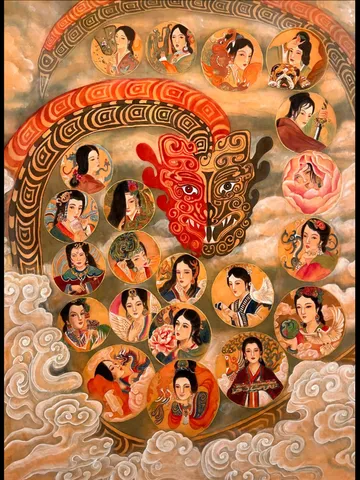
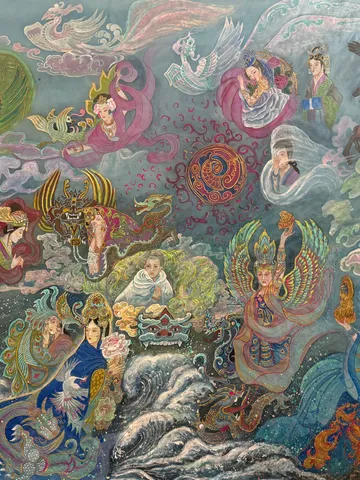
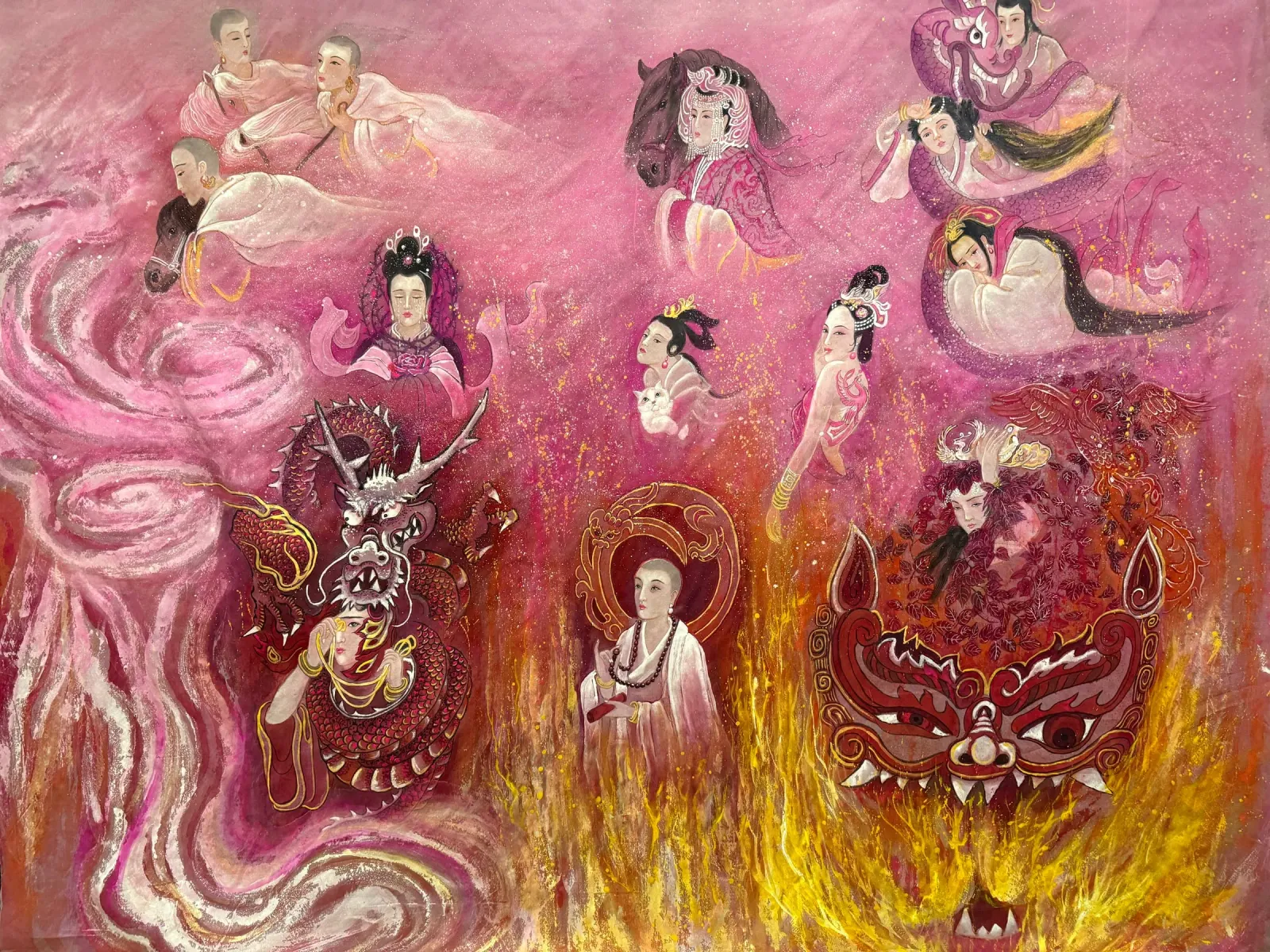
About this Painting
| Artist | Xiang Li 李湘 |
| Medium | Chinese watercolor on silk |
| Painted | 2019 |
| Subjects | The empresses of the Northern Qi and the Northern Zhou |
| Collection | The Chinese Empresses Collection |
| Availability | Original held by the artist · Prints available |