吕雉皇后
吕雉皇后:浏览李湘艺术网站的中国历代皇后资料。本页正文暂为英文,完整译文待补充。
呂雉
“The First Woman in Power”
The first woman to hold the title Empress of China — and, for fifteen years, the first to rule a unified China outright. Sima Qian recorded her among the sovereigns. History remembered her as a monster.
Her Story
When Sima Qian sat down to write the Records of the Grand Historian a century after her death, he made a decision that still startles readers. He placed Lü Zhi in the benji — the Basic Annals, the section of his history reserved for reigning sovereigns. She never took the title of emperor. Sima Qian recorded her as one anyway, because for fifteen years she was the person who ruled.
She did not begin near power. Lü Zhi was born around 241 BCE into a family from Shanfu in modern Shandong, and married to Liu Bang when he was a minor local patrol officer with a drinking habit and no prospects — a match her father made over her mother’s objections. The years that followed were not courtly. She farmed. And when civil war broke out after the Qin collapse, she was captured by Liu Bang’s rival Xiang Yu after the rout at Pengcheng in 205 BCE and held hostage in the enemy camp for roughly two years, her life contingent on her husband’s battlefield fortunes. She was released in 203 BCE under a truce.
She returned to a husband who was about to become the founding emperor of the Han — and to a court full of generals who had helped him win it. Lü Zhi understood, as the Shiji tells it, that a dynasty’s first decade is its most fragile. While Gaozu was campaigning in 196 BCE, she engineered the execution of Han Xin, the most brilliant commander of the age, and then of Peng Yue. Sima Qian frames these as the acts of a woman defending a house — and a clan — that could be destroyed at any moment.
Gaozu died in 195 BCE. What followed is the episode that has defined her ever since. Lü Zhi moved against Consort Qi, her rival for the late emperor’s affection and the mother of a rival heir. She had Qi’s son Liu Ruyi poisoned, and Qi herself mutilated and confined. Lü Zhi then brought her son, the young Emperor Hui, to look at what she had done. He fell ill for a year, and afterwards withdrew from government entirely. “This is not the act of a human being,” he is recorded as saying. “As the Empress Dowager’s son, I will never be able to govern the empire.”
So she governed it. For the next fifteen years — through Hui’s reign until 188 BCE, then as regent for two child emperors — Lü Zhi held the Han state. Her administration followed the light-handed Huang-Lao approach that would define the early Han: taxes kept low, the harsh Qin penal code steadily unwound. In 191 BCE the law criminalising the private possession of books was repealed, along with the statute punishing “subversive speech” — measures that helped make the Han a literate empire rather than a second Qin.
Her statecraft showed most clearly in what she chose not to do. In 192 BCE the Xiongnu ruler Modu Chanyu sent her a letter proposing, in barely veiled terms, that two lonely rulers might console one another. It was a calculated humiliation. Lü Zhi’s first instinct was to execute the envoy and go to war; the officer Ji Bu talked her out of it, arguing the Han could not yet win. Her reply survives: she was old, she wrote, her hair and teeth were falling out, her step unsteady — the Chanyu had been misinformed, and was not to trouble himself. She sent carriages and horses with it. The insult went unanswered and the border stayed quiet.
She died in 180 BCE. Within months the Liu princes and the ministers who had served Gaozu destroyed the Lü clan almost to the last member and put Emperor Wen on the throne. The people who wrote the history of her reign were the people who had just overthrown her family.
Though she ruled as a woman from within her chambers, the empire was at peace; punishments were rare and criminals few; the farmers worked their fields, and there was food and clothing enough.
Sima Qian, Shiji — closing verdict on the reign of Empress Lü
That verdict matters for how we read her. Sima Qian, writing closer to the events, presents the struggle as a contest between two great houses, the Liu and the Lü, with fear as Lü Zhi’s governing motive. Two centuries later Ban Gu rewrote the same material in the Hanshu and shifted the emphasis — cruelty became a trait of her character rather than a move in a political war, and the Lü clan became usurpers rather than rivals. Ban Gu’s version is the one that travelled. It is why she is remembered as a monster and not as a ruler.
Both readings sit in the same woman. She was the first to hold the title Empress of China, the first woman to rule a unified China, and she did it by methods that the men who did the same thing were rarely asked to answer for.
A note on the sources
Everything known about Lü Zhi comes from histories written after her clan was annihilated. The two principal accounts disagree in emphasis: Sima Qian treats her as a political actor in a clan war, while Ban Gu recasts the same events as personal cruelty and usurpation — and Ban Gu’s reading is the one that shaped her reputation for two thousand years.
- Sima Qian, Shiji (Records of the Grand Historian), ch. 9 — c. 94–91 BCE
- Ban Gu, Hanshu (Book of Han), ch. 3 — c. 111 CE
- Sima Guang, Zizhi Tongjian — 1084
- Hans van Ess, “Praise and Slander: The Evocation of Empress Lü in the Shiji and the Hanshu,” NAN NÜ 8:2 (2006)
The Emperor
Emperor Gaozu of Han 漢高祖
Born Liu Bang 劉邦 · 256 – 195 BCE · reigned 202 – 195 BCE
A village patrol officer from Pei with no rank and no education, who joined the revolt against the Qin and finished it as emperor of a unified China — the first commoner in Chinese history to do so. He beat the aristocrat Xiang Yu in five years of civil war, then spent his reign dismantling the very generals who had won it for him. Lü Zhi did much of that dismantling on his behalf.
Why he matters to her story: Gaozu built a dynasty but left it structurally unfinished — powerful kings, unproven succession, an untested code of law. Lü Zhi’s fifteen years were spent holding that unfinished thing together.
Connections
- RivalConsort Qi 戚夫人. Competed for Gaozu’s affection and for the succession. Lü Zhi destroyed her in 194 BCE.
- Granddaughter and daughter-in-law Empress Zhang Yan 張嫣. Married to her own uncle, Emperor Hui, on Lü Zhi’s arrangement, at roughly ten years old.
- Successor in power Empress Dou 竇太后. Rose in the court Lü Zhi built, and later wielded the same dowager power under Wen and Jing.
- Historical parallel Empress Wu Zetian 武則天. Eight centuries later, took the title Lü Zhi never claimed.
- Historical parallel Empress Dowager Cixi 慈禧. The last of the line Lü Zhi began: rule from behind the throne, and the same posthumous character assassination.
About this Portrait
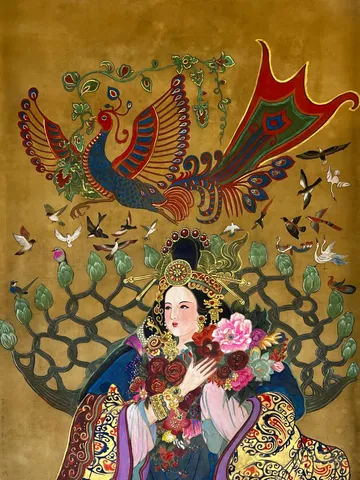
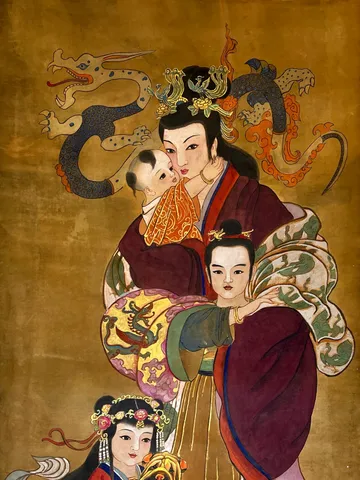
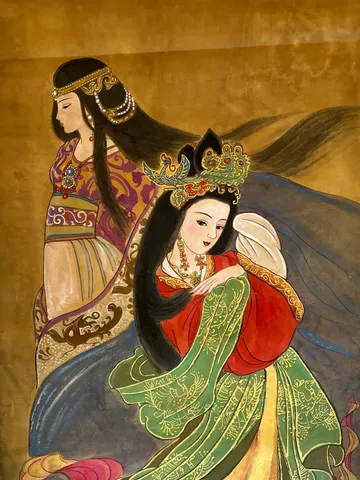
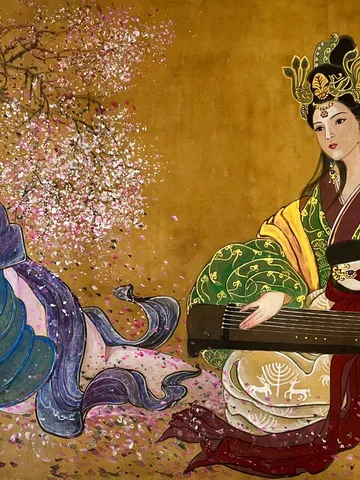
| Artist | Xiang Li 李湘 |
| Medium | Chinese watercolor on silk, hand-painted on hand-cut silk |
| Dimensions | 36 × 78 inches (91 × 198 cm) |
| Painted | 2012 |
| Collection | The Chinese Empresses Collection |
| Availability | Original held by the artist · Prints available |