北宋前期诸皇后
了解李湘《中国皇后》系列中的北宋前期诸皇后,探索其历史背景及与中国历代宫廷女性的联系。
北宋前期皇后
“The Century of Regents”
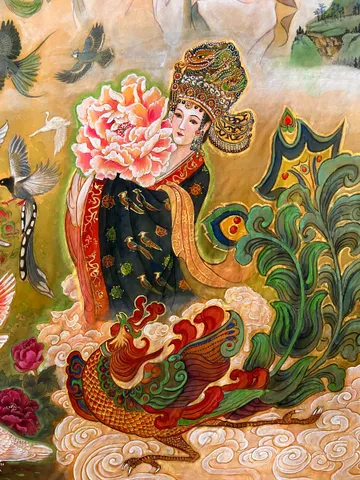
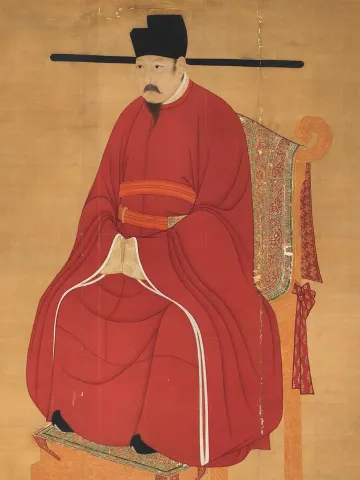
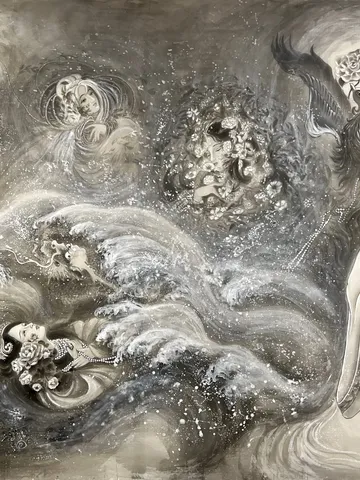
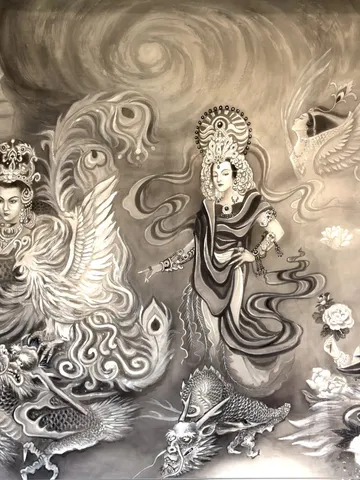
Thirteen empresses across six emperors, on one silk. Three of them governed the empire outright — a street drummer’s daughter, a general’s granddaughter, and a woman the language called the Yao and Shun among women. All three handed power back.
The Thirteen
 XiaohuiTaizu
 XiaomingTaizu
 XiaozhangTaizu
 ShudeTaizong
 YideTaizong
 MingdeTaizong
 ZhanghuaiZhenzong
 ZhangmuZhenzong
 Zhangxian MingsuZhenzong
 GuoRenzong
 Cisheng GuangxianRenzong
 XuanrenYingzong
 Qinsheng XiansuShenzong
Empress Xiaohui 孝惠皇后 · Lady He

consort of Emperor Taizu · d. 958 · honoured posthumously
She married Zhao Kuangyin while he was an officer in the Later Zhou army and died in 958 — two years before the night at Chenqiao Post Station when his officers put a yellow robe on him and made him emperor.
She never knew. He honoured her as empress after his accession.
Empress Xiaoming 孝明皇后 · Lady Wang

consort of Emperor Taizu · 942 – 963 · empress 960 – 963
The first woman actually to hold the title in the Song. She was seventeen at the founding, was known for her Buddhist devotion and her skill on the pipa, and died at twenty-one.
Empress Xiaozhang 孝章皇后 · Lady Song

consort of Emperor Taizu · 952 – 995 · empress 968 – 976
She is at the centre of the greatest unsolved mystery in Chinese history. On a snowy night in 976 Emperor Taizu drank alone with his younger brother; the attendants outside reported seeing shadows moving strangely by candlelight and hearing the sound of an axe striking the floor. In the morning Taizu was dead, aged forty-nine and in good health.
Empress Song, then twenty-four, sent a eunuch to fetch Taizu’s son. The eunuch went and fetched the brother instead. When he walked in she understood immediately what had happened, and said: the lives of us both are now in your hands.
He answered that they would share wealth and honour, and he took the throne as Emperor Taizong. She lived another nineteen years and was denied an empress’s funeral rites when she died.
Empress Shude 淑德皇后 · Lady Yin

consort of Emperor Taizong · d. before 976 · honoured posthumously
Taizong’s first wife, who died before he became emperor and was honoured after it. Almost nothing else survives.
Empress Yide 懿德皇后 · Lady Fu

consort of Emperor Taizong · 941 – 975 · honoured posthumously
A daughter of the general Fu Yanqing — which makes her the younger sister of the Fu empresses of the Later Zhou. One family supplied consorts to two consecutive dynasties.
She died in 975, a year before her husband took the throne.
Empress Mingde 明德皇后 · Lady Li

consort of Emperor Taizong · 960 – 1004 · empress 984 – 997
Taizong’s third wife and the only one to hold the title in life. When he died in 997 a senior eunuch tried to persuade her to set aside the heir and enthrone a different son; the chancellor Lü Duan blocked it in the palace and had the door held shut until the rightful heir was on the throne.
She was empress dowager for seven years afterwards.
Empress Zhanghuai 章怀皇后 · Lady Pan

consort of Emperor Zhenzong · 968 – 989 · honoured posthumously
Married to Zhenzong when he was a prince, and dead at twenty-one, eight years before he took the throne.
Empress Zhangmu 章穆皇后 · Lady Guo

consort of Emperor Zhenzong · 975 – 1007 · empress 997 – 1007
Empress through the first decade of the reign, including the Chanyuan Treaty of 1005 — the settlement with the Liao that bought the Song a hundred and twenty years of peace in exchange for an annual payment, and which historians have argued about ever since.
She died in 1007, and her successor was a woman the entire court had spent years trying to keep out.
Empress Zhangxian Mingsu 章献明肃皇后 · Liu E 刘娥

consort of Emperor Zhenzong · 969 – 1033 · empress 1012 · regent 1022 – 1033
She was an orphan from Sichuan who played a hand-drum in the street for money, and she ended as the first woman to govern the Song.
She was married young to a silversmith who took her to the capital and, unable to support her, effectively sold her into the household of the prince who became Emperor Zhenzong. His father found out and ordered her expelled; the prince hid her in an official’s house for fifteen years.
She came back when he took the throne, and rose. The court fought it hard — she had no family, no background, and the objection was explicit that a drum-girl could not be empress. She became empress in 1012 anyway, and by the last years of the reign she was reading the memorials.
When Zhenzong died in 1022 she governed for eleven years for a child emperor. She was competent, financially astute, and unforgiving of corruption. She also wore imperial robes to sacrifice at the ancestral temple — and when officials suggested she take the final step, as Wu Zetian had, she is recorded saying she would not do such a thing to the ancestors of the Zhao house.
She died in 1033. Chinese historians rank her with Empress Lü and Wu Zetian as one of the three great women rulers — and note that she is the only one of the three who gave it back.
Empress Guo 郭皇后

consort of Emperor Renzong · 1012 – 1035 · empress 1024 · deposed 1033
Chosen for the young emperor by Liu E over his own preference. After Liu E died he moved quickly: during a quarrel between consorts she swung at a rival, and the emperor stepped between them and took the blow across the neck.
He showed the scratch to his chancellor, and she was deposed within days and sent to a Daoist convent. She died two years later at twenty-three, and it was widely believed she was poisoned.
Empress Cisheng Guangxian 慈圣光献皇后 · Lady Cao

consort of Emperor Renzong · 1016 – 1079 · empress 1034 · regent 1063 – 1064
Granddaughter of one of the founding generals, and by common consent the most level-headed empress of the dynasty. In 1048 a group of palace guards mutinied at night and got as far as the emperor’s quarters; she cut the hair of the servants she sent out to fight them so that she could identify and reward them afterwards, and organised the defence of the door herself.
She was regent for the sickly Emperor Yingzong, then a restraining presence over Shenzong — she opposed Wang Anshi’s reforms in person, arguing that they were breaking the very households they were meant to help.
She died in 1079, having been empress, dowager and grand dowager across three reigns and forty-five years.
Empress Xuanren 宣仁皇后 · Lady Gao

consort of Emperor Yingzong · 1032 – 1093 · regent 1085 – 1093
Raised in the palace by Empress Cao, her aunt, and married to the future Yingzong as a child — the court called them the bride and groom of the inner palace.
When Shenzong died in 1085 leaving a nine-year-old, she took the regency and reversed the entire reform programme in a matter of months, recalling Sima Guang and the conservatives and dismantling Wang Anshi’s system. Whether that was salvation or catastrophe is still the central argument of Song historiography.
She refused honours for her own family absolutely, and contemporaries called her the Yao and Shun among women — the highest compliment the language had. She died in 1093, and her grandson spent his adult reign undoing everything she had done.
Empress Qinsheng Xiansu 钦圣宪肃皇后 · Lady Xiang

consort of Emperor Shenzong · 1046 – 1101 · regent 1100
Great-granddaughter of a Song chancellor, and empress through the reform years. She had no children.
In 1100 Emperor Zhezong died at twenty-three with no heir, and the succession fell to her. The chancellor Zhang Dun objected to her choice on the grounds that the prince was frivolous and unfit to rule an empire. She overruled him.
The prince became Emperor Huizong — the greatest painter ever to sit on the Chinese throne, and the emperor under whom the Northern Song was destroyed and who died a prisoner in Manchuria. Zhang Dun had been right.
She died the following year, having governed for seven months.
A note on the sources
The Song is the best-documented pre-modern state in the world. The Song Shi runs to nearly five hundred chapters, the Xu Zizhi Tongjian Changbian reconstructs the court day by day, and private writing survives in volume. The result is that these women have real biographies rather than fragments.
The one genuine mystery is the death of Emperor Taizu in 976 — the shadows, the axe, the brother on the throne by morning. No contemporary source states plainly what happened, and Chinese historians have argued about it for a thousand years without resolution.
- Tuotuo et al., Song Shi (History of Song), ch. 242 — the Biographies of the Empresses — 1345
- Li Tao, Xu Zizhi Tongjian Changbian — 12th century
- Patricia Buckley Ebrey, The Inner Quarters: Marriage and the Lives of Chinese Women in the Sung Period — California, 1993
- John W. Chaffee, Branches of Heaven: A History of the Imperial Clan of Sung China — Harvard, 1999
Connections
- What came next The end of the Northern Song — Huizong, the emperor Empress Xiang chose, and the catastrophe of 1127.
- The dynasty before Empress Chai and the Later Zhou — Zhao Kuangyin took the throne from the Fu dowager’s seven-year-old son in 960.
- The comparisons Empress Lü Zhi and Wu Zetian — the two women Liu E was measured against, and the one thing she did that neither of them did.
About this Painting
| Artist | Xiang Li 李湘 |
| Medium | Chinese watercolor on silk |
| Subjects | Thirteen empresses of the early Northern Song, on one silk |
| Painted | 2022 |
| Collection | The Chinese Empresses Collection |
| Availability | Original held by the artist · Prints available |