柴皇后与后周诸皇后
了解李湘《中国皇后》系列中的柴皇后与后周诸皇后,探索其历史背景及与中国历代宫廷女性的联系。
柴氏 · 符氏
“The Last Nine Years”
One chose a common soldier at a roadside inn and he founded the dynasty. One walked out of a sacked city and talked an army out of touching her. One handed the throne to a seven-year-old and lost it, six months later, to a yellow robe and a night march.
Their Story
The Later Zhou lasted nine years and is the most consequential of the Five Dynasties, because it is the one that nearly worked. Its second emperor was the best ruler China had produced in a century, and when he died at thirty-eight his generals took the throne from his seven-year-old son and founded the Song.
Three women stand at the corners of that.
Empress Chai — Empress Shengmu
She had been a palace woman of Emperor Zhuangzong of the Later Tang. When he was killed in the mutiny of 926 the new emperor dismissed the palace household, and she was sent home with the others.
Her parents came to meet her on the road, and at an inn near the Yellow River crossing she saw a young soldier of the garrison and told them that this was the man she intended to marry.
They were appalled. She was a court lady of good family; he was a common soldier with a tattooed neck and a reputation for drinking. She argued, then divided her money with them, kept her half, and married him anyway.
The soldier was Guo Wei. Twenty-five years later he took Kaifeng and founded the Later Zhou.
She did not live to see it. She was honoured as Empress Shengmu after his accession, and he never appointed another empress.
Empress Fu the Elder — Empress Xuanyi
She was the daughter of the general Fu Yanqing, and her first husband was the son of the warlord Li Shouzhen.
In 949 Li Shouzhen rebelled and was besieged at Hezhong by Guo Wei. When the city fell the family killed themselves, and the soldiers came through the compound.
She walked out to meet them. She told them she was the daughter of Fu Yanqing, that her father commanded armies, and that any man who touched her would answer to him.
I am the daughter of Fu Yanqing. My father commands armies. Whoever lays a hand on me will answer to him.
Empress Fu the Elder to the soldiers at the fall of Hezhong, 949 CE — Jiu Wudai Shi, ch. 121
They took her to Guo Wei, who heard the story, treated her as a daughter, and sent her home under escort.
She then married his heir, Chai Rong, and became empress when he took the throne in 954. She died two years later, aged twenty-six.
Empress Fu the Younger — and the end
Her younger sister married Chai Rong after her death and became empress in her turn.
In 959 Chai Rong died suddenly on campaign, aged thirty-eight, in the middle of the most successful military recovery of the century — he had beaten the Later Shu, taken fourteen prefectures from the Southern Tang, and was pushing north to recover the Sixteen Prefectures when he fell ill.
His heir was seven years old. Empress Fu the Younger became empress dowager.
In the first month of 960, with a reported Khitan incursion on the frontier, the army marched north under Zhao Kuangyin. At Chenqiao Post Station, forty li from the capital, his officers put a yellow robe on him while he was — according to the official version — asleep and drunk, and proclaimed him emperor.
He turned the army around and entered Kaifeng without a fight. The child abdicated. The dowager was moved to a residence and both were kept alive and provided for, which by the standards of the previous fifty-three years is remarkable in itself.
The Song dynasty began, and the Five Dynasties ended. It would last three hundred and nineteen years.
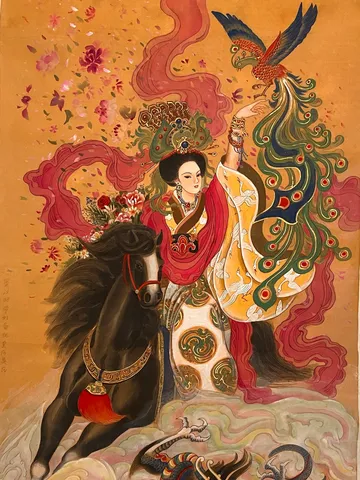
A note on this painting
The subject of this painting is Empress Chai — Empress Shengmu, the wife of Guo Wei, confirmed by the artist. The page has carried the title Empress Fu the Elder, which belongs to a different woman a generation later: Chai was Guo Wei’s wife, Fu married his heir Chai Rong.
Xiang Li’s own file name had it right, as it has almost every time on this project. The page now covers all three Later Zhou empresses in sequence, with Empress Chai as the subject of the portrait. The URL is unchanged to protect its search history; the page title has been corrected.
- Xue Juzheng et al., Jiu Wudai Shi (Old History of the Five Dynasties), ch. 121 — 974
- Ouyang Xiu, Xin Wudai Shi (New History of the Five Dynasties), ch. 20 — c. 1073
- Sima Guang, Zizhi Tongjian, ch. 288–294 — 1084
The Emperors
Emperor Taizu of Later Zhou 后周太祖
Guo Wei 郭威 · 904 – 954 · reigned 951 – 954
An orphan raised by an aunt, a soldier at eighteen with a flying-sparrow tattoo on his neck that gave him his nickname. He was the general Empress Li’s son tried and failed to have killed in 950, and he took the throne with her written blessing.
He was, unusually for the period, a reformer rather than a warlord: he cut taxes, abolished the punishment of families for one man’s crime, and lived plainly enough that his own funeral instructions specified an earthenware coffin and no gold.
Emperor Shizong 后周世宗 · Chai Rong 柴荣 · 921 – 959 — his wife’s nephew, adopted as heir, and by wide agreement the ablest emperor of the tenth century. In five years he reorganised the army, surveyed and redistributed land, standardised the currency by melting down surplus Buddhist statuary, beat the Southern Tang and the Later Shu, and had begun taking back the Sixteen Prefectures when he fell ill and died at thirty-eight.
Had he lived another decade there would very probably have been no Song dynasty.
Connections
- The dynasty before Empress Li (Later Han) — who issued the edict that made Guo Wei emperor.
- What came after The Song empresses — Zhao Kuangyin took the throne from the Fu dowager’s son in 960.
- Across the river The Zhou sisters of Southern Tang — the southern court Chai Rong took fourteen prefectures from.
- The comparisonLou Zhaojun of the Northern Qi — the other empress who saw a poor soldier and decided, on the spot, to marry him. See the Northern Qi and Zhou empresses.
About this Portrait
| Artist | Xiang Li 李湘 |
| Medium | Chinese watercolor on silk, hand-painted on hand-cut silk |
| Dimensions | approx. 36 × 72 inches (91 × 183 cm) |
| Painted | 2021 |
| Subject | Empress Chai (Empress Shengmu), consort of Emperor Taizu of Later Zhou |
| Collection | The Chinese Empresses Collection |
| Availability | Original held by the artist · Prints available |