赵飞燕皇后
赵飞燕皇后 - 从贫困到显赫
趙飛燕
“The Flying Swallow”
A singing girl who danced her way to the throne — and was then rewritten, centuries after her death, into an erotic legend and an idiom about body shape.
Her Story
She is one of the two women against whom Chinese beauty has been measured for two thousand years, and almost everything most people know about her was invented after she died.
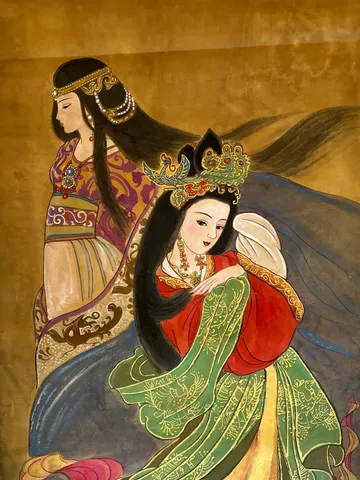
Zhao Feiyan was born into a family that had already fallen. She drifted to Chang’an as a child, was taken in by a household named Zhao, and was placed as a singing girl in the establishment of Princess Yang’a. There she learned to dance, and she was extraordinary at it — light enough that people said she seemed to weigh nothing. They called her Feiyan, the flying swallow. It was a nickname given by other servants, and it outlasted her actual name entirely.
Emperor Cheng visited the princess’s house, watched her dance, and took her into the palace. She then did something calculated: she brought her younger sister Zhao Hede in after her. Two sisters together were harder to displace than one woman alone.
It worked. The reigning empress, Empress Xu, was accused of witchcraft and deposed in 17 BCE. Zhao Feiyan was created empress on 13 July 16 BCE — a dancer from a princess’s household elevated to the highest position a woman could hold in the empire.
And then, almost immediately, the emperor stopped wanting her. His attention went to her sister, and stayed there for the rest of his life. Feiyan held the title; Hede held the man. They were allies who had made each other and were now in the strangest possible rivalry, and neither of them ever bore a child.
The charge that has followed them since is that they killed the children other women bore — that any consort who became pregnant was disposed of, so that no rival heir could exist. The Hanshu reports the accusation and it is probably true in substance; it is also exactly the accusation always made against childless favourites.
Emperor Cheng died suddenly in 7 BCE, in his forties, with no heir. He died in Zhao Hede’s apartments, and in the investigation that followed she killed herself.
Feiyan survived, because she had been useful: she had backed the succession of Emperor Ai, the nephew who took the throne, and he made her empress dowager in return. She held that rank for six years while the Fu family ran the court.
When Emperor Ai died in 1 BCE, Wang Zhengjun recalled her nephew Wang Mang, and Wang Mang worked through the previous regime methodically. He stripped Feiyan of her rank, demoted her to commoner, and ordered her to keep watch at a tomb — the same sentence, on the same day, that he handed Empress Fu.
Both women killed themselves. The last two empresses of the Western Han died within hours of each other on the orders of the man who would end it.
What happened afterwards is the more interesting story. Several centuries later an anonymous author produced the Unofficial Biography of Zhao Feiyan, an erotic novella that invented most of the details now attached to her: that she was so light she could dance on a courtier’s palm, or on a crystal dish held aloft by servants; that she was insatiable; that she poisoned the emperor. None of it is in the histories. All of it is what people remember.
She also acquired a permanent opposite. The idiom 環肥燕瘦 — “Ring is plump, Swallow is slender” — pairs her with Yang Guifei of the Tang, eight hundred years later, as the two poles of female beauty: one full-figured, one thin as air. It is a compliment that reduces two political lives to body types, and it is the most widely known thing about either of them.
A girl who learned to dance because she had nothing else, who reached the top of an empire, and who was then rewritten by strangers into a pornographic legend and a figure of speech.
A note on the sources
Zhao Feiyan is the clearest case in this collection of fiction overwriting history. The Hanshu account is brief and political. The Unofficial Biography of Zhao Feiyan — a much later work of erotic fiction — supplies nearly every famous detail, including dancing on a palm. Where the two disagree, this page follows the Hanshu and names the novella as a novella.
- Ban Gu, Hanshu (Book of Han), ch. 97 — c. 111 CE
- Sima Guang, Zizhi Tongjian — 1084
- Zhao Feiyan waizhuan 趙飛燕外傳 — anonymous, later, and fiction
The Emperor
Emperor Cheng of Han 漢成帝
Born Liu Ao 劉驁 · 51 – 7 BCE · reigned 33 – 7 BCE
Son of Wang Zhengjun. He handed the government to his mother’s family and largely withdrew from it — the reign in which the Wang clan took hold of the Han state, and therefore the reign in which the dynasty was effectively lost, twenty-eight years before anyone said so out loud. He died at about forty-five with no heir.
Why he matters to her story: he raised her from a princess’s household to the throne and then lost interest within a year. Her childlessness — and his — is why the succession passed sideways to a nephew, and why the Wangs were left holding the empire.
Connections
- Predecessor Empress Xu — deposed for witchcraft on accusations the Zhao sisters made. Feiyan took the title four months later.
- Mother-in-law Empress Xiaoyuan (Wang Zhengjun) — outlived her by fourteen years, and it was her nephew who ordered Feiyan’s death.
- Died the same day Empress Fu — the two last empresses of the Western Han, given the same sentence by Wang Mang.
- Historical parallel Empress Wu Zetian — the other woman who rose from outside the aristocracy to the top of an empire, eight centuries later.
About this Portrait
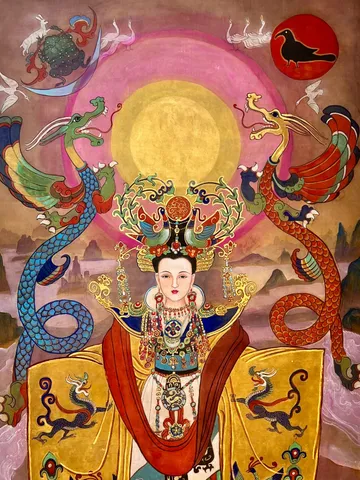
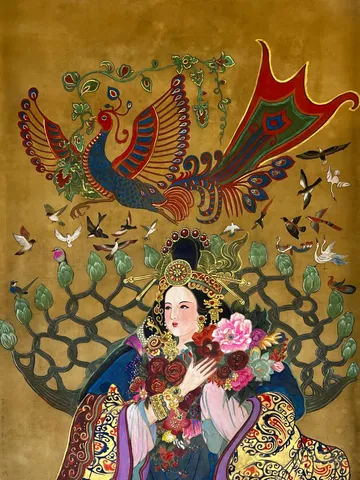
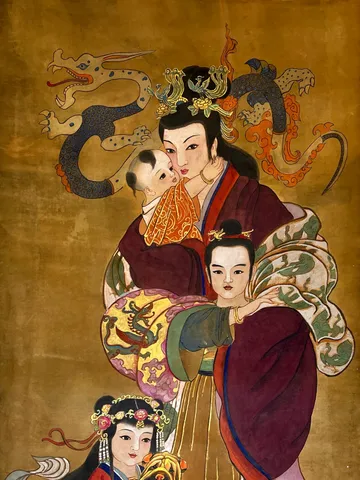
| Artist | Xiang Li 李湘 |
| Medium | Chinese watercolor on silk, hand-painted on hand-cut silk |
| Dimensions | 36 × 79 inches (91 × 201 cm) |
| Painted | 2012 |
| Collection | The Chinese Empresses Collection |
| Availability | Original held by the artist · Prints available |