孝元皇后
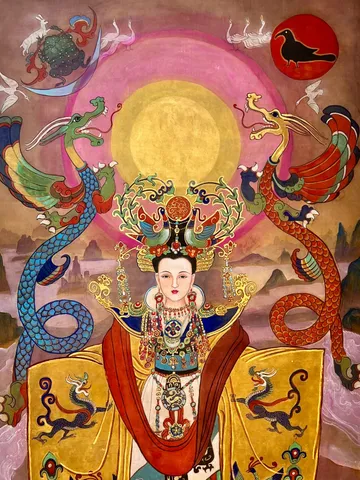
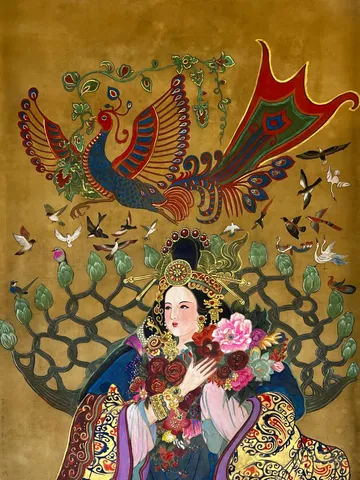
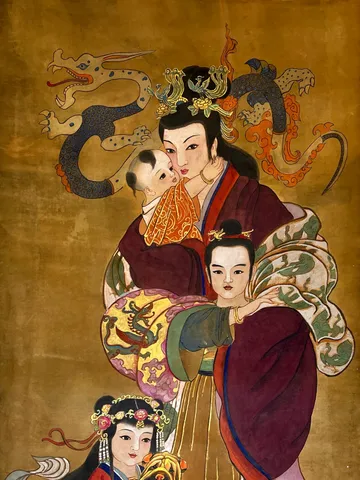
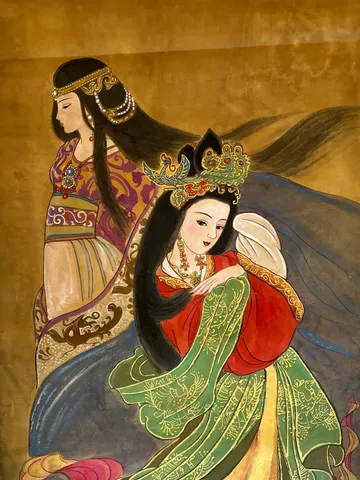
了解李湘《中国皇后》系列中的孝元皇后,探索其历史背景及与中国历代宫廷女性的联系。
王政君 · 孝元皇后
“Sixty-One Years”
Chosen because of where she happened to be sitting. Empress or dowager through five reigns — and the reason her nephew Wang Mang was able to end the Western Han.
Her Story
She was empress or dowager for sixty-one years, and she is remembered for a single moment near the end of them, when she threw a piece of jade at her nephew.
Wang Zhengjun entered the harem of the crown prince by accident. Emperor Xuan sent five palace women for his son to choose from; the prince, still grieving a favourite concubine who had died, pointed vaguely in their direction without looking. She happened to be sitting nearest. She was chosen because of where she was sitting.
She conceived on what the sources indicate was their only night together, and bore a son — the first grandson of the reigning emperor, which settled the succession. When the prince took the throne as Emperor Yuan in 48 BCE she became empress, though he barely saw her afterwards and spent his affection elsewhere.
That was the whole of her marriage. Everything else came from outliving people.
Her son became Emperor Cheng in 33 BCE and she became empress dowager, and it was then that the machinery began to move. She appointed her brothers to the great offices of state. Five of them were made marquesses on a single day. For the next three decades, the position of Commander-in-Chief — effectively head of government — passed almost continuously from one Wang to another.
She was not conspiring. She was doing what a Han empress dowager was expected to do: promote her family, because a woman with no family in office had no security at all. Lü Zhi had done it. Dou had done it. The difference was duration — Wang Zhengjun simply lived a very long time, and the Wang clan accumulated for sixty years without interruption.
Emperor Cheng died in 7 BCE without an heir. Then Emperor Ai, then Emperor Ping — both young, both short-lived. She outlasted all of them, and each death returned her to the centre.
By 1 CE the head of the Wang family was her nephew Wang Mang: austere, learned, publicly incorruptible, and admired by the Confucian establishment as the model of a virtuous minister. He was regent for a child emperor. In 9 CE he stopped pretending and declared his own dynasty, the Xin.
The Western Han ended after two hundred and fifteen years, and it ended through her.
Before he could rule he needed the imperial seal — the jade Heirloom Seal of the Realm, and she had it. He sent a cousin to ask for it. She refused. He sent again. Eventually, in front of the messengers, the eighty-year-old grand empress dowager took the seal and hurled it at the floor, cursing the family she had spent her life raising.
She took the seal and threw it to the ground, and cursed him.
Hanshu, ch. 98 — the surrender of the imperial seal, 9 CE
She lived another four years under her nephew’s dynasty and would not use its calendar or its ceremonies. She died in 13 CE, aged eighty-four. Wang Mang buried her with full honours beside Emperor Yuan, which was the last thing she is likely to have wanted.
The Han was restored nine years later, and the historians of the restored dynasty had to decide what she had been. Ban Gu gave her an entire chapter — an unusual honour — and the verdict is more sorrowful than hostile: a woman who did exactly what the system required of her, whose only real crime was to do it for sixty-one years without dying.
It is worth putting her beside Lü Zhi at the other end of the dynasty. Lü Zhi seized power deliberately, was called a monster for it, and the Han survived her by two centuries. Wang Zhengjun never seized anything, was praised for her modesty throughout, and the dynasty did not survive her at all.
A note on the sources
Ban Gu gave Wang Zhengjun a chapter of her own in the Hanshu — a rare honour, and a difficult one to write, since he was working for the restored Han and had to explain how the dynasty had been lost through a woman the record otherwise describes as modest and dutiful. The later tradition that she chipped a corner off the imperial seal, and that it was repaired in gold, is a good story but appears well after the fact.
- Ban Gu, Hanshu (Book of Han), ch. 98 — the Biography of Empress Yuan — c. 111 CE
- Ban Gu, Hanshu, ch. 99 — the Biography of Wang Mang
- Sima Guang, Zizhi Tongjian — 1084
The Emperor
Emperor Yuan of Han 漢元帝
Born Liu Shi 劉奭 · 75 – 33 BCE · reigned 48 – 33 BCE
Son of Xu Pingjun, the empress murdered when he was an infant. He was a cultivated, scholarly, indecisive ruler — the first Han emperor raised entirely on Confucian doctrine, and the one under whom the eunuchs and the consort clans began to run the government in earnest. His father is said to have observed that this son would ruin the house.
Why he matters to her story: he chose her by pointing without looking, then largely ignored her. The marriage gave her one son and, through him, sixty-one years at the centre of the Han state.
Connections
- Mother-in-law Xu Pingjun — Emperor Yuan’s mother, poisoned before he was two.
- Her son’s empress Empress Zhao Feiyan — married Emperor Cheng, and the rivalry between them is the last domestic drama of the Western Han.
- Counterpart Empress Lü Zhi — the empress at the dynasty’s beginning, who seized power openly and was condemned for it. Wang Zhengjun seized nothing and lost the dynasty.
About this Portrait
| Artist | Xiang Li 李湘 |
| Medium | Chinese watercolor on silk, hand-painted on hand-cut silk |
| Dimensions | 36 × 72 inches (91 × 183 cm) |
| Painted | 2012 |
| Collection | The Chinese Empresses Collection |
| Availability | Original held by the artist · Prints available |