孝惠皇后(张嫣)
了解李湘《中国皇后》系列中的孝惠皇后(张嫣),探索其历史背景及与中国历代宫廷女性的联系。
張嫣
“The Child Empress”
Married to her own uncle at about ten years old, on her grandmother’s orders. She held the highest title available to a woman in China and never had a moment of power.
Her Story
She was about ten years old when her grandmother married her to her uncle.
Zhang Yan was the daughter of Princess Yuan of Lu — the only daughter of Emperor Gaozu and Empress Lü Zhi — and of Zhang Ao, Prince of Zhao. That made her Lü Zhi’s granddaughter. It also made her the niece of Emperor Hui, the young man Lü Zhi had installed on the throne and then hollowed out.
In 192 BCE, Lü Zhi arranged their marriage. The logic was dynastic and entirely cold: if the emperor’s wife was Lü Zhi’s own granddaughter, any heir would carry Lü blood on both sides and the throne would stay inside the family for another generation. That the bride was a child, and that the groom was her mother’s brother, did not enter the calculation. The Shiji records the objection that such a marriage violated every principle of kinship. It records that Lü Zhi proceeded anyway.
The marriage produced nothing. Emperor Hui had withdrawn from government two years earlier, after his mother showed him what she had done to Consort Qi, and he spent the rest of his short life drinking. He died in 188 BCE at twenty-two. Zhang Yan was perhaps fourteen.
But the absence of an heir was a political problem, and Lü Zhi solved it the way she solved things. Sons were taken from other women in the palace and presented as Zhang Yan’s own. The mothers were killed. One of these children was placed on the throne as the boy emperor Qianshao, with Lü Zhi ruling as regent; when he grew old enough to learn that his real mother had been murdered and said so, he was removed and killed too, and another child took his place.
Zhang Yan was the instrument of all of it and had no part in any of it. She was a child in a palace, given a husband she could not refuse, then children who were not hers, whose mothers died so that the fiction could hold.
When Lü Zhi died in 180 BCE and the Liu princes destroyed the Lü clan, the new government faced an awkward question about the young dowager empress. She was not a Lü by surname, and she had done nothing. But she was the pretext for the false heirs, and she carried the taint of the whole arrangement.
They did not kill her. They deposed her, stripped her title, and confined her to the Northern Palace, where she lived quietly for another seventeen years. She died in 163 BCE, in her late thirties, and was buried near Emperor Hui — restored in death to the position that had ruined her life.
Later tradition gave her the name Xiaohui, “the filial and benevolent,” and a persistent folk belief that she died a virgin. The historical record does not say so; the sources are simply silent on a marriage everyone involved seems to have understood as a formality. What the silence does suggest is that even the historians who wrote the Han’s official history could find nothing to say about her except what was done to her.
She appears in the Shiji and the Hanshu only in the margins of her grandmother’s chapter. She has no annals, no verdict, no assessment of a reign. She is the clearest case in this collection of a woman who held the highest title available to a woman in China and had no power whatsoever — and of what the imperial marriage system could do to a child when a dynasty needed one.
A note on the sources
Zhang Yan has no chapter of her own. Everything known about her appears inside the annals of her grandmother, Empress Lü Zhi, or in the brief account of Emperor Hui’s reign — which is itself mostly an account of his withdrawal from it.
- Sima Qian, Shiji (Records of the Grand Historian), ch. 9 — c. 94–91 BCE
- Ban Gu, Hanshu (Book of Han), ch. 2 and ch. 97 — c. 111 CE
- Sima Guang, Zizhi Tongjian — 1084
The Emperor
Emperor Hui of Han 漢惠帝
Born Liu Ying 劉盈 · 210 – 188 BCE · reigned 195 – 188 BCE
Emperor at fifteen, and her uncle. In 194 BCE his mother took him to see what she had done to Consort Qi; he fell ill for a year and afterwards withdrew from government entirely, saying that as the Empress Dowager’s son he would never be able to govern the empire. He drank himself to death at twenty-two.
Why he matters to her story: the marriage existed to produce an heir from two Lü bloodlines. Hui’s collapse made that impossible, and everything done to Zhang Yan afterwards followed from that failure.
Connections
- Grandmother Empress Lü Zhi 呂雉 — arranged the marriage, supplied the false heirs, and had their mothers killed.
- Husband and uncleEmperor Hui — her mother’s brother.
- MotherPrincess Yuan of Lu — the only daughter of Gaozu and Lü Zhi.
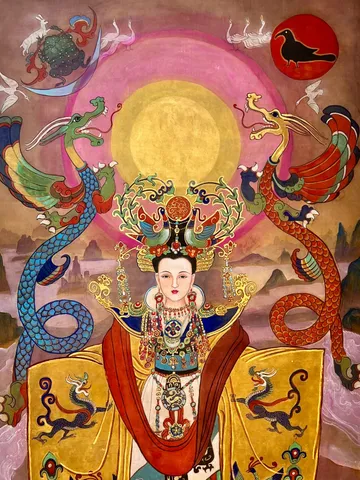
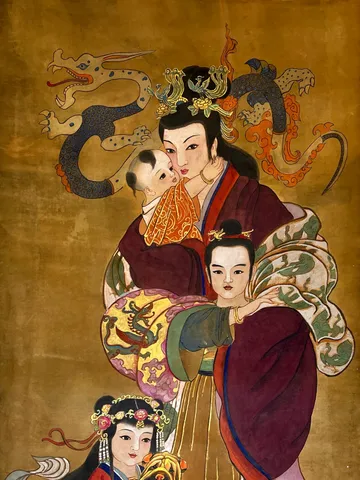
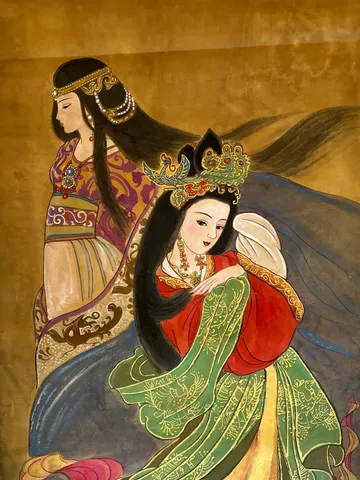
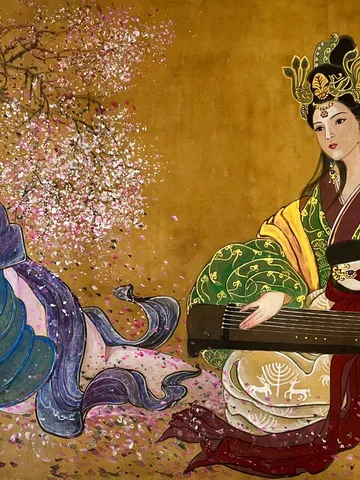
About this Portrait
| Artist | Xiang Li 李湘 |
| Medium | Chinese watercolor on silk, hand-painted on hand-cut silk |
| Dimensions | 36 × 72 inches (91 × 183 cm) |
| Painted | 2012 |
| Collection | The Chinese Empresses Collection |
| Availability | Original held by the artist · Prints available |