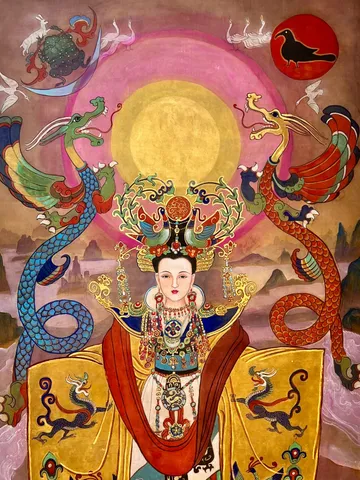
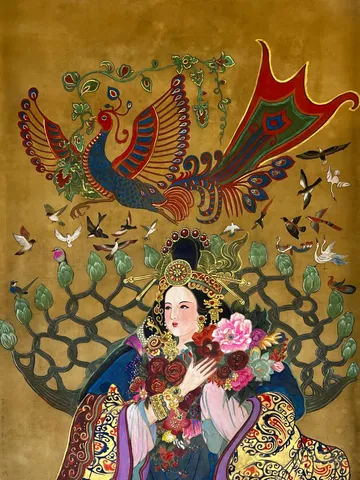
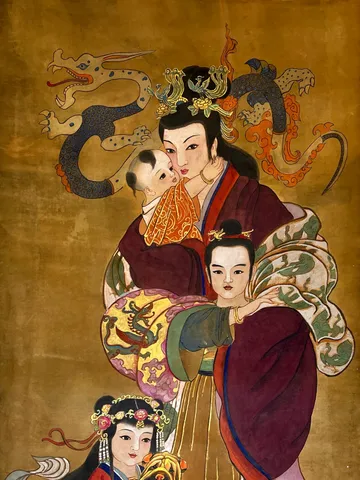
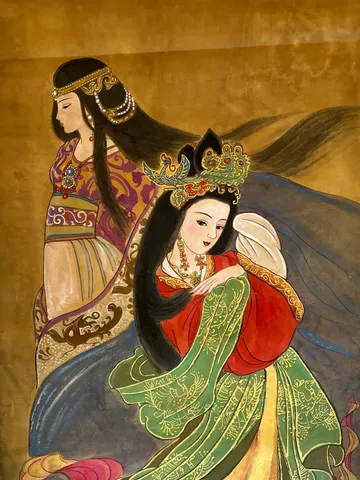
懿献皇后(梁女莹)、邓皇后(邓猛女)、桓思皇后(窦妙)
了解李湘《中国皇后》系列中的懿献皇后(梁女莹)、邓皇后(邓猛女)、桓思皇后(窦妙),探索其历史背景及与中国历代宫廷女性的联系。
梁女莹 · 邓猛女 · 窦妙
“One Emperor, Three Empresses”
A tyrant’s sister, a palace servant, and a scholar’s daughter. The last of them held the empire for eight months, was asked to sign a massacre, said no — and the refusal cost her family, her freedom, and in the end the dynasty.
Their Story
Three women, one emperor, twenty-one years. The first was installed by the most feared man in China; the second was raised from a palace servant and destroyed by a rumour; the third was chosen because the woman the emperor actually wanted was not well born enough — and she is the one who lost the Han.
Liang Nüying — Empress Yixian, 147–159
She was Liang Na’s youngest sister and Liang Ji’s, and she was the reason her brother put a fourteen-year-old marquess on the throne in 146: Liu Zhi was already betrothed to her. She became empress in 147.
She had no children, and she made sure nobody else did either. Consorts who conceived did not survive their pregnancies. Emperor Huan came to loathe her and could do nothing, because her brother ran the empire and would have removed him.
She lost his favour entirely in the late 150s and died on 9 August 159, of rage and despair, the histories say.
Her death was the crack in the wall. One month later, Emperor Huan took five eunuchs into a palace latrine — the one room where nobody could listen at the door — swore an oath with them, and moved on Liang Ji. Liang Ji and his wife took poison. The clan was exterminated, dozens of officials were executed, and the sale of the confiscated Liang estates raised so much that the emperor cut the empire’s land tax in half for a year.
Deng Mengnü — Empress Deng, 159–165
She entered the palace in 153 as a serving girl.
Her name changed three times. She was born a Deng. Her mother was the sister of Liang Ji’s wife, and when the Liangs took an interest they made her a Liang. When Emperor Huan raised her he disliked that surname — it was the wrong year to be a Liang — and ordered her called Bo instead. Only later, on learning who her father had actually been, did he restore Deng.
She was made empress in 159, immediately after Liang Ji’s fall, and she is the only empress in this dynasty who arrived at the position from the servants’ quarters.
It did not make her generous. The histories say she became arrogant and jealous, and she and a Consort Guo spent years denouncing each other to the emperor until he believed neither and disliked both. On 27 March 165 he deposed her and sent her to the Drying Room — the palace punishment quarters — where she died soon after.
Dou Miao — Empress Huansi, 165–168
Her father Dou Wu was a Confucian scholar of the old school and a descendant of Dou Rong, which made her a distant kinswoman of Empress Dou of eighty years earlier. She became a consort in 165 and the emperor did not care for her.
What he wanted was Consort Tian Sheng. His officials, led by the formidable Chen Fan, refused — she was low-born — and pressed him toward the scholar’s daughter instead. He gave in and made Dou Miao empress on 10 December 165. It was a marriage arranged by a faction, and everyone knew it.
Emperor Huan died in January 168 without a son. Dou Miao became empress dowager and regent, and she and her father chose a twelve-year-old marquess, Liu Hong, who became Emperor Ling.
Her first act was to have Consort Tian Sheng executed — before her husband was in the ground.
Her second act was better. She, her father and Chen Fan recalled the officials and students who had been arrested and banned in the purge of 166, and set them to work on the eunuchs’ corruption. She backed the general Duan Jiong’s campaign that finally ended the Qiang wars. For a few months in 168 the Eastern Han looked as if it might be governed again.
Then Dou Wu and Chen Fan brought her their plan: kill the eunuchs. All of them.
She refused. Her reason was that it was unjust to execute men who had committed no offence — which was true, and which was the most decent sentence spoken by anyone in this story.
The delay was fatal. In the autumn a eunuch named Zhu Yu found out, gathered seventeen others, seized the boy emperor “for his protection,” kidnapped the empress dowager, and issued edicts in her name. Chen Fan was taken and killed. Dou Wu declared the eunuchs in revolt and fought; they convinced the general Zhang Huan that Dou Wu was the traitor, and he was beaten and killed himself. The Dou clan was slaughtered. Her mother was exiled to Bijing, in what is now northern Vietnam.
It would be unjust to destroy those who have committed no offence.
Empress Dowager Dou Miao, summer 168 CE, refusing to sanction the extermination of the eunuchs — Hou Hanshu, ch. 69
Dou Miao kept her title and lived under house arrest for four more years. Zhang Huan, who had been tricked into destroying her family, petitioned repeatedly for her release and was refused. A eunuch who spoke up for her was executed on a fabricated charge.
In 172 word came that her mother had died in exile. She fell ill and died on 18 July.
The eunuchs hated the Dous so much that they had her body carried out on a luggage cart and left exposed for several days, and proposed burying her with the rites of an ordinary consort. Emperor Ling — the boy she had chosen, who owed her his throne — overruled them, and she was buried as an empress dowager beside her husband.
Sixteen years later the Yellow Turbans rose. Twenty-one years later the court massacred two thousand eunuchs in a single day, and the warlords came into Luoyang, and the Han was effectively finished. All of it runs through the summer of 168 and one refusal to order a massacre.
A note on the sources
The Hou Hanshu was compiled by scholars whose sympathies lay entirely with Chen Fan and Dou Wu, so the eunuchs of this period are drawn as pure villainy and the two deposed empresses are given the standard vocabulary of jealousy and arrogance. Dou Miao’s refusal in 168 is the passage most likely to be accurate precisely because it is inconvenient: it makes the scholars’ heroine responsible for the disaster.
- Fan Ye, Hou Hanshu (Book of the Later Han), ch. 7, ch. 10 pt. 2, ch. 69 (Dou Wu and Chen Fan) — 5th century CE
- Sima Guang, Zizhi Tongjian, ch. 53–57 — 1084
- Rafe de Crespigny, Fire Over Luoyang: A History of the Later Han Dynasty 23–220 AD — Brill, 2017
- Lily Xiao Hong Lee et al., Biographical Dictionary of Chinese Women: Antiquity Through Sui — 2007
The Emperor
Emperor Huan of Han 汉桓帝
Born Liu Zhi 刘志 · 132 – 168 CE · reigned 146 – 168 CE
Chosen at fourteen by Liang Ji because he was engaged to Liang Ji’s sister, and kept as a figurehead for thirteen years. In 159 he destroyed the Liang clan in a conspiracy sworn with five eunuchs in a palace latrine — and then made all five of them marquesses and handed them the government.
What followed was the collision that defines the end of the Han. The classically educated officials and the university students at Luoyang organised against eunuch corruption; the eunuchs answered in 166 with the first Partisan Prohibitions, arresting and blacklisting hundreds. It is one of the earliest recorded instances anywhere of an organised student political movement, and it was crushed.
He kept an enormous harem — the sources say five or six thousand women — and left no son. Chinese tradition names him, with his successor Emperor Ling, as the emperor whose misrule ended the dynasty; Zhuge Liang says so directly in his memorial of 227.
Connections
- Her sister Liang Na (Empress Shunlie) — Liang Nüying’s elder sister, regent for three emperors, dead nine years before the clan fell.
- Her kinswoman Empress Dou (Zhangde) — the same Dou family, eighty years earlier, whose fall in 92 CE first put a eunuch in power. Dou Miao’s fall in 168 completed what that one began.
- What came next Empress Song and Empress Ling — the empresses of the boy Dou Miao chose, and the last full generation of the Han.
- The end Empress Xianmu (Cao Jie) — daughter of Cao Cao, wife of the last Han emperor, sixty years on.
About this Portrait
| Artist | Xiang Li 李湘 |
| Medium | Chinese watercolor on silk, hand-painted on hand-cut silk |
| Dimensions | approx. 36 × 72 inches (91 × 183 cm) |
| Painted | 2015 |
| Subjects | Three empresses — all consorts of Emperor Huan |
| Collection | The Chinese Empresses Collection |
| Availability | Original held by the artist · Prints available |