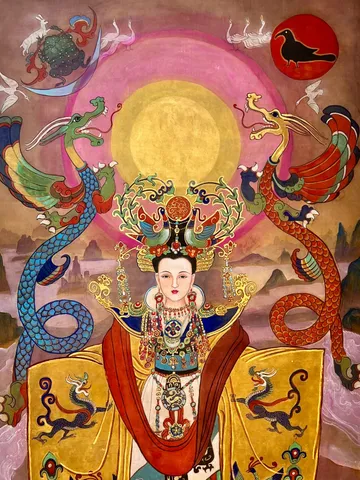
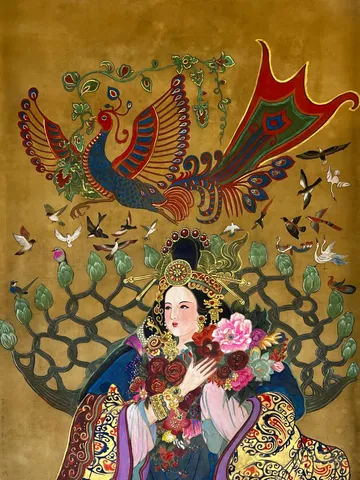
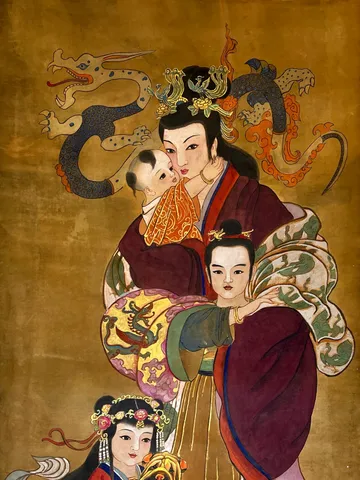
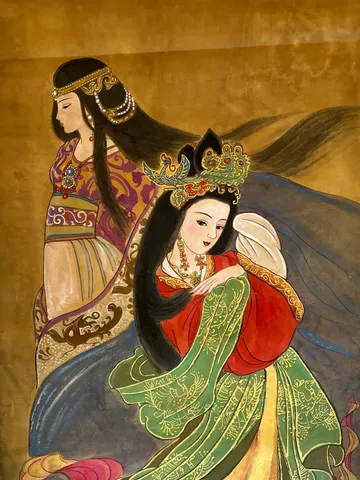
献穆皇后(曹节)
献穆皇后(曹节)-中国东汉王朝的最后皇后
伏寿 · 曹节(献穆皇后)
“The End of the Han”
The first was dragged out from behind a wall and died in prison for a letter written fourteen years earlier. The second was Cao Cao’s daughter — and when her brother sent men to collect the imperial seal, she refused them, again and again, and finally threw it on the floor.
Their Story
Emperor Xian reigned for thirty-one years and ruled for none of them. His first empress tried to have his keeper killed and was destroyed for it. His second was his keeper’s daughter — and she is the one who fought hardest for the dynasty at the end.
Empress Fu Shou — 195 to 214
She married Emperor Xian in 195, when he was fourteen and the court was fleeing east through burning country with warlords fighting over the carriage. In 196 Cao Cao took custody of the emperor and settled him at Xu, and from that point the Han existed as a letterhead.
In 200 the emperor made one attempt. A group of officials led by Dong Cheng received what tradition calls the girdle edict — orders sewn into a belt — to kill Cao Cao. It failed. Everyone involved was executed, including Dong Cheng’s daughter, a consort of the emperor, who was pregnant. Emperor Xian begged for her life and was refused.
Empress Fu, watching this, wrote to her father Fu Wan describing what Cao Cao had done and asking him to act. Fu Wan, sensibly, did nothing at all.
The letter surfaced fourteen years later.
In 214 Cao Cao demanded her deposition and sent Hua Xin to fetch her. She hid in a cavity behind a wall of her own apartments. He pulled down the wall and dragged her out by the hair, and she was brought barefoot past her husband, who was sitting with Cao Cao’s deputy. She called out to him to save her.
He said: I myself do not know how long I have to live.
She was taken to prison and died there in February 215. Her two sons were poisoned. More than a hundred of her family were executed, and her mother and nineteen others were exiled.
Empress Cao Jie — 215 to 220
In 213 Cao Cao had sent three of his daughters into the palace as consorts. With Fu Shou gone, Cao Jie was made empress in 215. She was a hostage placed by a jailer, and everybody understood it.
Cao Cao died in March 220. He had never taken the throne. His son Cao Pi had no such scruples, and by autumn the abdication was arranged: the emperor would “yield” the mandate, the paperwork would be correct, and the Han would end politely.
One thing was missing. The imperial seal was in the empress’s keeping, and the empress was Cao Pi’s sister.
Envoys came for it. She refused. They came again. She refused again. This went on for several visits — her brother’s men, sent to her repeatedly, going back empty-handed each time.
At last she came out herself, wept, and threw the seal on the ground in front of them.
Heaven will not bless you!
Empress Cao Jie, throwing the imperial seal to the ground before her brother’s envoys, 220 CE — Hou Hanshu, ch. 10
It is the only recorded act of resistance in the entire abdication. Her father had built the machine; her brother was operating it; her husband had already signed. She was the last person defending the Han and she was defending it against her own family.
Emperor Xian was made Duke of Shanyang and allowed to keep his rites. Cao Jie went with him. They lived quietly in Shanyang for fourteen years — he is said to have practised medicine and treated local people without charge — and he died in 234. She lived another twenty-six years and died in 260, still titled Duchess of Shanyang, and was buried with him at the Chan Mausoleum with the rites of a Han empress.
She outlived the dynasty by forty years. She also outlived the Wei dynasty her brother founded, in all but name — five years after her death, another family took it away from the Caos in exactly the same ceremony, with exactly the same paperwork.
A note on the sources
These events sit at the seam between two official histories written from opposite sides — the Hou Hanshu, sympathetic to the Han, and the Sanguozhi, written under the dynasty Cao Pi founded. The scene of Fu Shou dragged from behind the wall comes from Yue Zi’s Chronicles of the Emperors, preserved in Pei Songzhi’s commentary; it is vivid, partisan, and probably close to true. The seal scene is in the Hou Hanshu itself, which is notable — a Han-sympathetic historian recording that the one person who resisted was a Cao.
- Fan Ye, Hou Hanshu (Book of the Later Han), ch. 9 and ch. 10 pt. 2 — 5th century CE
- Chen Shou, Sanguozhi (Records of the Three Kingdoms), with Pei Songzhi’s commentary — 3rd and 5th centuries CE
- Sima Guang, Zizhi Tongjian, ch. 62–69 — 1084
- Rafe de Crespigny, Imperial Warlord: A Biography of Cao Cao 155–220 AD — Brill, 2010
The Emperor
Emperor Xian of Han 汉献帝
Born Liu Xie 刘协 · 181 – 234 CE · reigned 189 – 220 CE
Son of the Consort Wang whom Empress He poisoned, and put on the throne at eight by Dong Zhuo, who had just deposed his half-brother. He was moved from warlord to warlord for six years — through the burning of Luoyang, a starving flight east, and a river crossing where courtiers clung to the boats and had their fingers cut off — until Cao Cao took him in 196 and kept him for the next twenty-four years.
He is one of history’s most thoroughly powerless men, and he was not a fool. He backed the one plot that had a chance and it cost him a pregnant consort, an empress and two sons. After that he did what was left: he survived.
After the abdication he was made Duke of Shanyang and permitted the ceremonies of a Han emperor within his own domain. He is said to have spent those fourteen years practising medicine among the local people. When he died in 234 the Wei court, ruled by the grandson of the man who had deposed him, buried him with full imperial honours.
Connections
- The woman whose son he wasConsort Wang, poisoned by Empress He in 181. Her son became the last Han emperor.
- Her brother’s empresses Empress Zhen and Empress Guo — Cao Pi’s consorts, and the first empresses of the Cao Wei that replaced the Han.
- The first empress of the dynasty Empress Guanglie (Yin Lihua) — 195 years and fifteen empresses earlier, at the other end of the Eastern Han.
- Where it began Empress Lü Zhi — four centuries before, the first woman to hold this title at all.
About this Portrait
| Artist | Xiang Li 李湘 |
| Medium | Chinese watercolor on silk, hand-painted on hand-cut silk |
| Dimensions | approx. 36 × 72 inches (91 × 183 cm) |
| Painted | 2015 |
| Subjects | Two empresses — both consorts of Emperor Xian |
| Collection | The Chinese Empresses Collection |
| Availability | Original held by the artist · Prints available |