梁妠(顺烈皇后)
皇帝十三岁——那个男孩,严济花了十年试图把他挡在王位外,被十九个拿着剑的宦官放了进去。梁娜曾经
梁妠 · 顺烈皇后
“The Sister”
Regent for three emperors in six years, and the only one of them to hand power back voluntarily. She was also the one person who could have stopped her brother, and the record of what she did and did not stop is the record of how the Han ended.
Her Story
She was twelve when she entered the palace, and she went in alongside her own aunt.
The emperor was thirteen — the boy Yan Ji had spent a decade trying to keep off the throne, put there by nineteen eunuchs with swords. Liang Na had been raised on the classics and on Han history, and she seems to have understood the position she was walking into better than anyone else in the building.
She kept declining to sleep with him. Her stated reason was that an emperor owes his consorts equal treatment and she should not monopolise him. Emperor Shun found this astonishing, which tells you what he was used to.
When he came to choose an empress in 131 he could not decide between four favourites and proposed drawing lots before the gods. His officials talked him out of it — one does not select the mother of the empire by lottery — so he chose the one everyone agreed was the most virtuous, and Liang Na became empress in March 132.
Her father Liang Shang was promoted, and then promoted again, until he was Grand Marshal. He was an honest, limited man who had the sense to appoint people better than himself, and the court under him was cleaner than it had been in decades.
He died in September 141, and Emperor Shun gave his office to his eldest son.
Liang Ji is the reason this page is difficult. Over the next eighteen years he became the most powerful and the most feared man in China: he removed anyone who criticised him, executed officials on invented charges, and eventually poisoned an emperor. Everything Liang Na accomplished has to be weighed against the fact that she was the one person alive who might have stopped him and did not.
Emperor Shun died in 144. His only son was one year old. Liang Na became empress dowager and regent.
The record of her regency is genuinely good. She worked, she kept honest officials close, and she overruled her brother when it mattered — in 145 he demanded the execution of the upright minister Li Gu, and she refused and protected him. When the baby emperor died that same year, she announced the death immediately and openly, which after the previous reign was a deliberate statement: no more concealed successions.
Then she summoned two candidates and let her brother choose. The officials wanted Liu Suan, Prince of Qinghe, an adult, serious and capable. Liang Ji wanted a child. She gave him the child — Liu Zuan, aged seven, who became Emperor Zhi.
The boy was sharp. At a court audience in 146 he looked at Liang Ji and said, in front of everyone, there sits an arrogant general. Liang Ji had him poisoned. He was eight years old. The histories say Liang Na did not know.
There sits an arrogant general.
Emperor Zhi, aged eight, of Liang Ji — 146 CE. He was poisoned shortly afterwards. Hou Hanshu, ch. 34
Again the officials asked for Prince Suan. Again Liang Ji refused, and put forward a fourteen-year-old marquess who happened to be engaged to the Liang sisters’ youngest — Liang Nüying. He became Emperor Huan; she became empress the following year. Prince Suan was accused of conspiracy, demoted, and killed himself. Li Gu — the man Liang Na had personally saved two years before — was executed, along with Du Qiao. There is no record of her intervening this time.
In early 150 she formally returned power to Emperor Huan, which not one of her predecessors had done voluntarily. She died on 6 April that year, thirty-four years old, and was buried with her husband.
And with her gone, there was nothing left to restrain Liang Ji at all. He ran the empire for another nine years as a private estate. In 159 Emperor Huan — the boy he had installed, whose wife was his sister — conspired with five eunuchs in a palace lavatory, the only room without listeners, and destroyed him. Liang Ji and his wife killed themselves. The clan was exterminated, dozens of officials executed, and the confiscated Liang property was worth so much it paid half the empire’s land tax for a year.
Liang Na is the most sympathetic figure in the late Eastern Han and the clearest illustration of its problem. She was capable, she was restrained, she gave power back — and none of it mattered, because the office she held was inseparable from the family that had put her in it.
A note on the sources
The Hou Hanshu treats Liang Na kindly and Liang Ji as a monster, and separates them carefully — she is repeatedly described as not knowing what he had done. That separation is convenient and may be partly a courtesy to a woman the historians admired. Her age at death is given as forty-five in her biography, which cannot be right if she was born in 116; the discrepancy is noted but unresolved.
- Fan Ye, Hou Hanshu (Book of the Later Han), ch. 10 pt. 2 and ch. 34 (Liang Ji) — 5th century CE
- Sima Guang, Zizhi Tongjian, ch. 51–54 — 1084
- Rafe de Crespigny, Fire Over Luoyang: A History of the Later Han Dynasty 23–220 AD — Brill, 2017
The Emperor
Emperor Shun of Han 汉顺帝
Born Liu Bao 刘保 · 115 – 144 CE · reigned 125 – 144 CE
The child Yan Ji poisoned his mother to disinherit, deposed at nine on false charges, and restored at ten by nineteen eunuchs who broke into the palace at night. He owed his throne to them and never stopped paying: eunuchs were permitted to adopt sons and pass on their marquisates in his reign, which turned a court faction into hereditary aristocracy.
He was mild and not unintelligent, but he governed by trusting whoever was nearest — first the eunuchs, then his father-in-law, then, disastrously, his brother-in-law Liang Ji. He also founded the imperial academy’s expansion, and the great scientist Zhang Heng served at his court.
He died at twenty-nine, leaving a one-year-old heir and a Grand Marshal nobody could remove.
Connections
- Her sister Liang Nüying (Empress Yixian) — married to the emperor Liang Ji installed, and empress from 147. The second Liang empress in three years.
- Her predecessor Empress Yan Ji (Empress Ansi) — who tried to keep Liang Na’s husband off the throne, and whose fall put the eunuchs in permanent power.
- Her ancestorThe Consort Liang destroyed by Empress Dou in 83 CE was her great-great-aunt. The family that Dou wiped out came back and took the empire.
- The pattern Deng Sui before her, Empress Song and Empress Ling after — each regency, each clan, each destruction.
About this Portrait
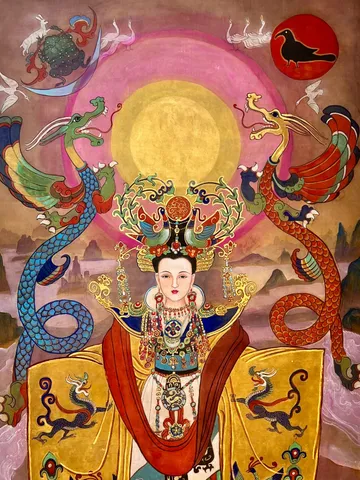
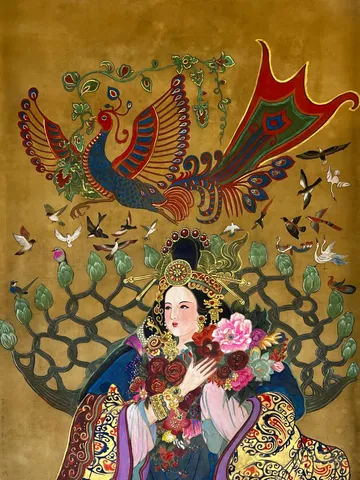
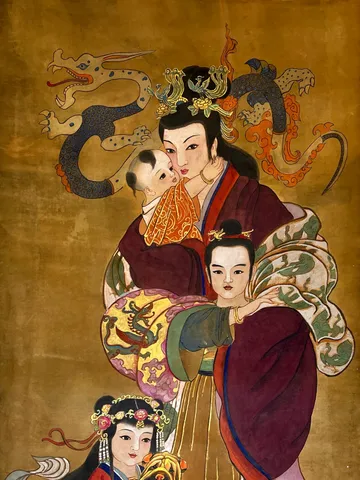
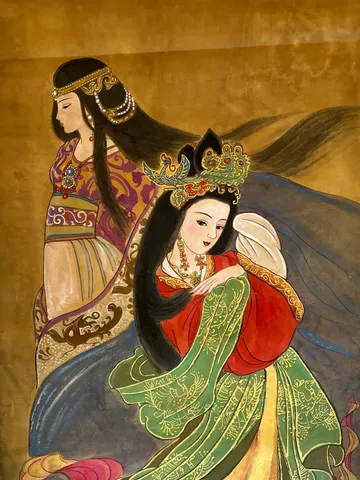
| Artist | Xiang Li 李湘 |
| Medium | Chinese watercolor on silk, hand-painted on hand-cut silk |
| Dimensions | approx. 36 × 72 inches (91 × 183 cm) |
| Painted | 2014 |
| Subject | Liang Na, Empress Shunlie, consort of Emperor Shun |
| Collection | The Chinese Empresses Collection |
| Availability | Original held by the artist · Prints available |