Cao Pi — Emperor Wen of Wei
曹丕 · 魏文帝
“Took an abdication the Han had no power to refuse”
Cao Cao's son and successor, and the man who formally ended the Han. In 220 he accepted the throne from Emperor Xian in a staged abdication, founded Wei, and set the pattern the Sima family would use on his own grandsons forty-five years later. He was also a serious poet and critic — his essay on literature is one of the earliest in Chinese.
His most consequential act of government was the nine-rank system for appointing officials, meant to find talent and within two generations the mechanism by which a handful of great families monopolised office. His campaigns south against Wu achieved nothing; the Three Kingdoms settled into the stalemate that defines them during his reign.
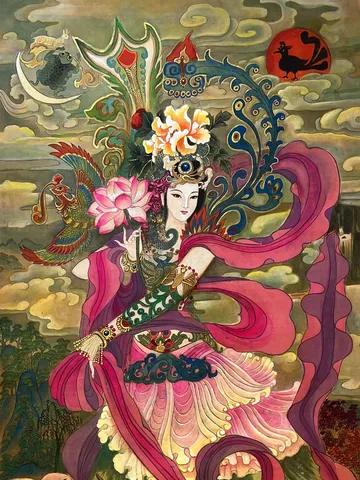
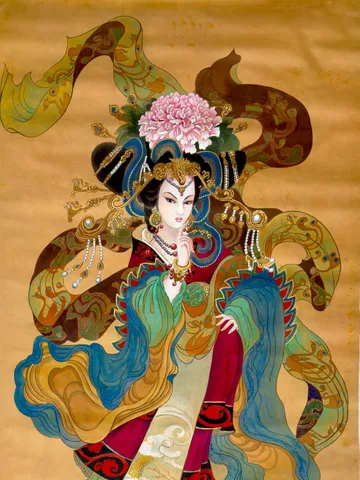
Two of Xiang Li's Cao Wei silks belong to his court. Lady Zhen — Zhen Luo, the Luo River goddess of later poetry — came to him from a defeated rival's family, bore his heir, lost his favor and was ordered to die in 221; she was made empress only after her death, by her son. Guo Nüwang, who replaced her, was Empress Wende, and the histories written under her stepson are not kind about how the replacement happened.
The empresses of this reign
Painted on silk in gemstone mineral pigments by Xiang Li.
About this page
Written for this site to place Cao Pi's reign around the paintings. For the full biography, the dynastic histories and the scholarship behind them, start at Wikipedia.