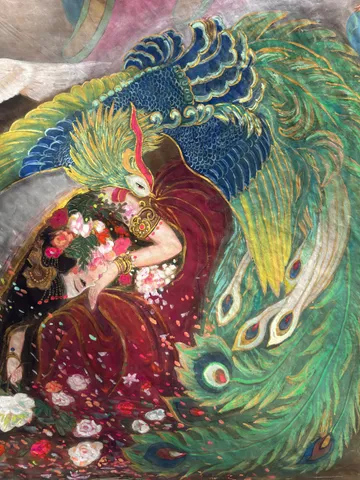
西晋四位皇后
了解李湘《中国皇后》系列中的西晋四位皇后,探索其历史背景及与中国历代宫廷女性的联系。
杨艳 · 杨芷 · 贾南风 · 羊献容
“The Chain”
A dying woman protects her disabled son by choosing his wife and her own successor. Thirty years later the successor has been starved to death, the wife has been made to drink powdered gold, and China has lost the north for two hundred and seventy years. Every link in that chain was forged out of love for one child.
Their Story
The Jin reunified China in 280 and lost the north within forty years. What happened in between is one of the most destructive collapses in Chinese history — the War of the Eight Princes, then the Wu Hu uprisings, then Luoyang burning and the court fleeing south.
These four women are the chain of decisions that got there. Each one hands the story directly to the next, and the first link is an act of maternal love.
Yang Yan — Empress Wuyuan, 266 to 274
She married Sima Yan before the Jin existed, when he was still a Cao Wei nobleman whose family was in the process of stealing a throne. She bore him three sons and three daughters.
The eldest surviving son, Sima Zhong, was intellectually disabled. Everyone at court could see it and several people said so. Yang Yan fought them all, on the principle that the succession goes by birth order and not by ability, and she won. He stayed crown prince.
Then she chose his wife. Sima Yan wanted a daughter of the Wei family and described the choice with brutal frankness: the Wei girl was tall, fair and would bear many sons; the Jia girl was short, dark, and jealous. Yang Yan — lobbied hard by the Jia faction — insisted on Jia Nanfeng. She won that too.
In 274 she fell ill, and made her last calculation. A new empress might bring her own sons and displace hers, so she asked her husband on her deathbed to marry her cousin Yang Zhi, keeping the position inside her family and her boy on the throne. He promised, and he kept the promise.
She died that year, having personally installed the disabled emperor, the empress who would rule through him, and the successor empress who would be murdered by her. All three of her decisions were made to protect her son.
Yang Zhi — Empress Wudao, 276 to 291
She married Sima Yan in 276 and was, by every account, gentle, beautiful, and decent. She had a son who died in childhood.
Her one recorded political act was an act of mercy. Jia Nanfeng, as crown princess, had behaved so violently — she killed several of her husband’s women, and the sources say she once ran a pregnant concubine through with a halberd so that the child came out with the blade — that Sima Yan resolved to depose her. Yang Zhi talked him out of it. She interceded for the girl her cousin had chosen, repeatedly, and Jia Nanfeng was spared.
When Sima Yan died in 290, Yang Zhi’s father Yang Jun took the regency and locked the new empress out of government.
Jia Nanfeng waited a year. In 291 she brought in two imperial princes with troops, had Yang Jun declared a traitor, and destroyed the Yang clan — the killing ran to several thousand people.
Yang Zhi was inside the palace. She wrote four characters on a length of silk — save the Grand Tutor — tied it to an arrow and had it shot over the wall. It was recovered and produced as proof that the empress dowager had incited rebellion.
She was stripped of her title, reduced to commoner, and shut in Jinyong City. She cut off her hair and prostrated herself before Jia Nanfeng, calling herself “your handmaid,” and begged for her mother’s life. Her mother was executed anyway.
Then her food was stopped. She died of starvation in 292, aged thirty-three, and was buried without rites — no coffin robes, and, on Jia Nanfeng’s instruction, face down, with charms and written spells placed over her so that her spirit could not testify against anyone.
Jia Nanfeng — Empress 290 to 300
The daughter of Jia Chong — the minister whose subordinate had personally killed the last real Cao emperor in the street — and one of the most thoroughly condemned women in Chinese historiography.
She was two years older than her husband, short, dark-complexioned, and by the standards of the court plain. She was also, plainly, the most politically capable person in the building. Her husband was Emperor Hui, remembered for one sentence: told that the common people were starving for want of rice, he asked why they did not eat meat porridge instead.
From 291 to 300 she governed. She removed Yang Jun, then removed the two princes who had helped her do it, and then ran a court that was — this is the part the histories bury — stable. For nine years, in a dynasty about to tear itself apart, nothing happened. She kept competent ministers, her cousin Jia Mo restrained her, and the empire held.
What she could not solve was the succession. She had no son. The crown prince, Sima Yu, was another woman’s, and the day he inherited she was finished.
So in 300 she had him summoned, got him extremely drunk, and had a woman put a text in front of him to copy out in his own hand — a draft demanding that the emperor and empress kill themselves. He copied it. He was deposed on the evidence, sent away, and then killed with a medicine pestle in a latrine.
That murder is the crack the dynasty broke along. Within weeks the prince Sima Lun used it to storm the palace. Jia Nanfeng was deposed and shut in Jinyong City — the same building where she had starved Yang Zhi — and in May 300 was made to drink wine laced with powdered gold.
And then it began. Eight princes, sixteen years, armies of steppe cavalry hired by each side and never sent home, the two Jin emperors after her both captured and killed, Luoyang and Chang’an sacked, and the north lost for two hundred and seventy years. Millions died.
She is blamed for all of it. She did commit the murder that started it. But it is worth noticing that the nine years she held power were the last nine peaceful years the Western Jin had, and that everything catastrophic happened after the men removed her.
Yang Xianrong — empress of two empires
Sima Lun installed her as the new empress in 300, days after killing the old one. She was a girl from a good Tai Shan family, chosen precisely because she had no power of her own.
Then the War of the Eight Princes went through her like weather. Every time a prince took Luoyang he deposed her as his predecessor’s creature; every time he was driven out she was restored. She was deposed and reinstated five times, and twice she was sent to Jinyong City to await execution and simply outlasted the man who sent her.
In 311 the Xiongnu-led armies of Han-Zhao took Luoyang, burned it, and carried off the emperor. She was among the captives. The general who took the city, Liu Yao, took her for himself, and when he became emperor of Han-Zhao in 318 he made her his empress.
She is the only woman in Chinese history to have been empress of two separate empires, to two emperors, on opposite sides of a war of conquest.
Until I served you, I did not know there was such a thing in the world as a husband.
Yang Xianrong to Liu Yao, comparing him with Emperor Hui of Jin — Jin Shu, ch. 31
She bore Liu Yao three sons, and one of them was made his heir. She died on 13 May 322 and he grieved for her openly.
She had spent eleven years as the ornament of a throne nobody could hold, and the last four as the wife of the man who burned it down.
A note on the sources — and a correction
Correction: the earlier version of this page headed Yang Zhi’s section “Empress Xiaoyang.” Her posthumous title is Empress Wudao 武悼皇后 — dao meaning one who died young and wronged, which is exactly what the court was acknowledging when it restored her name after Jia Nanfeng’s fall.
The Jin Shu was compiled in the seventh century under Tang supervision, four hundred years after these events, and it has a thesis: that the Western Jin fell because a woman usurped a man’s authority. Jia Nanfeng is drawn accordingly — every physical description of her is an insult, and her nine years of functioning government are given a paragraph while her crimes get chapters. The crimes are real. The framing is not neutral.
- Fang Xuanling et al., Jin Shu (Book of Jin), ch. 31 — the Biographies of the Empresses — 648 CE
- Sima Guang, Zizhi Tongjian, ch. 79–92 — 1084
- David Graff, Medieval Chinese Warfare 300–900 — Routledge, 2002
- Damien Chaussende, “Western Jin”, in The Cambridge History of China, Vol. 2: The Six Dynasties — 2019
The Emperors
Emperor Wu of Jin 晋武帝
Sima Yan 司马炎 · 236 – 290 · reigned 266 – 290
Grandson of Sima Yi. In 266 he required the last Cao Wei emperor to abdicate — the same ceremony, almost word for word, that Cao Pi had used on the last Han emperor forty-six years earlier — and in 280 he took Eastern Wu and reunified China for the first time since 184.
Then he stopped. He disbanded the provincial armies, handed real military power to twenty-seven of his own relatives as princes with their own troops, and spent his later years in a harem so large that the standing joke, recorded as fact, is that he toured it in a cart drawn by goats and slept wherever the goats stopped.
Every element of the catastrophe was in place when he died in 290: an emperor who could not govern, armed princes with claims to the throne, no imperial army to check them, and a court where the only competent political actor was his son’s wife.
Emperor Hui of Jin 晋惠帝 · Sima Zhong 司马衷 · 259 – 307 — intellectually disabled, emperor for seventeen years, passed between princes as a piece of legitimacy. He is remembered for asking, when told the people had no rice to eat, why do they not eat meat porridge? He was poisoned in 307.
Connections
- The dynasty they replaced Empress Mao and Empress Guo — Empress Guo of Wei spent twenty-five years trying to stop the Sima family. The Jin is what she failed to prevent.
- The kingdom they conquered The Empresses of Eastern Wu — Wu fell to Jin armies in 280, ending the Three Kingdoms.
- What came after Yu Wenjun (Empress Mingmu) and the empresses of the Eastern Jin — the court that fled south to Jiankang after Luoyang burned.
- The comparison every historian makes Empress Lü Zhi — the original charge of a woman usurping the throne, and the standard Jia Nanfeng was measured against.
About this Portrait
| Artist | Xiang Li 李湘 |
| Medium | Chinese watercolor on silk, hand-painted on hand-cut silk |
| Dimensions | approx. 36 × 72 inches (91 × 183 cm) |
| Painted | 2017 |
| Subjects | Four empresses of the Western Jin, across two emperors |
| Collection | The Chinese Empresses Collection |
| Availability | Original held by the artist · Prints available |