The Empresses of the Early Ming
明朝前期皇后
“Big-Footed Ma and the Women of Tumu”
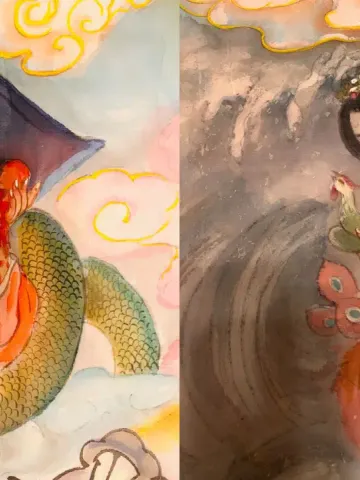
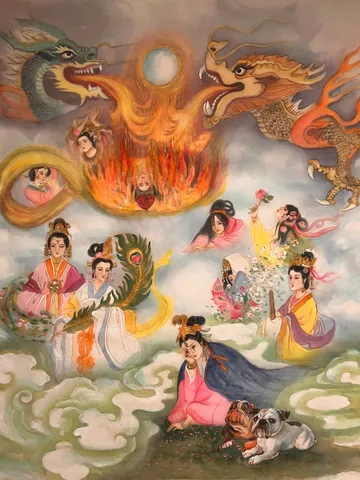
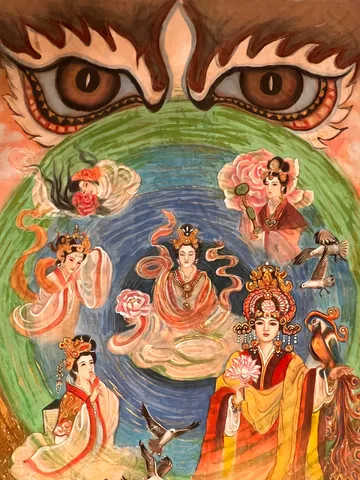
The first painting of three. It opens with a barefoot orphan who talked the most murderous founder in Chinese history out of half his executions, and closes with the catastrophe at Tumu — an emperor captured on a battlefield, and the women who ransomed, replaced and restored him.
Their Story
Empress Ma 马皇后 · Empress Xiaocigao 孝慈高皇后
1332 – 1382 · consort of the Hongwu Emperor
She had unbound feet — the Ma family were poor and she was orphaned, and nobody had bound them. The Chinese nickname for her, Big-Footed Ma, is still current, and she never made any attempt to hide them.
She married Zhu Yuanzhang when he was a rebel officer; when he was imprisoned by his own commander she smuggled bread to him inside her clothes and burned herself doing it.
As empress she is the only person who could reliably stop him killing people, and he killed a great many. She interceded for scholars, officials and once for the richest man in China; she kept lists of men she thought were about to be executed unjustly. Asked on her deathbed if she wanted anything, she said only that he should seek worthy men and accept criticism.
After she died in 1382 he never appointed another empress, and the purges got dramatically worse.
Empress Ma 马皇后 · Empress Xiaominrang 孝愍让皇后
1378 – 1402 · consort of the Jianwen Emperor
The second empress of the Ming, and for two hundred and forty years the dynasty refused to admit she had existed.
She married Zhu Yunwen, the Hongwu Emperor’s grandson, in 1395 and became empress when he took the throne in 1398 at twenty-one. He immediately began stripping his uncles of their commands — a young ruler surrounded by hardened field generals who were also his family. The fourth uncle, Zhu Di, raised the Yan garrison and marched south.
The civil war ran three years. In July 1402 Zhu Di’s army entered Nanjing and the palace caught fire. She died in it, aged twenty-four. Whether her husband died with her, escaped as a monk, or fled overseas was still being investigated by the state decades later; one theory holds that the great voyages of Zheng He were partly a search for him.
Zhu Di became the Yongle Emperor and erased the reign. The four years 1399–1402 were officially renumbered as Hongwu 32 to 35, so that his own succession followed his father’s directly and his nephew had never ruled. Her elder son, the six-year-old crown prince, disappeared. Her younger son was imprisoned at two and released in 1457 at fifty-seven, after fifty-five years in a walled compound; the account says he could not tell an ox from a horse.
She was given no posthumous title until 1644, when a collapsing Ming court finally restored the reign it had spent its whole existence pretending away. On this scroll she stands next to Empress Xu — the wife of the man who burned her out of her own palace.
Empress Xu 徐皇后 · Empress Renxiaowen 仁孝文皇后
1362 – 1407 · consort of the Yongle Emperor
Daughter of Xu Da, the greatest general of the founding generation, and married to Zhu Di when he was Prince of Yan.
During the civil war she defended Beiping herself. Her husband was away with the field army when the imperial forces besieged the city; she put on armour, went up onto the wall, and organised the women of the city to carry stones and defend it. The siege failed.
She became empress when he took the throne in 1402, wrote instructional works for women that stayed in print for centuries, and died in 1407. He never appointed another empress either, and had her buried in the tomb he was building for himself at what became the Ming Tombs.
Empress Zhang 张皇后 · Empress Chengxiaozhao 诚孝昭皇后
d. 1442 · consort of the Hongxi Emperor
Empress for ten months — her husband reigned less than a year — and then the most important person in the empire for seventeen years.
She was empress dowager under her son and grand empress dowager under her grandson, who came to the throne at eight. She refused a formal regency but ran the government in practice through a council of senior ministers, and she is the reason the eunuch Wang Zhen was kept in check while she lived.
She died in 1442. Five years later Wang Zhen led the emperor personally onto a battlefield at Tumu, where the Mongols captured him and destroyed the imperial army.
Empress Hu and Empress Sun 胡皇后 · 孙皇后
consorts of the Xuande Emperor
Empress Hu was virtuous, childless, and deposed in 1426 so that Consort Sun — who had produced a son — could take her place. The court disliked it; Empress Dowager Zhang disliked it more, and kept Hu living in the palace with precedence over Sun at banquets for the rest of her life.
Empress Sun is the one who mattered later. When her son was captured by the Mongols at Tumu in 1449 and the court panicked, she authorised his brother’s accession to deny the Mongols a hostage worth anything — and then, eight years on, backed the coup that put her son back on the throne.
Empress Qian and Empress Zhou 钱皇后 · 周皇后
consorts of the Zhengtong / Tianshun Emperor
When her husband was captured at Tumu, Empress Qian emptied her own treasury for the ransom, and when it failed she spent her nights weeping and prostrating in prayer until she went blind in one eye and lame in one leg.
He came back after a year as a prisoner, spent seven more under house arrest in the Southern Palace, and she stayed with him throughout. When he was restored in 1457 he ordered that she be buried with him — an instruction his son’s mother, Empress Zhou, spent decades trying to overturn.
Empress Wang and Empress Hang 汪皇后 · 杭皇后
consorts of the Jingtai Emperor
Empress Wang was deposed for objecting when her husband set aside his captured brother’s son as heir in favour of his own. The objection saved her: when the Jingtai Emperor fell in 1457 she was no longer empress and was spared, and she lived to eighty.
Empress Hang, who replaced her, had died in 1456. Her tomb was destroyed on the restored emperor’s orders.
Empress Wu and Empress Wang 吴皇后 · 王皇后
consorts of the Chenghua Emperor
Empress Wu was empress for one month. The emperor was seventeen and entirely under the control of Consort Wan, a palace woman nineteen years his senior who had raised him; when Empress Wu had Consort Wan beaten for insolence, she was deposed within days.
Empress Wang, her replacement, survived by making herself invisible for twenty-three years while Consort Wan systematically ended every pregnancy in the palace.
A note on the sources
The Ming Shi was compiled under the Qing over nearly a century and is unusually careful. It is also written by scholar-officials about a dynasty that had persecuted scholar-officials, so its warmth toward Empress Ma and Empress Zhang — both of whom restrained emperors — should be read with that in mind. The restraint itself is well evidenced.
- Zhang Tingyu et al., Ming Shi (History of Ming), ch. 113–114 — 1739
- Ray Huang, 1587, A Year of No Significance — Yale, 1981
- Frederick W. Mote, Imperial China 900–1800 — Harvard, 1999
- Ellen Soulliere, “Palace Women in the Ming Dynasty” — 1987
Connections
- Next The empresses of the middle Ming — Hongzhi to Longqing.
- And then The empresses of the late Ming — Wanli to Chongzhen, and the fall.
- Before The Yuan empresses — the Mongol dynasty the Ming overthrew.
About this Painting
| Artist | Xiang Li 李湘 |
| Medium | Chinese watercolor on silk |
| Subjects | The empresses of the early Ming |
| Painted | 2023 |
| Collection | The Chinese Empresses Collection |
| Availability | Original held by the artist · Prints available |