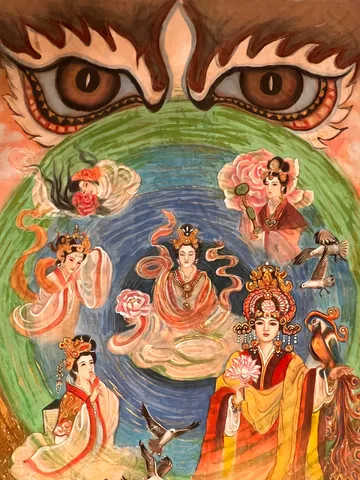
The Empresses of the Middle Ming
明朝中期皇后
“The Monogamous Emperor and the Silk Cord”
The second of three. It contains the only Chinese emperor who never took a concubine — and, one reign later, the night sixteen palace women tried to strangle an emperor in his sleep and got the knot wrong.
Their Story
Empress Zhang 张皇后 · Empress Xiaokangjing 孝康敬皇后
d. 1541 · consort of the Hongzhi Emperor
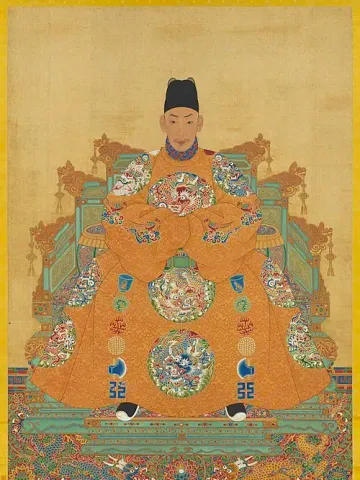
Her husband is the only emperor in Chinese history who never took a concubine. Not one, in eighteen years on the throne. The imperial harem — the institution this entire collection is built around — simply stood empty for his whole reign.
They lived as a married couple: ate together, slept in the same room, read together. The court found it faintly scandalous and the historians found it admirable, and it is genuinely without parallel.
He died in 1505 at thirty-five. Her son was the Zhengde Emperor, and she outlived him too, dying in 1541 after her own family had been destroyed by the emperor who followed.
Empress Xia 夏皇后
d. 1535 · consort of the Zhengde Emperor
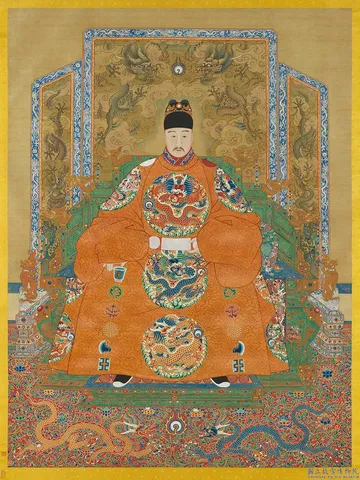
The Zhengde Emperor built himself a pleasure compound called the Leopard Quarter and effectively moved out of the palace. He gave himself a second identity as a general named Zhu Shou and issued imperial orders promoting him. He kept tigers.
Empress Xia was married to him at fifteen and had almost no contact with him thereafter. He died at twenty-nine with no heir — he fell drunk out of a fishing boat — and the throne passed sideways to a cousin.
She lived another fifteen years in a palace where she had no standing at all, and was buried without full honours.
Empress Chen, Empress Zhang and Empress Fang 陈皇后 · 张皇后 · 方皇后
consorts of the Jiajing Emperor
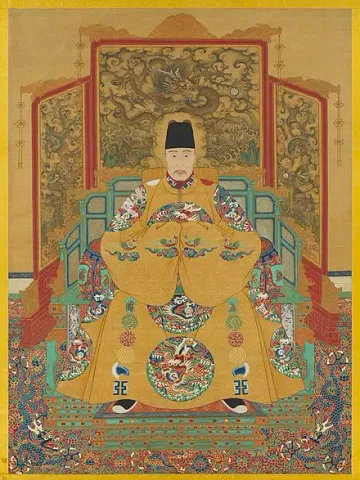
Empress Chen was pregnant and pouring tea when the emperor made a remark about another consort’s hands. She put the cup down hard. He shoved her; she miscarried and died. He recorded her death as illness.
Empress Zhang was deposed after four years for interceding on behalf of a relative, and died in the Cold Palace.
Empress Fang is on this page because of one night. In 1542 sixteen palace women — worked to exhaustion collecting menstrual blood and morning dew for the emperor’s immortality elixirs, and beaten when the yield was poor — came into his bedroom while he slept and tried to strangle him with a silk cord from a bed curtain.
They drew the cord about his throat, but the knot they had tied would not close.
The Renyin palace incident, 1542 — Ming Shi, ch. 114
They tied the knot wrong. It would not draw tight. One of them lost her nerve and ran for the empress, and Empress Fang came, got the cord off him, and had them seized. All sixteen were executed by slow slicing, along with two consorts.
Fourteen years later a fire broke out in her quarters. Jiajing was told and gave no order to intervene, and she burned to death. He gave her a full imperial funeral.
Empress Li and Empress Chen 李皇后 · 陈皇后
consorts of the Longqing Emperor
Empress Chen was deposed in all but name for remonstrating with him and sent to a separate palace, where the future Wanli Emperor — a child — visited her daily to read, on his own mother’s insistence.
That mother was Empress Dowager Li, a former palace maid who became the most powerful woman of the late Ming. She raised Wanli with legendary strictness, made him kneel for hours over lapses, and backed the reformer Zhang Juzheng for ten years — the last period in which the Ming state actually worked.
A note on the sources — and a correction
Correction: the entry for Empress Fang in The Complete Edition of Chinese Empresses attached the wrong biography to a correct name. Empress Fang — posthumously Empress Xiaolie — is real, was Jiajing’s third empress, and is correctly placed in this period. It was the life attached to her that was wrong. Corrected here and in the book.
The Renyin incident is recorded in the Ming Shi and in the confessions taken at the time. The motive given — exhaustion and beatings over the elixir ingredients — comes from those confessions, extracted under torture, and should be read accordingly. That the attempt happened, and failed on a knot, is not in doubt.
- Zhang Tingyu et al., Ming Shi (History of Ming), ch. 114 — 1739
- Ray Huang, 1587, A Year of No Significance — Yale, 1981
- Frederick W. Mote, Imperial China 900–1800 — Harvard, 1999
Connections
- Before The empresses of the early Ming.
- After The empresses of the late Ming — Empress Dowager Li’s son Wanli, and the fall.
- The comparison Empress Wenxian of the Sui — who obtained monogamy by making her husband swear to it. The Hongzhi Emperor simply never wanted anyone else.
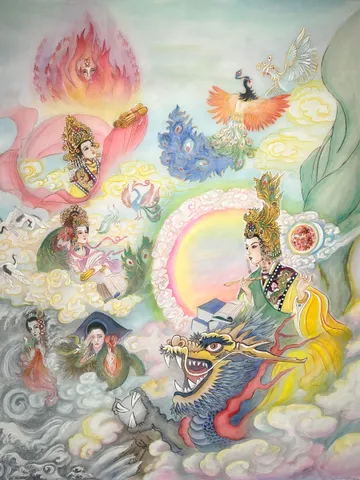
About this Painting
| Artist | Xiang Li 李湘 |
| Medium | Chinese watercolor on silk |
| Subjects | The empresses of the middle Ming |
| Painted | 2023 |
| Collection | The Chinese Empresses Collection |
| Availability | Original held by the artist · Prints available |