三国蜀汉诸皇后
了解李湘《中国皇后》系列中的三国蜀汉诸皇后,探索其历史背景及与中国历代宫廷女性的联系。
蜀汉皇后
“The Family in the Mountains”
The smallest of the three kingdoms, and the only one whose empresses are a family story. Two of them were sisters — daughters of Zhang Fei, granddaughters of a Xiahou — which made the last empresses of Shu Han blood relatives of the enemy they spent forty years fighting.
Their Story
Shu was the smallest of the three kingdoms and the one everyone roots for — Liu Bei claiming descent from the Han, Zhuge Liang running the state from a mountain province with a fraction of the manpower, the northern campaigns that could never quite work. It lasted forty-two years.
Its empresses are, unusually, a family story rather than a political one. Two of them were sisters. Their father was Zhang Fei. Their mother had been kidnapped as a teenager by Zhang Fei while gathering firewood — and she was a Xiahou, cousin to one of Cao Cao’s greatest generals. Which means the last two empresses of Shu Han were, on their mother’s side, close relatives of the enemy.
That fact mattered exactly once, and it is the best moment on this page.
Lady Gan — Empress Zhaolie
She came from a common family in Pei and caught Liu Bei’s eye when he was governing Xu Province, decades before there was anything to be empress of.
She was never his formal wife. Liu Bei kept losing formal wives — to war, to capture, to the sheer disorder of a career spent being driven from one province to the next — and Lady Gan ran his household through all of it. She was captured by his enemies more than once.
She bore him Liu Shan, and in 208, when Cao Cao’s cavalry caught the refugee column at Changban and Liu Bei fled abandoning his family, it was Lady Gan and the infant Liu Shan whom Zhao Yun went back into the rout to find. It is the most famous rescue in Chinese literature, and it is one of the few episodes in the Romance that is broadly true.
She died around 210, in Jing Province, and was buried there. Liu Bei honoured her as Lady Huangsi in 222. When he died the following year, Zhuge Liang petitioned that she be raised to Empress Zhaolie and reburied beside him. She had been dead thirteen years.
Empress Wu — Empress Mu
She was the sister of the general Wu Yi and the widow of Liu Mao, son of the previous governor of Yi Province — the man Liu Bei had just displaced.
In 214, having taken the province, Liu Bei was urged to marry her. He hesitated: Liu Mao had been a distant clansman, and marrying his widow looked improper. Fa Zheng talked him round with an argument from precedent, and it was done. It was a straightforward political marriage to bind the conquered province’s elite to the conqueror.
She became empress in 221 when he declared himself emperor, empress dowager in 223 when he died, and she outlived him by twenty-two years, dying in 245. She is a genuinely obscure figure in the sources — which is itself notable, because she held the highest rank in the state for a quarter of a century and left no scandal, no faction and no recorded quarrel.
The two Empresses Zhang — the sisters
Zhang Fei had two daughters, and Liu Shan married both of them.
The elder became crown princess in 221 and empress in 223 when Liu Bei died and her husband, aged sixteen, inherited a war. She died in 237 and was buried at Nanling; her posthumous name, Jing’ai, means “the reverent and lamented.”
Her younger sister entered the palace the same year and was made empress in February 238. She held the position for twenty-five years, to the end.
In 249, the Wei general Xiahou Ba defected to Shu — fleeing the purge that followed the Sima coup — and arrived at Chengdu as the son of Xiahou Yuan, a man Shu’s own armies had killed at Dingjun Mountain thirty years earlier. Liu Shan received him and said the death had been his own father’s doing in war, not a private matter. Then he sent for his sons and introduced them, and told Xiahou Ba: these are your kin.
They were. Their mother and grandmother were Xiahous. The empress of Shu Han was a first cousin once removed of the man who had just deserted the enemy, and the emperor used it to make him welcome. In a period defined by families destroying each other, it is a small, strange moment of a family being useful.
Your father met his end in the field, not by any act of my forebears. — And these are your kin.
Liu Shan to the defector Xiahou Ba, presenting his sons — 249 CE, Sanguozhi ch. 9 with Pei Songzhi’s commentary
In 263 Wei armies came over the mountains and Liu Shan surrendered. The empress went with him to Luoyang, where the court gave him a marquisate and a comfortable house.
She is the source, incidentally, of the video-game character “Xingcai” — a name invented in the twenty-first century for a woman whose own was never recorded.
A note on the sources — and a correction
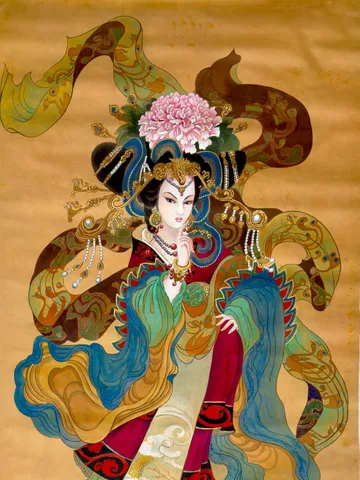
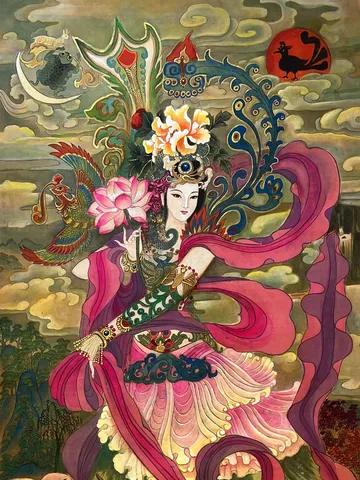
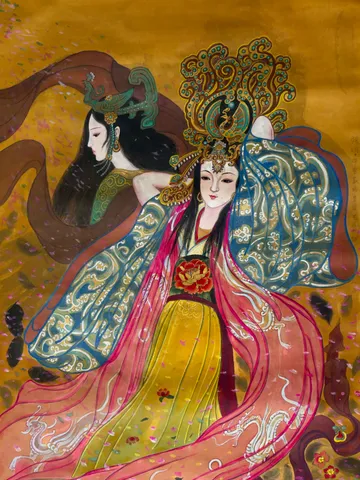
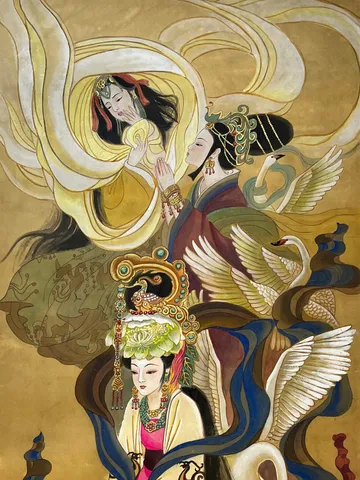
Correction: the earlier version of this page ran the heading “Empress Wu (Lady Gan)” over a biography that was entirely Lady Gan’s. These are two different women, a generation and a social world apart — Lady Gan was a commoner from Pei who was never formally married to Liu Bei, and Empress Wu was the well-connected widow of the previous governor’s son. They are separated here. Which of the two Xiang Li painted is a question for the artist; the label on the painting needs confirming.
Shu produced no official history of its own — Chen Shou, who wrote the Sanguozhi, was a Shu man writing under the dynasty that destroyed it, and he noted with some frustration that Shu had appointed no court historian, so the records simply did not exist. Everything here comes from what he could reconstruct.
- Chen Shou, Sanguozhi (Records of the Three Kingdoms), ch. 34 — the Biographies of the Consorts of Shu — 3rd century CE
- Pei Songzhi’s annotations — 5th century CE
- Sima Guang, Zizhi Tongjian — 1084
- Rafe de Crespigny, A Biographical Dictionary of Later Han to the Three Kingdoms — Brill, 2007
The Emperors
Liu Bei, Emperor Zhaolie of Han 汉昭烈帝
刘备 · 161 – 223 · reigned 221 – 223
A distant descendant of a Han prince who grew up weaving mats and selling straw sandals, and spent thirty years losing — driven out of Xu Province, out of Yu Province, out of Jing Province, sheltering in turn with almost every warlord who would have him. He was fifty-three before he held any territory securely.
He took Yi Province in 214, declared himself emperor in 221 when Cao Pi ended the Han, and then destroyed his own position by invading Wu to avenge Guan Yu against the advice of everyone. He was beaten at Xiaoting in 222 and died the following year at Baidicheng, handing the state to Zhuge Liang with the extraordinary instruction that if his son proved unfit, Zhuge Liang should take the throne himself.
Liu Shan 刘禅 · 207 – 271 · reigned 223 – 263 — the baby carried out of Changban. He reigned forty years, which is longer than any other emperor of the period, and is remembered mainly for surrendering and for what he said in captivity at Luoyang. Asked whether he missed Shu, he answered: I am happy here. I do not think of Shu. Historians have argued ever since about whether that was idiocy or the most successful piece of acting of the third century. He died in bed at sixty-four.
Connections
- The kingdom that conquered them Empress Mao and Empress Guo — Cao Wei, whose armies took Chengdu in 263.
- Their neighbour and enemy The Empresses of Eastern Wu — allies at Red Cliffs, enemies by 219, and the last of the three to fall.
- The dynasty Liu Bei claimed Empress Xianmu (Cao Jie) — the last Han empress. Liu Bei declared himself emperor in 221 on the grounds that the Han had not ended, only been stolen.
- Where it all began Empress Lü Zhi — the first empress of the Han, four hundred and twenty years before Shu claimed its name.
About this Portrait
| Artist | Xiang Li 李湘 |
| Medium | Chinese watercolor on silk |
| Dimensions | 24 × 36 inches (61 × 91 cm) |
| Painted | 2022 |
| Subjects | The empresses of Shu Han |
| Collection | The Chinese Empresses Collection |
| Availability | Original held by the artist · Prints available |