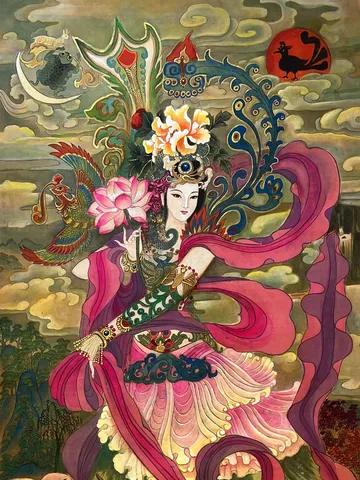
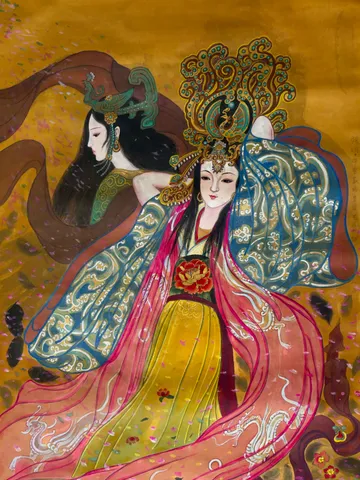
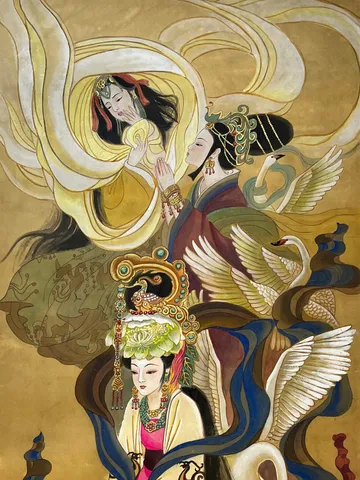
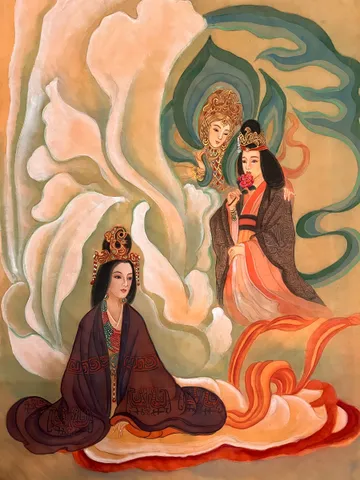
郭女王——文德皇后(曹魏)
郭女王——文德皇后(曹魏):浏览李湘艺术网站的中国历代皇后资料。本页正文暂为英文,完整译文待补充。
郭女王 · 文德皇后
“The Woman King”
Orphaned, sold into a marquis’s household, and named “Woman King” by a father who saw it coming. She helped decide who would inherit a state, became its first empress, raised her rival’s son — and he buried her exactly as she had buried his mother.
Her Story
Her father looked at her and said: this one is the king among my daughters. Then he gave her the style name Nüwang — Woman King — which is not a name anyone gave a girl in the second century, and it stuck to her for life.
He was a minor provincial administrator from a line of minor provincial officials, and he died while she was still a child. So did her mother. In the wars that broke the Han she lost the family, the household and the protection, and ended up in the establishment of a marquis as a servant — the sources are ambiguous about exactly what kind. She was an accomplished musician; she played the pipa unusually well.
How she got from there into the household of Cao Pi is not recorded. What is recorded is what happened once she was there.
Cao Cao had not named an heir. The contest was between Cao Pi and his brilliant younger brother Cao Zhi, and it was fought for years through factions, letters, staged displays of virtue and carefully leaked indiscretions. The Sanguozhi says flatly that Guo Nüwang advised Cao Pi through it, and that when he was finally designated heir she had a hand in planning it.
That is an extraordinary sentence to find in a third-century official history. It is not praise for her beauty or her modesty. It is a statement that a former servant girl helped engineer the succession of the state.
She became his favourite, and Lady Zhen was displaced. Lady Zhen complained, and in 221 Cao Pi ordered her death. In October 222, over the written objection of an official who warned against raising a woman of low birth to the highest position in the empire, Guo Nüwang was made empress.
She had no children.
As empress she is described doing the unglamorous work well. She managed the other consorts — treating them decently, disciplining them when required, and covering their mistakes rather than reporting them to an emperor who was not forgiving. She lived plainly. When Cao Pi moved to execute his cousin Cao Hong over an old grudge, she interceded at her mother-in-law’s urging and Cao Hong lived.
And she raised Lady Zhen’s son.
Cao Rui was not made crown prince — his mother’s disgrace made that impossible for years — but he was the only viable heir, and the relationship between the boy and his stepmother appears, in the record, to have been cordial. There is no sign she opposed him. When Cao Pi was dying in 226 and finally named him, she raised no objection. He took the throne, honoured his dead mother as an empress, honoured Guo Nüwang as empress dowager, and gave her family titles and land.
For nine years it held.
Then, at some point, one of Cao Pi’s old consorts told him the rest of it: that his mother’s death had been engineered by the woman who raised him, and that it was she who had ordered the body buried with the hair pulled over the face and the mouth filled with rice husks.
The late Emperor killed her himself — why question me? You are her son. Would you avenge a dead father by wrongly killing your later mother?
Empress Dowager Guo to Cao Rui — Han–Jin Chunqiu, cited in the Sanguozhi
What happened next is the one thing the sources cannot agree on. The Han–Jin Chunqiu has Cao Rui confronting her repeatedly, and her answering — furiously — that his father had given the order, so why was he asking her, and did he really intend to kill his stepmother to avenge his real one. He forced her to take her own life. The Weilüe says she died of illness and grief under his questioning, and that only afterwards was he told the truth. The Zizhi Tongjian splits the difference: he asked her about it so many times that she died of fear.
All three agree on the ending. She was buried with the full honours of an empress, beside Cao Pi — with her hair covering her face, and rice husks in her mouth.
And then her family kept their titles. Her cousin inherited her father’s fief and was promoted to general, and the Guos stayed in favour for the rest of Cao Rui’s reign, which is not what happens to the clan of a woman executed for murder.
The record on Guo Nüwang is, in the end, two incompatible things: the woman who thought her way from a servant’s room to the throne of a state, and the woman who did that to a body. Both are in the same chapter.
A note on the sources
Three near-contemporary accounts give three different deaths, and the difference matters: whether she was executed for murdering Lady Zhen, or died under the strain of being repeatedly accused of it. The strongest evidence against the murder charge is administrative rather than literary — the Guo family kept its fiefs, inherited more, and was promoted after her death. Cao Rui did not treat them as the relatives of a convicted killer.
- Chen Shou, Sanguozhi (Records of the Three Kingdoms), ch. 5 — 3rd century CE
- Pei Songzhi’s annotations, quoting the Book of Wei, the Weilüe and the Han–Jin Chunqiu — 5th century CE
- Sima Guang, Zizhi Tongjian, ch. 73 — 1084
- Cutter & Crowell, Empresses and Consorts: Selections from Chen Shou’s Records of the Three States — University of Hawaii Press, 1999
The Emperor
Cao Pi, Emperor Wen of Wei 魏文帝
曹丕 · 187 – 226 · reigned 220 – 226
The eldest surviving son of Cao Cao, and the man who converted his father’s military dominance into a dynasty. In 220 he required Emperor Xian to abdicate, ending four hundred years of Han — a ceremony his own sister, Empress Cao Jie, tried to obstruct by refusing to surrender the imperial seal.
His most consequential domestic act was adopting the nine-rank system for appointing officials, which was intended to find talent and instead handed permanent control of government to a handful of aristocratic families for the next three hundred years.
He was a considerable writer — his Discourse on Literature is the first work of literary criticism in Chinese — and a hard man to his own family, keeping his gifted brother Cao Zhi under guard and moving him from fief to fief for life. He died at thirty-nine after a reign of six years.
Connections
- Her rival Empress Zhen (Luo Shen) — displaced by her, executed in 221, and buried in the manner Guo Nüwang was later accused of choosing.
- Her stepsonCao Rui, Emperor Ming of Wei — Lady Zhen’s son, whom she raised, and who ended her life or hastened it depending on which history you read.
- Her stepson’s empresses Empress Mao and Empress Guo — the next generation at the same court.
- Her predecessor as Empress of China Empress Xianmu (Cao Jie) — the last Han empress, and her sister-in-law.
About this Portrait
| Artist | Xiang Li 李湘 |
| Medium | Chinese watercolor on silk, hand-painted on hand-cut silk |
| Dimensions | approx. 36 × 72 inches (91 × 183 cm) |
| Painted | 2016 |
| Subject | Guo Nüwang, Empress Wende |
| Collection | The Chinese Empresses Collection |
| Availability | Original held by the artist · Prints available |