唐朝最后7位见于记载的皇后
了解李湘《中国皇后》系列中的唐朝最后7位见于记载的皇后,探索其历史背景及与中国历代宫廷女性的联系。
唐末七位皇后
“A Refusal to Leave a Space Blank”
Their Story
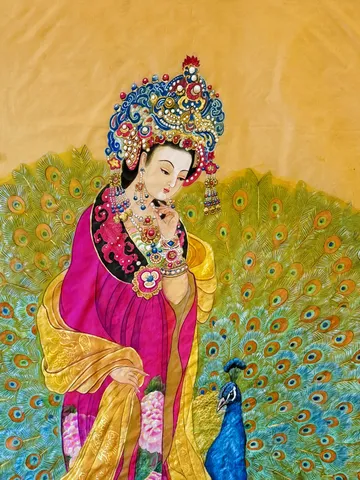
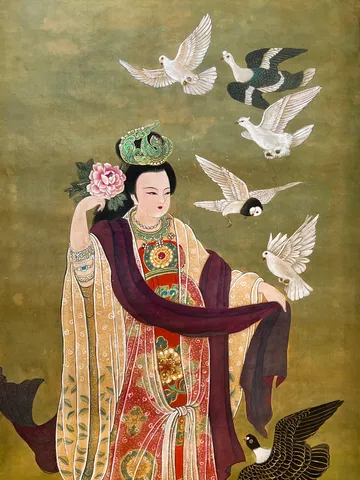
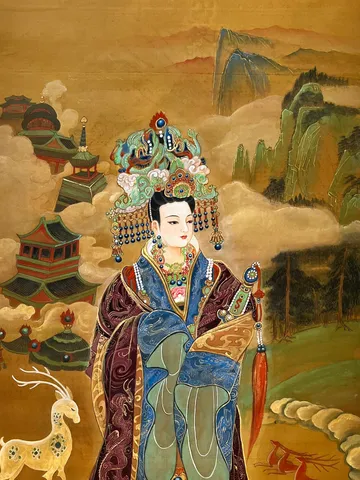
This is the painting about the gap in the record.
By the last century of the Tang the histories have almost stopped noticing the women of the palace. Emperors were being installed and removed by eunuch commanders; the provinces had gone; the court archives were repeatedly burned. What survives of these seven, in some cases, is a single family name and the fact that a later emperor called her mother.
Xiang Li could have skipped them — most collections do. Instead she read what could be found about the emperors around them, and painted the seven of them together on one long roll, in the order they lived.
It is the only work in the collection made in that spirit: not a portrait of a life, but a refusal to leave a space blank.
Empress Gongxi — 恭僖皇后 · Lady Wang
d. 845 · consort of Muzong · mother of Emperor Jingzong
She was never empress while her husband lived. Muzong appointed no empress at all, and neither did any of his three sons.
Her son Jingzong took the throne at fifteen in 824, spent his reign playing polo and hunting foxes at night, and was murdered by his own servants and eunuchs in a drinking room in 827, aged seventeen.
She was honoured as empress dowager and lived another eighteen years.
Empress Zhenxian — 贞献皇后 · Lady Xiao
d. 847 · consort of Muzong · mother of Emperor Wenzong
Her son Wenzong is the one who tried. In 835 he conspired with two officials to lure the senior eunuchs into a courtyard on the pretext of a miraculous sweet dew on a pomegranate tree, and have them killed there.
The eunuchs saw the armed men behind the curtain. What followed is called the Sweet Dew Incident: they seized the emperor bodily, carried him back into the palace in his own sedan chair, and then killed more than a thousand people across the capital, including four chief ministers and their entire households.
Wenzong lived another five years under guard. He asked a court official one day whether he could be compared to the last emperors of the Han and Zhou. The official said he was greater. He said no — those men were at least controlled by their nobles, and he was controlled by his own household slaves. Then he wept, and did not attend court again.
The rulers you name were held down by their vassals. I am held down by my own household slaves. Compared to them, I am far worse off.
Emperor Wenzong, son of Empress Zhenxian, after the Sweet Dew Incident — Zizhi Tongjian, ch. 246
Empress Xuanyi — 宣懿皇后 · Lady Wei
consort of Muzong · mother of Emperor Wuzong
The third of the three Muzong consorts, and the third to be made empress dowager by a son rather than empress by a husband.
For a period in the 840s all three of them were living in the palace at once — three dowagers, three sons who had each held the throne, and not one of them had ever been empress.
Consort Wang — 王才人
d. 846 · consort of Emperor Wuzong
She came from Handan, entered the palace at thirteen, and was a singer and a dancer. She was tall enough and rode well enough that when she and Wuzong went out on horseback in matching clothes, people could not tell which was the emperor — which he found delightful and did on purpose.
He wanted to make her empress. The court refused: low birth, no son. He let it go.
In 846 he was dying of the immortality elixirs his court alchemists had been feeding him. He asked her what she would do after he was gone.
She said she would follow him. He did not believe her.
When he died she hanged herself from a beam in the palace. The court, which had refused her the title while it mattered, gave her a posthumous rank and buried her beside him.
Empress Yuanzhao — 元昭皇后 · Lady Chao
consort of Emperor Xuanzong · mother of Emperor Yizong
Almost nothing survives. She was a consort of Emperor Xuanzong — the one who was hostile to Empress Dowager Guo — and she bore his eldest son, and she died before he became emperor.
Her son honoured her posthumously. That is the entire record.
Empress Hui’an — 惠安皇后 · Lady Wang
d. c. 866 · consort of Emperor Yizong · mother of Emperor Xizong
A Noble Consort of Emperor Yizong, and the mother of the boy the eunuchs chose to put on the throne in 873 — Xizong was twelve, the fifth son, and selected precisely because he was manageable.
She had died about seven years earlier. Her son gave her the title when he inherited.
His reign is when it ended in practice: the Huang Chao rebellion took Chang’an in 880, and the court fled to Sichuan for four years while the rebels held the capital and the great families were slaughtered in it.
Empress Gongxian — 恭宪皇后 · Lady Wang
consort of Emperor Yizong · mother of Emperor Zhaozong
The last of the seven, and the mother of the last emperor anyone bothered to assassinate.
Nothing else is recorded about her. Her son’s wife, Empress He, closes the dynasty on the next page.
A note on the sources
The biographies of the empresses in the Old Book of Tang get shorter and shorter as the dynasty goes on, and for the last century several run to two or three sentences. This is not carelessness: the palace records were burned when Huang Chao took Chang’an in 880, and again when the city was dismantled in 904. What the tenth-century compilers had to work with was fragments.
Where this page says nothing is known, that is the finding, not a gap in the research. The events around these women — the Sweet Dew Incident, the Huang Chao rebellion — are documented in detail. The women are not.
- Liu Xu et al., Jiu Tang Shu (Old Book of Tang), ch. 52 — 945 CE
- Ouyang Xiu et al., Xin Tang Shu (New Book of Tang), ch. 77 — 1060
- Sima Guang, Zizhi Tongjian, ch. 241–253 — 1084
- Michael Dalby, “Court Politics in Late T’ang Times”, in The Cambridge History of China, Vol. 3 — 1979
The Emperors
The emperors of the late Tang
Muzong (r. 820–824) — undid his father’s reconquest within two years by disbanding the armies to save money; died at twenty-nine of the elixirs.
Jingzong (r. 824–827) — took the throne at fifteen, murdered at seventeen by his own servants after a night of drinking.
Wenzong (r. 827–840) — attempted to destroy the eunuchs in 835 and lost; a thousand people died and he spent his remaining years under guard.
Wuzong (r. 840–846) — able and decisive; suppressed Buddhism on a national scale, closing forty thousand temples and shrines; died of the elixirs at thirty-two.
Xuanzong 宣宗 (r. 846–859) — the last competent emperor of the dynasty, called the Little Taizong; died of the elixirs.
Yizong (r. 859–873) and Xizong (r. 873–888) — under whom the provinces went, the Huang Chao rebellion took the capital, and the Tang stopped functioning as a state.
Four of the seven died of mercury poisoning taken deliberately in pursuit of immortality. It is worth stating plainly, because it is the single most reliable cause of death in the late Tang imperial family.
Connections
- Before them Empress Dowager Guo — Xianzong’s consort, who outlived every emperor on this page except the last two.
- After them Empress He — the last empress of the Tang, killed in 906.
- Where it started Empress Taimu and Empress Zhangsun — the beginning of the dynasty, and the height of it.
- What follows The Five Dynasties and Ten Kingdoms
About this Painting
| Artist | Xiang Li 李湘 |
| Medium | Chinese watercolor on silk |
| Format | Long horizontal scroll — seven figures in sequence |
| Painted | 2018 |
| Subjects | The seven last recorded empresses of the Tang |
| Collection | The Chinese Empresses Collection |
| Availability | Original held by the artist · Prints available |